


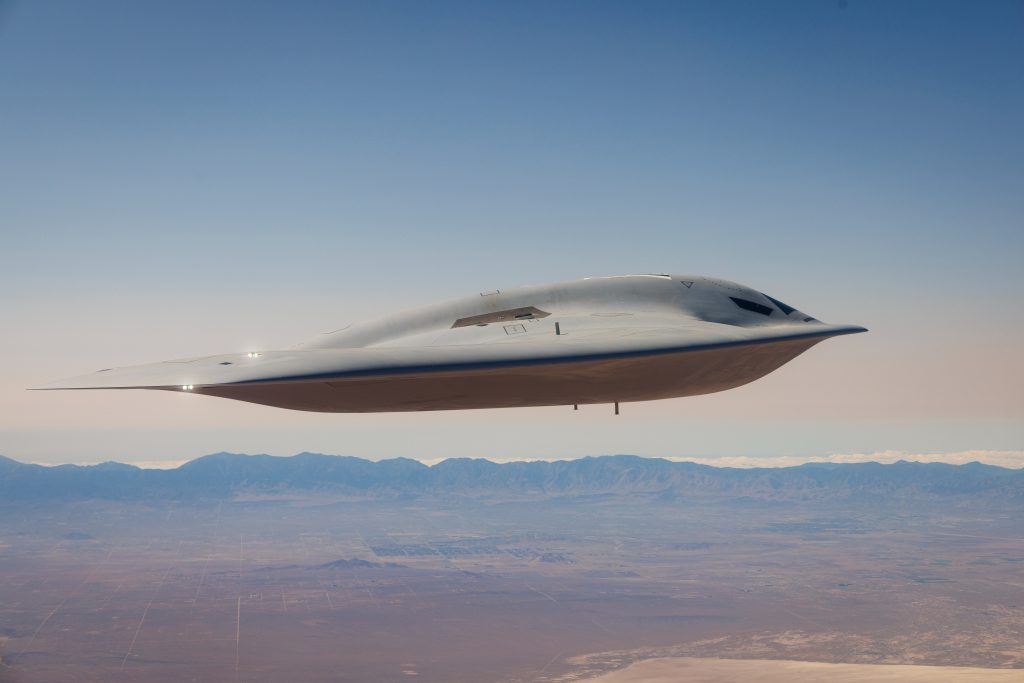
The US Air Force has an existing acquisition target for the Northrop Grumman stealth bomber of 100 aircraft.
The top US military officer in the Indo-Pacific region says he would support expanding the acquisition target for the US Air Force’s next-generation stealth bomber to double the current level.
During a Senate Armed Services Committee hearing on 21 April, US Navy Admiral Samuel Paparo was asked if he believes the current target of fielding 100 Northrop Grumman B-21 Raider bombers is sufficient to meet requirements for both conventional and nuclear missions.
“Would you agree that we need to procure at least 145 B-21s? And shouldn’t we be seriously considering at least 200?” Senator Deb Fischer of Nebraska, which is home to US Strategic Command, asked Paparo.
“I would favor 200 B-21 bombers,” Paparo replied. “Not just for the nuclear deterrence mission, but for penetrating strike capabilities.”
“I couldn’t be a stronger advocate,” he added.
Paparo also noted that he expects Beijing’s nuclear arsenal will “nearly double” over the next five years. That build-up is separate from the substantial inventory of atomic weapons commanded by Russia, with which China declared a “no limits partnership” in 2022.
“We’ve got to overmatch that capability,” Paparo says. “We have to continue to modernise the US nuclear deterrent.”
Nuclear-armed bombers, including B-21s, form one leg of the so-called “nuclear triad”, with submarine- and silo-launched ballistic missiles being the second and third components.

Although traditionally held by a naval officer, the commander of Indo-Pacific Command oversees operations of all US military branches in Asia, Australia, Oceania and the Indian and Pacific Oceans. The position includes responsibility for deploying US Air Force assets, including those that presumably would be used to defend Taiwan in the case of a Chinese invasion or blockade.
The handful of unclassified war games and academic studies that have examined such scenarios predict that long-range anti-ship strikes by USAF aircraft, particularly bombers, would be critical to a US-Taiwan victory.
The US Air Force operates the only fleet of dedicated bomber aircraft within the Western world. All three of the USAF’s bomber types were deployed as part of the Operation Epic Fury campaign against Iran.
Northrop Grumman is currently flight testing the initial B-21 design in California, with two test aircraft flying and several more undergoing assembly. The latest milestone was the first B-21 in-flight refueling, completed in April using a Boeing KC-135 tanker.
The air force plans to begin fielding operational B-21s in 2027, with the first aircraft going to the bomber wing at Ellsworth AFB, South Dakota.
Much like Washington’s current long-range stealth platform — the Northrop Grumman B-2 Spirit — B-21s will likely launch from bases in North America and fly around the world to strike targets thousands of kilometres away.
In 2025, the majority of the small B-2 fleet was sortied for Operation Midnight Hammer — a mission that included deep-penetration strikes against Iranian nuclear enrichment facilities. While most of those bombers formed the strike package, a smaller number flew in the opposite direction as a diversion.
The notion of expanding B-21 acquisition beyond 100 aircraft has been discussed for years, but senior air force and Pentagon officials have generally declined to make any open commitment to a specific figure.

The entire B-21 programme was structured to ensure the next-generation bomber remains affordable enough to field a 100-aircraft fleet. Cost overruns on B-2 development led Washington to cap that fleet at just 21 examples, with 20 still in service.
The $1.5 trillion deluge of spending unveiled in the Trump Administration’s 2027 defence budget request does not specifically include funds to increase the B-21 fleet. However, top Pentagon officials say they have not ruled out such a move.
“I’m on board with assessing the numbers,” General Dan Caine, chairman of the joint chiefs of staff, said in a 30 April hearing before the Senate Armed Services Committee.
Caine, an air force fighter pilot by training, said that assessment will need to look at both the Pentagon’s operational plans for possible conflict scenarios — known as “O-Plans” — and the likely trajectory of future air power threats.
“We want to make sure… that we’re staying well in front of it,” he says. “I want to make sure we’re buying ahead of the technology development curve.”
The four-star general and favourite advisor of US President Donald Trump says he does not see an urgent need to expand the B-21 acquisition target, but intends to review the relevant O-Plans before rendering a verdict.
“I don’t believe so, but I do want to take the due-diligence time,” Caine said when asked by lawmakers if he sees a need to field more than 100 B-21s.
At the same 30 April hearing, US secretary of defense Pete Hegseth noted that the administration is requesting $6 billion for continued B-21 programme work.
Hegseth also volunteered his opinion on additional B-21 purchases, saying, “We believe we’ll require a lot more, over 100, in the future”.
The post US Pacific commander supports increasing B-21 acquisition to 200 aircraft first appeared on FlightGlobal.