


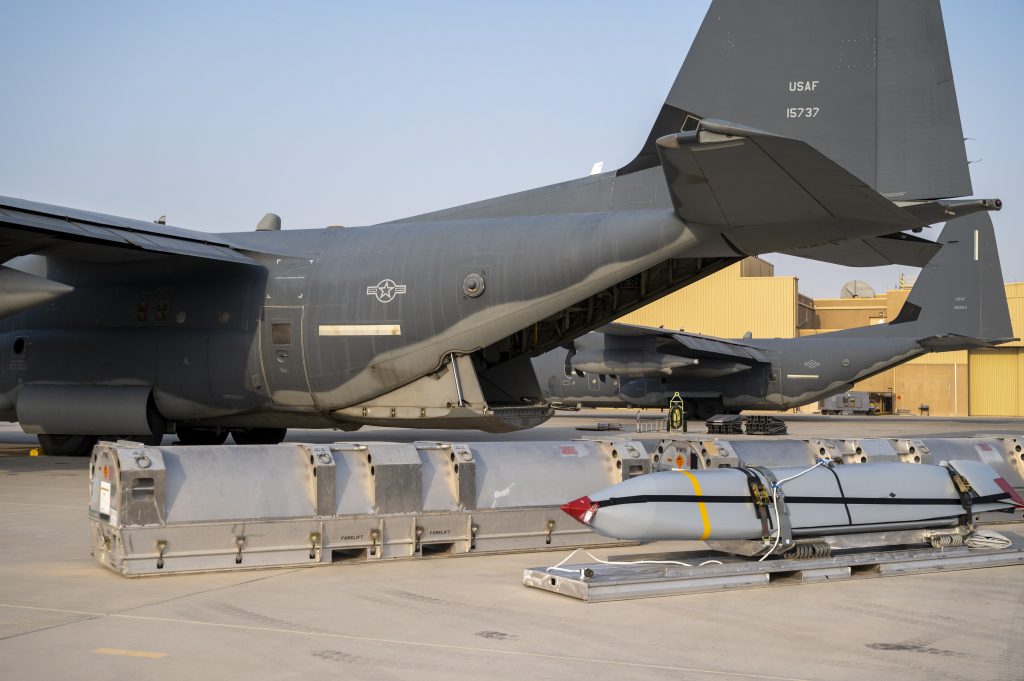
The concept envisions thousands of cruise missiles air-launched from pallets carried in the back of cargo aircraft.
The US Air Force is exploring options for an air-launched cruise missile that can be deployed from the back of transport aircraft to strike ships.
A formal request for information (RFI) published on 27 April asks industry to provide potential solutions for such a munition, which should be capable of being launched in flight via cargo pallets. Additionally, the air force wants a missile that can be produced at a rate of up to 2,000 units annually.
The initiative is called Family of Affordable Mass Missiles – Beyond Adversary’s Reach (FAMM-BAR). A related effort for a similar weapon carried by strike fighter aircraft is also underway, dubbed the FAMM – Lugged.
“The programme office seeks to streamline the battle space by developing a single common air-to-surface munition that is affordable, adaptable and possesses significant standoff range,” the air force’s Portfolio Acquisition Executive for Weapons office says.
Such a palletised system would likely be launched from an aircraft’s rear cargo ramp, using parachutes to separate the pallet from the aircraft. Air Force Special Operations Command has previously tested a Lockheed Martin system called Rapid Dragon for deploying palletised cruise missiles from the MC-130J special operations transport.
An initial list of requirements laid out in the FAAM-BAR informational solicitation include a range beyond 1,000nm (1,852km), speed of Mach 0.7 (466kt), ability to conduct mid-course navigation and a minimum production rate of 1,000 units annually.
The RFI notes that orders could reach up to 2,000 units annually for a period of five years.

Notably, the intended target set for the FAAM-BAR is listed as “slow-moving maritime” vessels.
That indicates the USAF is looking to build on the existing air-to-ground maritime strike capability offered by the US Navy’s Lockheed-made Long Range Anti-Ship Missile (LRASM). Those missiles are derivatives of the Joint Air-to-Surface Standoff Missile (JASSM) used by the air force to strike land targets.
The JASSM has been heavily employed in Washington’s air campaign against Iran, with more than 1,000 units fired by aircraft like Boeing B-52H heavy bombers.
Though capable, JASSM and LRASM quantities are limited, with Lockheed working to expand production to 1,100 units annually across two production lines.
Think tank Center for Strategic and International Studies estimates the US military expended over 1,000 JASSMs between late February and mid-April – when Washington and Tehran agreed to a temporary ceasefire.
That is equivalent to roughly 25% of pre-war stocks and four years of current production, CSIS estimates.
A number of FAMM potential candidates have emerged from industry suppliers over the past year, including the Lockheed Martin Common Multi-Mission Truck, L3Harris Red Wolf, Northrop Grumman Lumberjack, Anduril Industries Barracuda.
Testing is already underway on the fighter-carried FAMM-Lugged with the Lockheed Martin F-16 strike fighter.
In March, the US Air Force’s 96th Test Wing carried out fit and functionality checks, loading procedure validation of loading, and test flights with a FAMM-L weapon.
Those tests included a weapon release from an F-16 in flight.
The post US Air Force seeking long-range anti-ship missile deployed from transport aircraft first appeared on FlightGlobal.