


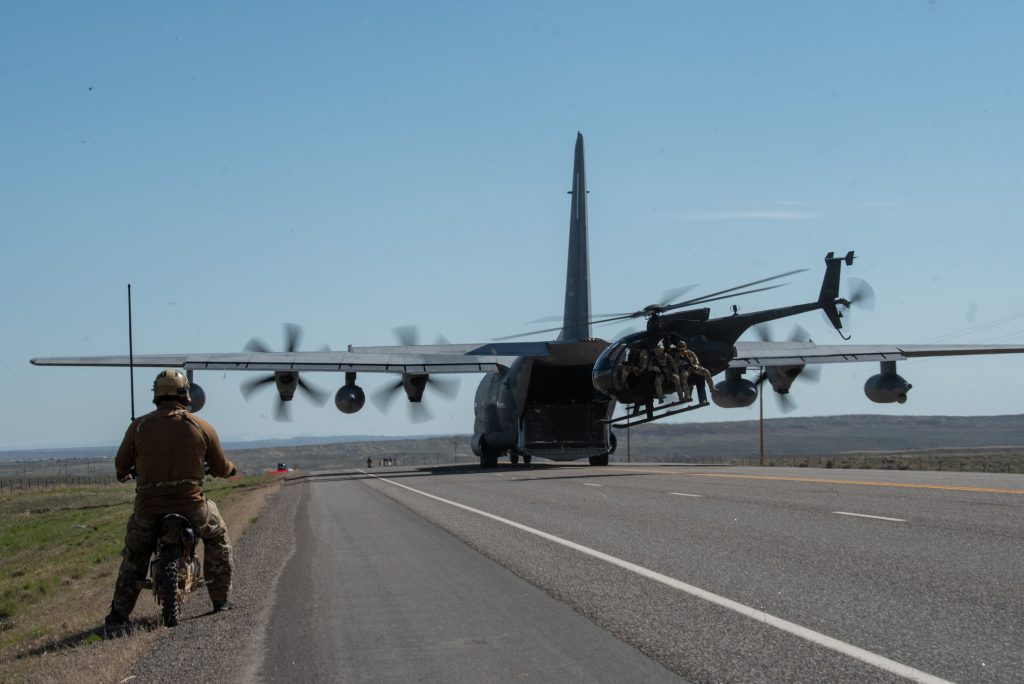
Draft legislation from the US Senate would provide $127 million to cover four MH-6 helicopters and two MC-130J special operations transports destroyed while recovering a downed American F-15E crew.
Lawmakers in Washington, DC are advancing funding to replace some aircraft lost during combat operations in Iran.
The draft legislation, which comes as the Trump Administration has signed a preliminary armistice with Tehran, would provide some $127 million to cover Boeing MH-6 Little Bird helicopters and Lockheed Martin MC-130J Commando II special operations transports destroyed in April.
Four Little Birds and two MC-130Js were intentionally sabotaged on the ground by US commandos during the effort to recover an American officer whose Boeing F-15E fighter had been shot down over Iran’s Isfahan province.
The MC-130Js, with Little Birds stowed in the cargo bay, became mired in the soft sand of an improvised runway and could not be extricated.
A draft of the 2027 National Defense Authorization Act (NDAA) released by the Armed Services Committee of the US Senate (SASC) on 16 June includes line items for addressing combat losses in the MH-6 and MC-130J fleets, which are operated exclusively by special operations forces (SOF).
$72 million is detailed for “SOF mobility combat loss” under rotary-wing aviation programmes, while a further $55 million is allocated for combat losses under the AC/MC-130J section.
Notably, that funding would only offset a fraction of the more than 40 aircraft lost in the Iran operation, a figure which includes multiple fighter types, a Boeing E-3 airborne warning and control jet, several KC-135 tankers and numerous General Atomics MQ-9A uncrewed aerial systems.
Despite including dollar figures, the annual NDAA is a policy bill and does not guarantee the funds will actually be allocated by Congress. The draft text released by the Armed Services Committee will still have to be approved by the full Senate, as well as the House of Representatives.
Interestingly, the SASC bill also zeroes out fiscal year 2027 funding for the L3Harris OA-1K Skyraider II close air support turboprop, which is a darling of US Special Operations Command (SOCOM). The draft bill would cut more than $59 million requested for OA-1K acquisition to offset replenishment of combat losses.
If funding is ultimately approved, the process for regenerating the MC-130J and MH-6 fleets would be different than the typical military procurement process.

Unlike the primary US military services, which acquire their aircraft in standard configuration from the manufacturer, SOCOM often undertakes its own speciality “SOF-peculiar” modifications after purchasing commercial or military aircraft.
That modification work takes places at the Pentagon’s Special Operations Forces Support Activity (SOFSA) site in Lexington, Kentucky.
In the case of the MC-130J, a fairly clear path has been laid to replacing the two aircraft destroyed in Iran.
“The department has its processes to fund and replace losses in combat,” Colonel Justin Bronder, SOCOM’s head of fixed-wing aircraft procurement, said in May during the annual SOF Week conference in Tampa, Florida.
That process would see the US Air Force purchase new-build C-130J transports from Lockheed, which are then turned over to SOCOM.
“We team with the air force, which provides the ‘green’ C-130 aircraft,” Bronder says. “Then our charge is to get the SOF-peculiar modifications on it that transform it into the Commando II.”
SOCOM took delivery of its final MC-130J in December 2024, concluding a 14-year production run covering 60 aircraft.
The standard C-130J is still in active production, with 20-24 aircraft delivered annually from Lockheed’s Marietta, Georgia line.

When it comes to replacing the four Little Birds destroyed in Iran, the path is slightly less clear.
Although sustained by Boeing, the MH-6 and AH-6 light attack variant are actually commercial rotorcraft produced by MD Helicopters and modified aftermarket by SOCOM.
“We take a commercial MD 530 and essentially militarise it,” says Paul Kylander, SOCOM’s Little Bird product manager. “We build, from the ground up, these aircraft out of the SOFSA.”
At the moment, SOCOM is focused on upgrading the existing Little Bird fleet to the new A/MH-6R standard, which includes a new zero-hour fuselage made by Boeing, structural reinforcements to the airframe and modernised cockpit avionics.
“We are in the process of delivering -6R aircraft to the unit,” Kylander says.
Within the US military, the Little Bird is exclusively operated by the US Army’s 160th Special Operations Aviation Regiment, which receives its aircraft from SOCOM.
The “Romeo” Little Birds are remanufactured aircraft from the existing fleet, not new-build MD 530s.
“We’re not buying new MD packages,” Kylander said in May, “We’re buying brand new fuselages from Boeing and we’re resetting the fleet.”

Of note is that there are only superficial differences between the light attack AH-6 and troop-carrying MH-6 assault variants of the Little Bird, according to Kylander. Both types have the same commercially available MD 530F at their core.
“From a cockpit standpoint, from a drivetrain-rotor system standpoint, it’s exactly the same,” he said at SOF Week.
In order to replenish the Little Birds destroyed in Iran, SOCOM would have to first purchase new aircraft from MD, which may be what the $72 million included in the draft Senate legislation is intended to support.
The Pentagon has placed such orders with MD in recent years, including a nearly $1.4 billion order through the Foreign Military Sales system in 2017 to furnish up to 150 MD 530Fs for the now-defunct Afghan air force.
Subsequent orders were also placed by Kenya and Lebanon.
Although the exact cost of a new Little Bird is opaque, due to both the uncertainty around MD’s pricing of the baseline MD 530F and the exact cost of modifying each aircraft into the Little Bird configuration, the $72 million allocation breaks down to roughly $18 million per aircraft, assuming four MH-6s are covered.
A 2026 new-build example of the less capable MD 500E is currently being listed for $3 million.
The post US Congress pursues funding to replace MC-130Js and Little Birds lost in Iran rescue operation first appeared on FlightGlobal.