

The re-engine effort has been approved for early-stage engineering development, while a new radar is now in low-rate initial production.
Two US Air Force programmes to modernise the Boeing B-52 have cleared key developmental milestones, and the service plans to convert another two of the heavy bombers into text aircraft to support the work.
William Bailey, assistant air force secretary and chief of acquisitions, says the USAF has approved low-rate production of a new Raytheon active electronically scanned array radar for the bombers.
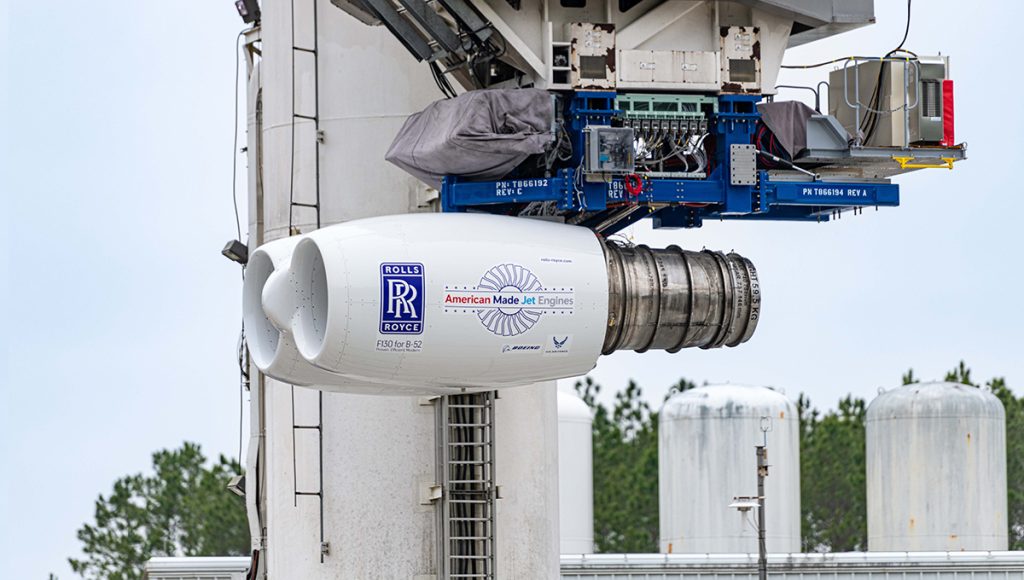
Separately, Rolls-Royce was cleared to begin engineering and manufacturing development under the re-engine programme that will replace the B-52’s eight Pratt & Whitney TF33 turbofans with Rolls’ F130s.
Approvals to advance the radar and engine programmes were given in August and June, respectively.
“Those are the number one drivers to aircraft availability,” Bailey says.
The USAF is expected to spend $21 billion modernising the B-52 fleet, which will extend the bomber’s service to at least 2050.
As part of that effort, it plans to convert two frontline bombers into test aircraft to support the engine and radar modernisations.
The service lost one test-configured B-52H in June; that aircraft crashed at Edwards AFB in California while supporting the Radar Modernization Program (RMP). All eight people aboard the bomber died; they included military personnel, government civilian workers and two Boeing staff.
The two bombers assigned to test duty are scheduled to enter modification at Boeing’s San Antonio facility in the coming months, where they will receive modifications for both the RMP and the Commercial Engine Replacement Program (CERP).
The jets will join another RMP test aircraft, meaning three test aircraft will support B-52 modernisation.

With the updates, the USAF faces the challenge of balancing its immediate need to overhaul the more-than-60-year-old jets with its demand for airpower, Bailey says. “The mission of B-52 is not to sit in a depot.”
However, the air force is starting to face insurmountable issues linked to inherent limitations of the Cold War bombers.
“Depot comes to a point where they say, ‘I can only do so much with a TF33 engine,’” Bailey notes.
In an audit of the TF33 replacement effort released in July, the US Government Accountability Office said air force maintainers are “struggling with finding sufficient parts for the current engines”.
The CERP re-engine effort is expected to begin developmental flight testing in 2028, with initial operational capability projected by 2033.
Rolls-Royce passed a CERP critical design review in May. Boeing received a $2 billion contract in late 2025 to cover integration with and testing of F130s on two B-52Hs.
The air force plans to designate re-engined bombers B-52Js.
Raytheon is under contract to provide a new sensor – the AN/APQ-188 – for the B-52 fleet under the RMP effort.
The AN/APQ-188 will replace the outdated Northrop Grumman AN/APQ-166 mechanically scanned radar currently installed on B-52Hs, which the air force describes as “antiquated and failing”.
The new radar is based on Raytheon’s widely used AN/APG-79 system carried on Boeing F/A-18E/F Super Hornet and EA-18G Growler electronic attack fighters.
The post US Air Force to advance B-52 engine and radar upgrades with additional test aircraft first appeared on FlightGlobal.