


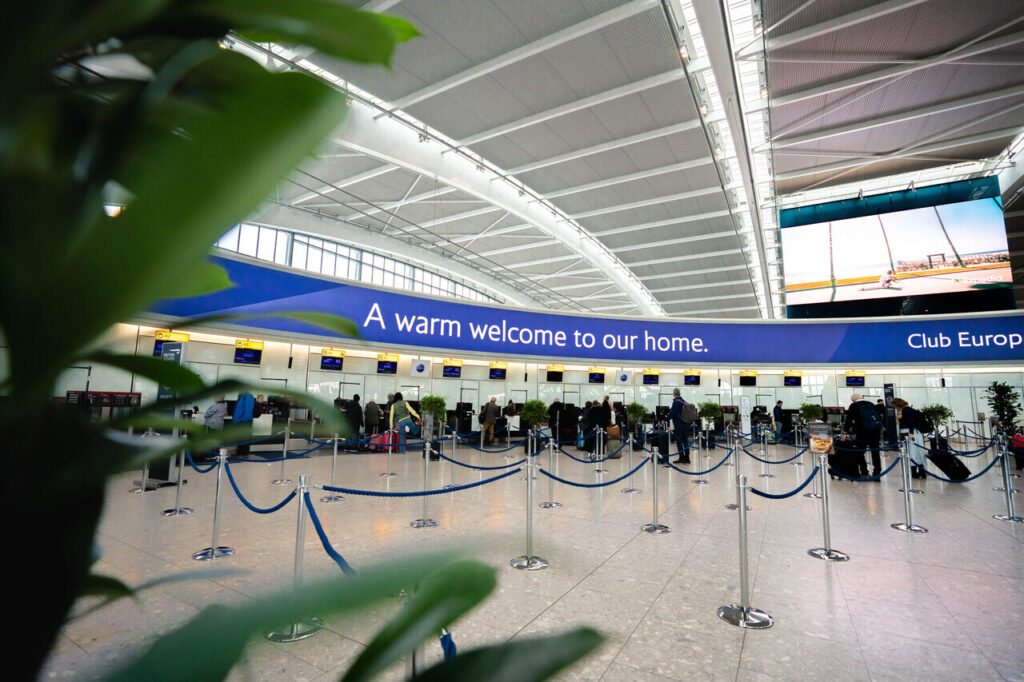
Approval for a third runway at the London hub should only be granted if stricter legislation forcing aviation to pay for its own decarbonisation by 2050 is brought in, says the Climate Change Committee in a government-commissioned report.
There is “no credible pathway” for London Heathrow to add a third runway unless the UK enacts new legislation obligating the aviation industry to “clean up its emissions” by 2050 under a “polluter pays” principle, according to an influential environmental advisory body.
That is the conclusion of the Climate Change Committee (CCC) in a government-commissioned report examining whether the airport’s proposed expansion could be delivered in a way that is consistent with the country’s carbon budgets and net-zero targets.
One pathway that could enable the proposed expansion to proceed without breaching those targets would be to make the airline industry pay for engineered carbon removals and sustainable aviation fuels (SAF) through higher ticket prices, which would also help limit demand growth, the report suggests.
Under this course of action, the CCC envisions that carbon removals would account for 36% of the UK aviation sector’s emissions reductions by 2050, with SAF accounting for one-fifth – the full cost of which should be borne by the industry and not the taxpayer.
Lower demand growth would account for a further 24% of the industry’s emissions reductions by mid-century, with efficiency improvements making up the final 20%.
Table of Contents
Higher prices for passengers
This pathway would likely see airlines passing on the decarbonisation costs to customers through higher ticket prices. The CCC estimates that this would result in a £150 ($202) increase in the price of a return ticket from London to Alicante in Spain by 2050 and a £400 rise in the cost of a return flight to New York. These increases would be phased in gradually, it says.
“Our key conclusion is that the government cannot expand Heathrow airport without requiring the aviation industry to clean up its emissions and, therefore, that the government should legislate policies that require the aviation industry to fully address all of their emissions by 2050 – either directly or by purchasing engineered removals,” said CCC chair Nigel Topping during a 14 September media briefing ahead of the report’s release.
He adds that this legislation “must happen before the development consent order is granted, if it’s to be consistent with our legally-binding carbon budgets and targets”. The CCC recommends that these new policies are added to the government’s revised Jet Zero strategy next year.
“Delivering on this will require an incredible net-zero policy framework for aviation and we believe that this should be set out in the government’s revised Jet Zero strategy, which is due in 2027, supported by a detailed implementation plan covering policy delivery, investment, financing and risk management,” says Topping, adding: “If aviation is to grow, it must take full responsibility for the emissions it creates.”
The UK’s Department for Transport on 18 June published a draft revision to the Airports National Policy Statement, which it has renamed the Heathrow Expansion National Policy Statement (HENPS), and opened it up for comments to ascertain how the proposed addition of a third runway could meet “key tests” on noise, air quality, climate and economic growth.
The government charged the CCC with advising it on how the planned expansion could be carried out in a way that is consistent with the UK’s legally-binding emissions-reduction obligations. The intention is for a third runway to be operational by 2035.
In its report, entitled Advice to the UK Government on Proposed Heathrow Airport Expansion, the CCC says the climate test in the draft HENPS must be strengthened to explicitly include the UK’s 2050 net-zero target because, by that point, aviation will be responsible for the lion’s share of the country’s carbon dioxide emissions.
By 2050, “aviation will be one of the two biggest emitters alongside agriculture”, says the CCC’s director of analysis and chief economist, James Richardson.
Increasing emissions
Emissions from flying have more than doubled in the UK since 1990, and Heathrow accounts for about half of the country’s aviation emissions, according to the CCC.
“Those aviation emissions are projected to increase even without Heathrow expansion and the UK does not currently have a credible plan to reduce them in line with net-zero. That creates a serious challenge for meeting our climate commitments,” says Topping.
“Our view is that any climate test in the planning consideration must look beyond individual carbon budget periods and consider the impact on all of the UK’s legally binding climate targets, including net zero in 2050.”
He adds that “we need to be honest about the uncertainty” around how quickly SAF and carbon removal technologies can be scaled up, noting that neither is “guaranteed for scale as quickly as hoped”. In its report, the CCC says: “To meet climate targets, demand for flying can only increase once there is progress on clean technology to decarbonise and remove residual emissions from flight.”
IATA itself said in June that hopes of the industry achieving its 2050 net-zero goal were “fading fast”. The trade group estimates that SAF will make up just 0.8% of global jet fuel this year. The aviation industry’s 2050 net-zero goal is contingent on 65% of its fuel needs being met by SAF by the middle of this century.
Government and industry response
The UK government says it will “carefully consider the CCC’s advice along with all responses received to the Heathrow expansion consultation”.
“We’re investing £219 million in sustainable aviation fuel production and a further £43 million in cleaner technologies to support greener aviation, while expansion could deliver around £40 billion to the economy and support up to 60,000 local jobs,” says the Department for Transport, adding that “any expansion proposal would need to align with our net-zero targets”.

British Airways and other airlines have raised concerns about increased charges at Heathrow. Source: British Airways
Airlines have already expressed concerns about facing increased airport charges to fund Heathrow’s proposed expansion. The UK Civil Aviation Authority (CAA) said in a final decision published on 29 July that it would allow Heathrow Airport Limited to recover £320 million of early expansion costs incurred in 2025 and 2026 through additional airport charges. Any move that could further increase airlines’ costs is likely to be met with opposition.
London Heathrow has responded to the report by saying its expansion “cannot be a choice between economic growth and net-zero”, and must deliver both.
“The Climate Change Committee’s assessment does not change this and acknowledges that the key solutions exist today,” it says.
“We will continue working with the government and partners across the aviation sector to ramp up today’s proven technologies, while examining options for how the billions of pounds passengers already pay in carbon taxes can be used to support this.
“Given the right policies, a growing aviation sector can be empowered to deliver the huge economic and social value that air travel brings, while increasing the pace of delivery of the solutions needed to accelerate aviation’s decarbonisation.”
Airlines UK, the trade body for carriers including British Airways, EasyJet and Virgin Atlantic, has hit back at the CCC’s report, arguing that its suggestions would make flying “the preserve of the rich”.
“UK airlines back cost-effective airport growth and net-zero by 2050 – but the transition has to be affordable,” says Airlines UK chief executive Tim Alderslade. “Airlines are already investing billions in new aircraft, SAF and airspace upgrades and we have a plan to deliver it.
“The CCC’s approach would add £600 to a family’s trip to Europe and £1,600 to New York by 2050, putting holidays out of reach for millions and turning the clock back to a time when flying was the preserve of the rich. You can’t solve the climate crisis by pricing Britain out of the skies.”
Alderslade adds that “the answer is affordable SAF”, airspace reform and scaled-up carbon removals, noting: “Both SAF and GGRs [greenhouse gas removals] are proven technically viable, as the CCC itself admits. We should focus on delivering them, not pricing ordinary people out of the joys of travel.”
The post Heathrow expansion incompatible with UK climate targets under current policy framework: CCC first appeared on FlightGlobal.