



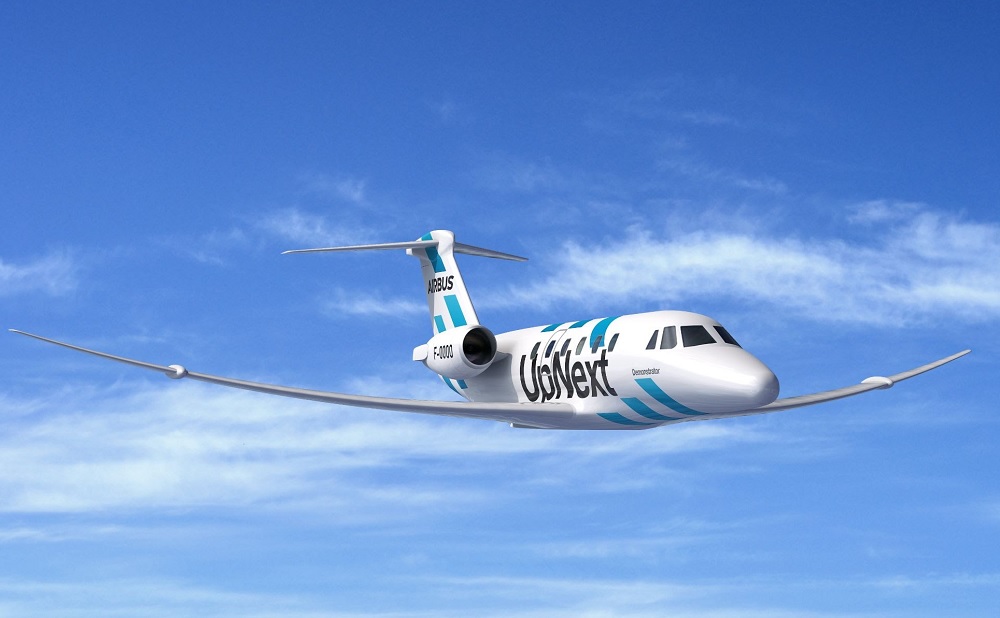
Technology advancements will make composites feasible for high-rate narrowbody production programmes, Hexcel CEO Gentile says.
The chief executive of carbon-fibre supplier Hexcel is confident Airbus and Boeing will take the fairly revolutionary step of designing their next-generation narrowbody jets not only with composite wings, but also composite fuselages.
Speaking on 9 September, CEO Tom Gentile describes the composite wing question as effectively settled.
“The wing will be composite. Everybody is in complete agreement on that,” Gentile says during an investor conference hosted by financial firm Jefferies. “In order…to reduce drag and increase lift, you need a carbon-fibre wing”.
Whether airframers will give their next narrowbodies composite fuselages is less clear.
“Personally, I think they will,” Gentile says. “There’s still a lot of debate on that.”
Whether Gentile is correct may not be clear for some time. Airbus and Boeing are generally expected to bring new narrowbodies to market in the mid-to-late 2030s. A third competitor, Embraer, has also indicated some interest in the space but has not committed.
Airbus and Boeing have disclosed few details about their future jets; much remains unclear, including the degree to which the aircraft will have composites.
What is clear is that the next narrowbodies must be capable of being produced rapidly, at rates as high as 80-100 jets monthly for each programme, by some estimates.
The projects are still years from fruition but the companies are increasingly revealing hints about where they are going.
Both Airbus and Boeing have recently been studying long, thin wings – with high aspect ratios, which reduce drag, improving efficiency. Airbus’ innovation arm UpNext is specifically evaluating a new composite high-aspect-ratio wing, while Airbus, under its separate Wing of Tomorrow programme, plans to evaluate long wings using a modified A321neo.

Boeing cancelled a project last year to develop a truss-braced-wing demonstrator but is continuing one aspect of that programme: studying a long, thin wing, it has said.
And on 8 September Boeing said longtime Spirit AeroSystems executive Sean Black will help oversee development of a 737 replacement as vice-president of the future production system.
Notably, Black, who was Spirit’s chief technology officer until Boeing acquired the company last December, in 2022 extolled Spirit’s composite-development work, saying the company had “a very good understanding of what it takes” to enable high-rate production.
Spirit has also contributed to NASA’s Hi-Rate Composite Aircraft Manufacturing programme, an effort to make composite manufacturing feasible for future narrowbody programmes.
Beyond narrowbodies
Airbus with its A350 and Boeing with its 787 pioneered the use of composites; both jets have composite wings and fuselages. The jets are 50% composite by weight, says Gentile, noting Hexcel supplies the A350’s resin and carbon fibre and that Japanese competitor Toray supplies the 787 programme.
Today’s narrowbodies also have composites, but far fewer – the materials account for about 15% of a 737 Max’s or A320neo’s weight, mostly attributable to fan blades and cases, nacelles and other engine components, Gentile says.

Composites require less maintenance than metals, and weigh less – a benefit that particularly pays dividends in the form of fuel efficiency on long-haul flights, Gentile notes. That is one reason Airbus and Boeing use the parts on their widebodies.
But composites also pose challenges. They are not especially conducive – at least not yet – to high-rate manufacturing. That is because production is time intensive and complex, involving laying up materials, resin-curing (a step Gentile says can take 12h) and the use of massive autoclaves.
Additionally, raw materials are costlier than metal, a NASA document notes.
Those are among reasons lower-rate-production types like 787s and A350s have much more carbon fibre.
But technology is evolving to where Gentile suspects Airbus and Boeing will take a massive leap.
“The question becomes: the fuselage. Do you go to a carbon-fibre fuselage?” for the next narrowbody, Gentile says.
Yes, he predicts.
“There has been a lot of work with both of the OEMs on the next-generation aircraft, not in terms only of the carbon-fibre development and the resin development, but also the production system,” he says.
Hexcel has been researching means to reduce composite costs and speed up the layup and curing process (the latter to as little as 3h), and it is improving processes like resin-infusion that do not require bulky autoclaves, says Gentile. Hexcel is also working to improve the three types of composite strength: tensile (“how hard it is to pull apart”), modulus (a measure of stiffness) and compression.
While 787 and A350 composites are largely “homogenous” (made the same way), next-generation aircraft could have a wide variation, meaning composites with differing material properties and produced using different processes.
“Because of all of that, and the sophistication, I do think you’re going to see a carbon-fibre wing and a carbon-fibre fuselage,” Gentile says. “I have no doubt we will be able to do it.”
The post The next narrowbody big question: Will the fuselage go composite? first appeared on FlightGlobal.