



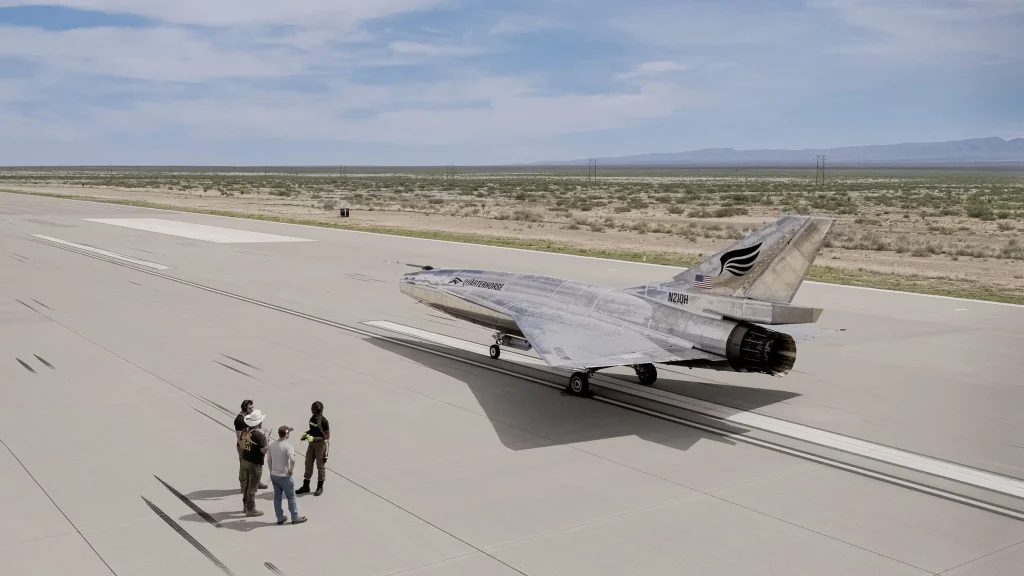
The start-up has already broken the sound barrier with its Mk 2.1 jet.
US hypersonic developer Hermeus has received regulatory approval to conduct supersonic flights with its latest aircraft design.
A notice from the US Federal Aviation Administration to be published on 11 September grants special flight authorisation for Hermeus to exceed Mach 1 with its Quarterhorse Mk 2.2 jet. The decision allows for up to six supersonic test flights by 20 August 2027 over White Sand Missile Range in New Mexico.
The flights must occur at or above 24,000ft during daytime.
Hermeus has already broken the sound barrier with its Quarterhorse Mk 2.1. That flight took place in May over White Sands, reaching Mach 1.21. The FAA similarly approved Hermeus to conduct seven supersonic flights with the Mk 2.1, with an authorisation window that runs until the end of 2026.
The next Quarterhorse jet is now set to begin its own test campaign.
“Mk 2.2 is on the ramp and rapidly moving towards first flight,” Hermeus chief executive Zach Shore said in late August.
Within the Mk 2 series, Hermeus plans to build three variants that will each push further toward the M5 threshold. The Mk 2.1 was the first to break the supersonic barrier, while the Mk 2.2 and Mk 2.3 successors will push into higher Mach speeds.
The company’s long-term goal is to develop a reusable aircraft capable of breaking the M5 hypersonic barrier.
A photo posted by Shore indicates a high degree of similarity between the Mk 2.2 Quarterhorse and the earlier Mk 2.1. Both jets feature delta wings with highly swept leading edges, variable air intakes situated in their nose cones and single vertical stabilisers.

While the Mk 2.1 is powered by a standard Pratt & Whitney’s F100 turbofan, the Mk 2.2 will use Hermeus’ own Gryphon II engine, which combines the F100 with an internally developed pre-cooler technology to manage engine temperature at high-supersonic speeds.
The successive Mk 2.3 variant is designed to survive the extreme thermal environment near M3, replacing aluminium with high-temperature materials to validate airframe manufacturing and thermal control systems ahead of ramjet transition.
The forthcoming Quarterhorse Mk 3 and Mk 4 designs will demonstrate in-flight transition from turbine to ramjet — a critical technical feat needed to progress into hypersonic flight.
Hermeus plans to accomplish that with its internally developed Chimera II turbine-based combined cycle (TBCC) engine, which is also based on the F100.
The Mk 4 will specifically aim to demonstrate sustained ramjet-powered, high-Mach flight at high altitudes.
Separately, Hermeus on 9 September revealed plans to develop a low-cost ramjet test platform designed to be air-launched from the Quarterhorse series.
Dubbed the Ramjet-X, Hermeus says it will provide access to sustained high-Mach flight data, which the company describes as “one of the biggest bottlenecks in high-speed aviation”.
Imagery released by Hermeus shows a Quarterhorse Mk 2-style aircraft carrying two Ramjet-X vehicles on underwing hardpoints.
The post FAA approves Hermeus to fly Quarterhorse Mk 2.2 supersonically first appeared on FlightGlobal.