


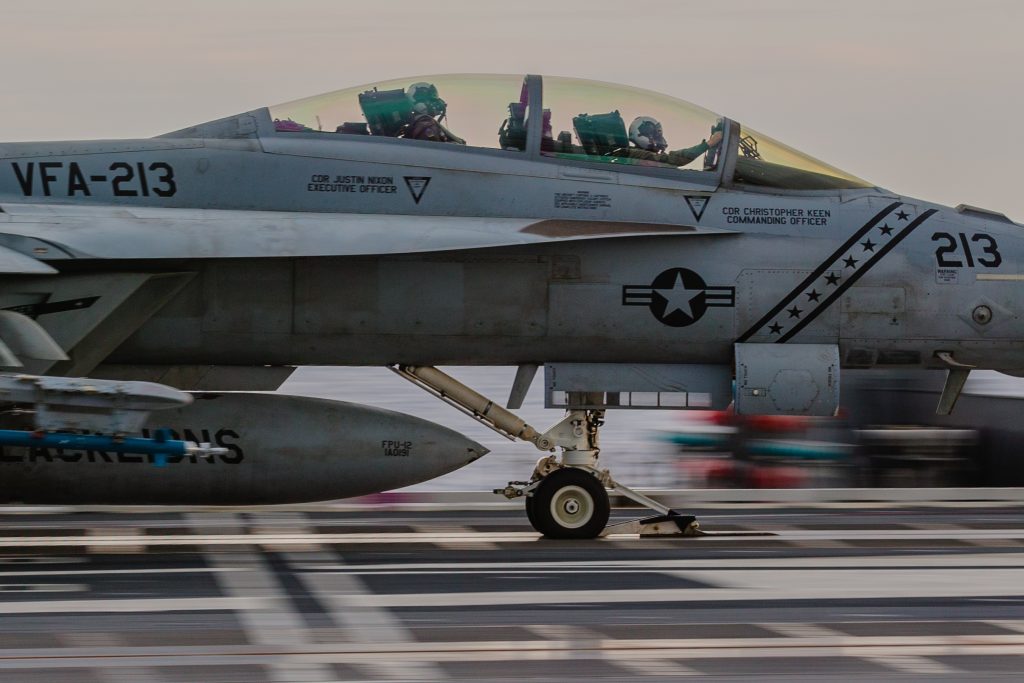
The USS John F Kennedy is the second Ford-class flattop and may now be the last to use the Electromagnetic Aircraft Launch System.
The US Navy’s newest aircraft carrier has begun sea trials ahead of a projected entry into service next year.
The USS John F Kennedy (CVN-79) departed the shipyard at Newport News, Virginia, on 13 August for acceptance trials that will test and evaluate onboard systems and components at sea, US shipbuilder Huntington Ingalls says.
The nuclear-powered flattop is the second vessel in the USN’s line of Ford-class carriers, with the inaugural example, the USS Gerald R Ford, already in service. The Kennedy is meant to replace the ageing USS Nimitz, which is scheduled for decommissioning after returning from its expected final deployment in July.
The Nimitz was the lead vessel in the Nimitz-class line of carriers, commissioned in 1975. Its air wing supported combat operations around the world, including the failed attempt at rescuing American hostages from Tehran in 1979, the Persian Gulf War, and the wars in Iraq and Afghanistan.
If sea trials progress smoothly, the Kennedy is expected to be ready for frontline service sometime in the first half of 2027, a two-year delay from the navy’s original projections.
Those delays have now driven the White House to order significant changes to the Ford-class design.
US President Donald Trump signed a directive on 13 August ordering the US Navy to ditch the electromagnetic catapult system developed for the Ford line.
Officially known as the Electromagnetic Aircraft Launch System (EMALS), the new catapult replaces the steam-driven launch system used on the Nimitz-class ships. Designed by General Atomics, the EMALS was one of the most radical changes made in the Ford-class design.

The presidential memo gives the Pentagon 60 days to develop a plan for replacing the EMALS with a traditional steam-driven catapult system on future Ford-class carriers. Electromagnetically driven weapons elevators featured on the Kennedy must also be replaced with conventional hydraulic lifts.
The EMALS uses a linear induction motor along the catapult track to accelerate aircraft off the flight deck, rather than the steam piston design that has been a fixture of carriers since the 1940s. The electrically driven launch method can achieve greater speeds off the flight deck with more controlled acceleration, reducing structural fatigue.
China incorporated electromagnetic catapults into the CNS Fujian, the country’s first CATOBAR (catapult-assisted take-off but arrested recovery) aircraft carrier.
That vessel began flight operations in late 2025.
In the US, development of the EMALS proved technically challenging and significantly delayed entry of the Gerald R Ford into frontline service. The carrier has subsequently employed the system operationally, including a record-setting 326-day deployment from 2025 to 2026 that logged 5,760 flight hours and 12,200 flight launches.

In fact, the USN said in February that results from that deployment indicate the EMALS contributed to an increased sortie generation rate compared to that of a Nimitz-class carrier.
“These systems are operating as designed,” the navy said.
For now, the White House directive killing electromagnetic systems only applies to the fourth Ford-class carrier (CVN-81), which has been designated the USS Doris Miller. That ship is not scheduled to be commissioned until 2034.
The third Ford vessel — the latest ship to bear the iconic USS Enterprise title — is apparently far enough into construction that replacing the EMALS and weapons lifts would not be practical.
Trump is a famous detractor of the electromagnetic system. During his first term as president, he chastised the US Navy for the choice to ditch the steam-driven catapult, calling it the “wrong” choice and saying steam has “worked for about 65 years perfectly”.
In 2019, Trump mused about ordering the navy to return to the older piston-driven launch system.
“We’re going to use steam,” he said at the time. “We don’t need that extra speed.”
The post US Navy’s newest aircraft carrier begins sea trials as Trump orders end to electromagnetic catapult first appeared on FlightGlobal.