


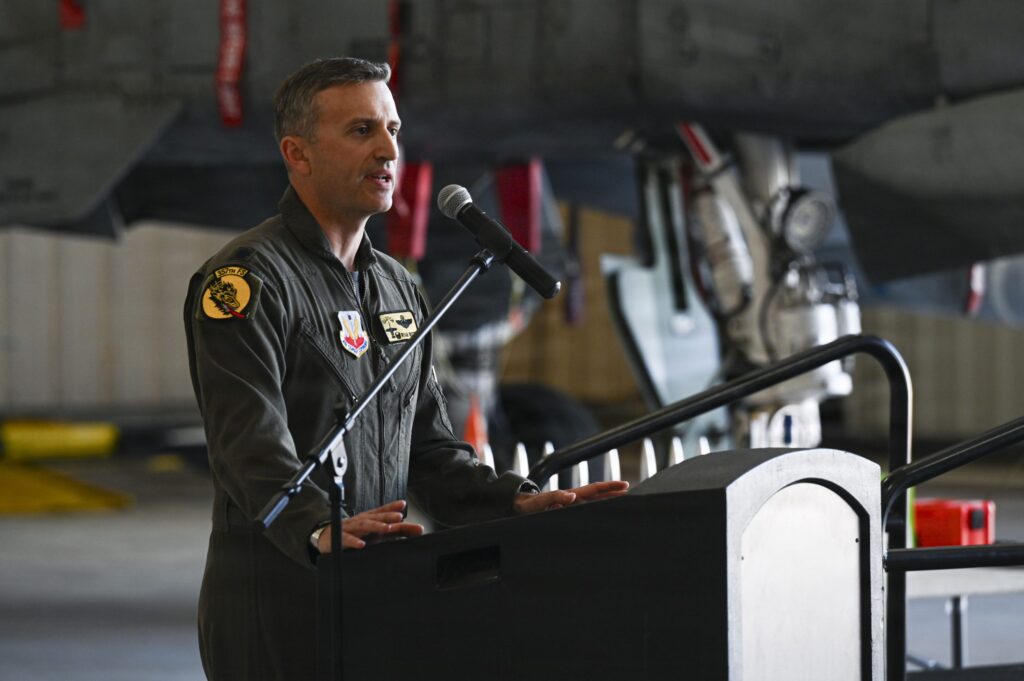
The squadron that qualifies new A-10 pilots for combat duty graduated its last class of students in April, as the US Air Force moves haltingly toward retiring the venerable ground attack fighter.
After years of noise about wanting to retire the Fairchild Republic A-10 fighter, the US Air Force now says it has graduated the last class of pilots assigned to fly the venerable ground-attack jet commonly known as the “Warthog”.
The milestone took place on 3 April at Davis-Monthan AFB in Arizona, home to the 357th Fighter Squadron that conducts Mission Qualification Training (MQT) for new aviators. Upon graduation, MQT-certified A-10 pilots are approved for combat duty as basic wingmen and sent to frontline fighter squadrons.
The MQT course runs six months and covers basic flight qualifications before moving into combat tasks like weapons employment, air-to-ground strikes and providing close-air support to ground troops – including with the A-10’s infamous seven-barreled GAU-8A Avenger cannon.
New pilots begin the syllabus holding only basic fighter jet qualifications in two-seat Northrop T-38Cs; in those jets, students always have an instructor pilot behind them.
“The very first sortie, they’re by themselves in the jet,” says Lieutenant Colonel Ryan Rutter, commander of the 357th Fighter Squadron that manages the A-10 MQT course. “Six months later, they are combat-mission ready, close-air-support pilots, ready to go execute that mission with their operational squadrons.”
In an interview with FlightGlobal, Rutter confirms the MQT class that graduated in April is the last cohort scheduled for the A-10 training pipeline. His squadron is set to wind down training operations in September.
Until then, Rutter and his instructor pilots are temporarily assigned to frontline A-10 squadrons to help train junior pilots, focusing on “building more experience and capacity”, he says.

The US Air Force previously hoped to conclude A-10 operations as soon as 2027, after beginning to retire aircraft in 2023. However, in a surprise move the Pentagon on 21 April said the Warthog will keep flying until at least the end of the decade.
“In consultation with [the Secretary of War], we will extend the A-10 Warthog platform to 2030,” said secretary of the air force Troy Meink. “This preserves combat power as the defence industrial base works to increase combat aircraft production.”
Alongside more modern fighters like Lockheed Martin F-35s and higher-performance strike platforms such as Boeing F-15Es, the USAF has deployed A-10 squadrons to the Middle East in support of combat operations over Iran and the Persian Gulf.
In what is just the latest battlefield evolution for the Cold War-era tank killer, A-10s have seen action hunting Iranian boats in the Strait of Hormuz and shooting down incoming one-way attack drones.
With its low cost-per-flight hour and high weapons payload, A-10s offer a potential solution to the problem posed by cheap, long-range aerial strike weapons like the Iranian Shahed-136 and Russian Geran-2 – which pose the threat of overwhelming continental air defences and exhausting supplies of expensive interceptor missiles.
This year, the USAF even developed a new probe-and-drogue aerial refuelling system for the 50-year-old Warthog, despite the type’s looming retirement.
It is that versatility, and unwavering support from ground troops in the US Army and Marine Corps, that has helped the A-10 stave off numerous attempts at deactivation by air force brass, who have long argued the attack fighter is too old, too expensive to maintain and ill-suited for surviving modern combat.
Those criticisms did not prevent the Pentagon from ordering A-10s into combat over Iranian airspace last month, when a combat search and rescue mission was launched to recover the crew of an F-15E shot down over Iran.
A-10 pilots took on what is known within the USAF as the “Sandy” mission – coordinating the rescue and supporting elements from the cockpit. That included escorting Sikorsky HH-60W combat rescue helicopters and “violently suppressing and engaging the enemy in a close-in gunfight”, said chairman of the US joint chiefs of staff General Dan Caine.
The pilot and weapons systems officer of the downed F-15E were recovered in separate operations.
“It requires very intense training,” says Colonel Kim Campbell, a retired USAF A-10 pilot. “It’s something that you’ve practiced, you’ve rehearsed, you’ve gone through scenarios – worst-case scenarios. These are highly trained A-10 pilots that have worked with the rescue task force to go out and do these missions.”

Campbell is arguably the best-known pilot to fly the Warthog. In 2003, during the US-led invasion of Iraq, her A-10 took heavy damage from a surface-to-air missile during a combat mission over Baghdad.
The jet lost hydraulic systems and left Campbell, who goes by callsign KC, contemplating ejecting over enemy territory. But Campbell engaged the A-10’s back-up mechanical flight control system – called “manual reversion” – and returned to friendly airspace.
She completed what was only the fourth A-10 landing using the mechanical systems, in combat or training, and received the Distinguished Flying Cross for performance under fire.
Years later, that feat elevated Campbell to the position of unofficial advocate for the A-10 community. In a 2023 interview, she told FlightGlobal that the air force keeps finding new uses for the Warthog, even as service leaders have sought to retire it.
“It’s happened over and over again,” she said on 21 April. “I’m an advocate for the airplane and I’m an advocate for the pilots because I think there’s no one better than us at what we do.”
Despite an A-10 affinity, Campbell says more important than keeping the jet flying is ensuring the US military has a platform that can adequately perform combat search and rescue and stand-in close-air support
“I think that’s the missing piece. Right now, there is no replacement and there is no aircraft that is designated for those missions and is training for those missions,” she notes.
Short of a clean-sheet design competition, which would take years to complete, the most likely candidate for an A-10 successor is the armed crop duster being produced by L3Harris for Air Force Special Operations Command.
A militarised version of the Air Tractor AT-802, the sturdy, rugged and low-cost OA-1K SkyRaider II can carry a range of precision and direct-fire weapons. L3Harris is also working to incorporate its Red Wolf long-range cruise missile onto the OA-1K, which is currently in low-rate initial production.
However, the single-engined, light SkyRaider II was designed to provide light-attack support in relatively permissive airspace. While featuring some armour, it has nothing like the titanium “bathtub” that famously encircles the A-10 cockpit – among survivability features that allowed Campbell to safely return from Iraq.
“I don’t think that there’s anything out there right now that is a suitable replacement,” Campbell says.
That includes strike fighters like F-15s and Lockheed Martin F-16s, she adds, noting those types are in heavy demand for other missions. Adding combat search and rescue or dedicated close-air-support to their missions risks over-saturating squadrons.
“You run the risk that there isn’t enough hours to fly all the missions that they’re tasked to do,” Campbell says.

For now at least, those missions are still handled by A-10s.
“I’m thankful to be in this squadron, and at this time, as we push to the end, to make solid A-10 wingmen that will take our mission and our mindset forward into whatever they fly next,” says Lieutenant Colonel Rutter.
Unlike earlier generations, today’s A-10 pilots and maintainers seem unlikely to spend much time with the Warthog. The USAF has already reduced its A-10 fleet from 281 in 2023 to slightly less than 150 today.
“They won’t be A-10 pilots for their entire career,” Rutter notes. “They will most likely have about one operational assignment that they are able to get through.”
Many Warthog pilots have already begun transitioning to other airframes, Rutter says, with a large portion going to fifth-generation F-35A strike fighters. Others are switching to F-15s and F-16s, though that balance may shift with news from the fiscal year 2027 budget draft that the air force plans to double its acquisition of Boeing’s latest F-15EX.
Whether A-10s are finally retired in 2030 or receive another reprieve, Rutter and Campbell stress the criticality of maintaining the skills and knowledge of Warthog pilots within the broader US Air Force fighter community. That includes their expertise in close-air support, combat search and rescue, and forward-air control.
“It’s important to kind of keep the institutional expertise and some of that culture alive,” Rutter says.
Campbell, who spoke at the graduation of the last A-10 MQT class in April alongside her husband and fellow A-10 combat veteran Scott Campbell, recalls their message to the new officers: “Be ready for anything, be prepared for anything. Because you never know when your moment will be.”
As things stand now, the A-10’s final exit will come in 2030. Or maybe not, if powers-that-be in Washington decide again to reverse course and keep the renowned Warthog flying into what could become its sixth decade of service.
For more on this topic, listen to the 27 April episode of the FlightGlobal Focus podcast.
The post US Air Force graduates final class of new A-10 pilots as retirement looms first appeared on FlightGlobal.