


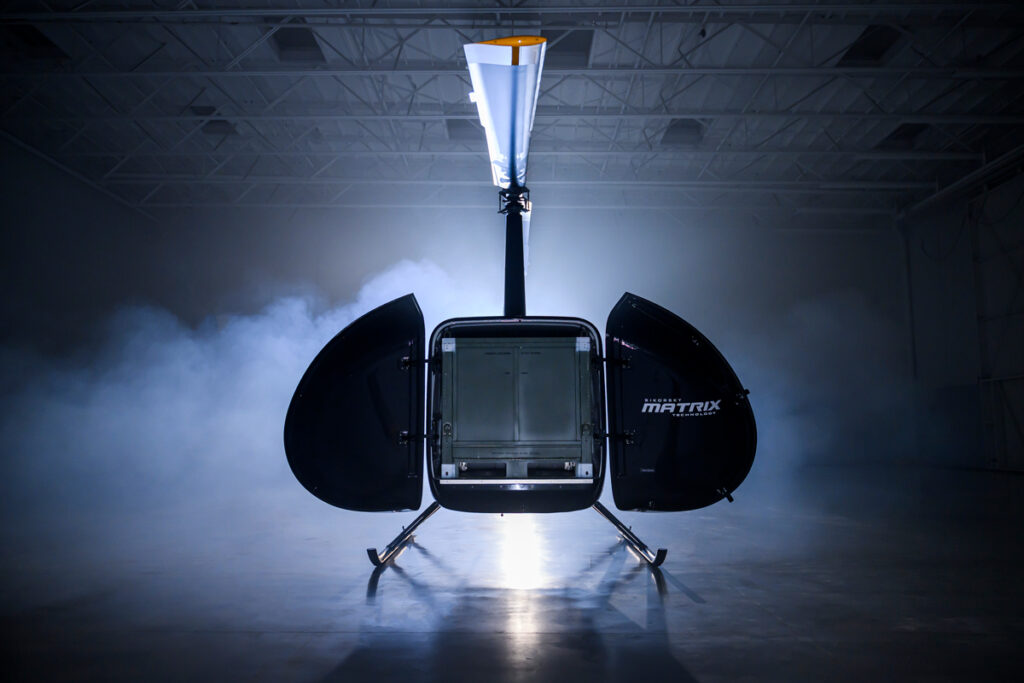
Sikorsky and Robinson Helicopters have secured $15 million to advance their R66 TurbineTruck cargo rotorcraft concept into flight testing.
A new industrial partnership between rotorcraft manufacturers Sikorsky and Robinson Helicopters is already bearing fruit.
In March, Robinson announced the creation of an uncrewed aircraft business unit dubbed Robinson Unmanned. The new division revealed that its first effort will be developing a fully autonomous cargo derivative of Robinson’s popular R66 light-single called the TurbineTruck.
Less than two months after its reveal, the TurbineTruck has been awarded a $15 million contract from the US Marine Corps (USMC), which will support development and flight testing of a prototype aircraft.
“We’re pretty confident that this will offer a tool where more missions are accomplished because they’re not having to weigh the risk of putting soldiers or airmen or Marines at risk on the front lines of moving material,” says David Smith, chief executive of Robinson Helicopters.
Smith adds that the TurbineTruck will significantly reduce the cost of rotary-wing air transport, making the design a strong candidate for civil customers as well.
Sikorsky is acting as prime contractor for the TurbineTruck demonstration to the USMC, which is providing funding for the project under the Medium Aerial Resupply Vehicle – Expeditionary Logistics (MARV-EL) programme.
Requirements for the MARV-EL programme included transporting at least 136kg (300lb) for more than 50nm (92km), with fully autonomous take-off, landing and waypoint navigation. Robinson says the TurbineTruck will offer a useful load exceeding 226kg and range beyond 325nm.
US Naval Air Systems Command, which manages aircraft procurement for the USMC, describes the MARV-EL concept as a “middle-weight unmanned logistics asset, providing combat sustainment to Marines when ground or manned aviation assets are unavailable due to threat, terrain, weather or competing priorities.”
Sikorsky’s Matrix autonomous flight technology is providing that uncrewed capability for the TurbineTruck. First developed for the Sikorsky UH-60 Black Hawk, Matrix allows a conventional rotorcraft to be modified with fly-by-wire flight controls that algorithmic software can then control, using inputs from an array of onboard sensors.
Matrix has logged completely autonomous flights with Sikorsky’s UH-60A Optionally Piloted Vehicle Demonstrator as far back as 2021 and was recently delivered to the US Army aboard the newer UH-60MX “Optimally Piloted” Black Hawk.
Sikorsky has also developed a fully uncrewed, cargo variant of the Black Hawk dubbed the U-Hawk.
Ramsey Bentley, director of strategy and business development for Sikorsky Advanced Programs, says the Lockheed Martin subsidiary worked with Robinson to modify the standard R66 for both Matrix adaption and the cargo logistics mission.
That included increasing the volume of the fuselage, removing the cockpit flight controls and seats, and adding forward opening clamshell doors for loading larger cargo. Bentley describes the TurbineTruck as being a “last mile” logistics platform.
“One of the unique things about… this aircraft is the range and payload capability in a very small package, specifically designed for bringing logistics to the point of need,” the former US Army aviator says.
Smith says the final design is not set in stone, but will continue to evolve based on feedback from the USMC.
“We’ve built the first couple of prototypes exactly as we think the Marine Corps would like to use it in the fielded demonstrations,” the Robinson CEO notes. “It’s great for parcels. It also fits large structures, like complex landing gear systems and wheels.”

The MARV-EL initiative is not an official programme of record, meaning the USMC has not established an acquisition target or fielding timeline. However, the structure of the development effort does allow for the direct purchase of aircraft, should the Marine Corps find a suitable design.
Other contenders include Piasecki with its quadrotor Kargo II design, acquired from Kaman in 2025.
Separate from MARV-EL, the USMC is pursuing a larger solution for ship-to-shore autonomous resupply under the Aerial Logistics Connector (ALC) programme, which is focusing on conventional rotorcraft modified for uncrewed operations.
Sikorsky is also competing on that programme using its OPV Black Hawk, which the company demonstrated for the Marine Corps in 2025.
Arrayed against Sikorsky in the ALC effort is the team of Airbus US, Shield AI, L3Harris and Parry Labs, which together are offering an autonomous derivative of the Airbus UH-72 military utility helicopter dubbed the MQ-72. ShieldAI is providing the pilotless flight capability to that effort with its Hivemind software.
Start-up Near Earth Autonomy was at one point also competing for the ALC contract with a modified Leonardo AW139 design, though the company now declines to say whether it remains involved in the project.
The post Sikorsky and Robinson secure Marine Corps contract for autonomous R66 flight demonstration first appeared on FlightGlobal.