


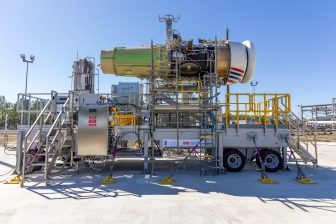
Engine maker hails results of Stennis combustion ground tests using modified business jet engine.
Rolls-Royce is pressing ahead with further research intended to optimise engines for hydrogen combustion, having successfully concluded ground tests of a modified Pearl 15 business jet powerplant running on the alternative fuel.
Disclosed on 29 April, the milestone saw the 16,000lb (71kN)-thrust demonstrator engine, designated GH2, taken through a full flight cycle, including a simulated taxi, take-off power, cruise, reverse thrust and shutdown.
Performed at NASA’s Stennis test facility in Mississippi, the ground runs were the culmination of a four-year project that also involved EasyJet, Tata Consultancy Services and the UK’s Health & Safety Executive.
But, says Adam Newman, chief engineer, hydrogen demonstrator programme at Rolls-Royce, only a modest total run-time was accumulated during the trials.
Rather, thanks to extensive preparatory work and subsystem testing ahead of the full engine run “to improve the fundamental systems”, the team was able to design “quite a neat, compact test programme”.
“We only needed to run it for a few tens of hours; it was really quite a short programme. That was really as a result of all the rig testing and things that had gone on behind it,” he says.
Indeed, with maturity not an aim of the project, the test engine will now be retired.
“That engine is done – we won’t run GH2 again. I think we have learned everything we need to at the moment from an engine-level demonstration,” says Newman.
“There’s clearly a lot to do before that engine [could] become a product; there’s an awful lot of technology still to develop but it’s a really good first step”.
Notable changes over the baseline Pearl 15 – which powers Bombardier Global 5500/6500 business jets – include a modified combustion system, says Newman, with tweaks to the fuel spray nozzles and combustor can.
These “minimal changes” helped maintain commonality with the Pearl 15 “to allow us to do the programme quickly”, he says.
However, rig tests are continuing of “much more novel redesigns of the engine” to further optimise performance, says Newman, for example, assessing whether the current fuel-spray nozzle design is still relevant when using hydrogen.
“The properties of kerosene combustion and hydrogen combustion are quite different and those differences open up some quite interesting design spaces for a future combustor,” he says.
Elsewhere, Rolls-Royce is also studying the potential for a dual-fuel combustor as part of the EU Clean Aviation-funded CAVENDISH project.
Although CAVENDISH did not contribute to the recent Pearl 15 testing with that specific system, Rolls-Royce nonetheless drew on other research from the project to inform its development.
Additional funding and expertise were contributed by the HYEST, RACHEL and LH2GT projects – all backed by the UK’s Aerospace Technology Institute – and WotAn, a project under Germany’s LuFo aviation research programme.

Learnings from two earlier engine demonstrators also informed the latest iteration.
In 2022, as an initial step, Rolls-Royce ran an AE 2100 turboshaft on gaseous hydrogen at Boscombe Down in the UK.
That sought to answer some fundamental questions, says Newman: “Does an engine actually work on hydrogen? Can we manage the ignition, the light up, the starting and shut down?”
Between that demonstrator and the final version was another Pearl 15 – seldom talked about by Rolls-Royce – used to prove that a number of supporting functions could still be performed without the presence of kerosene.
Jet fuel is used as a coolant, as a hydraulic fluid – to move variable stator vanes, for instance – “and for a number of secondary systems on the engine”, he notes.
“It was really important for us to show that we could do those functions in a hydrogen environment as well.”
Waste heat from the oil system was recirculated into the hydrogen, offering “quite a large specific fuel consumption benefit”, while other systems were “completely re-imagined”, he says.
Newman is reluctant to provide details but says Rolls-Royce “came up with some quite novel solutions”.
“I think that’s probably something a lot of people have missed: they go straight to the combustion and forget about a lot of the other things that happen on a gas turbine as well.”
Also underpinning the development effort was a programme of research to “really understand” how the increasingly exotic materials inside a modern jet engine “work in a hydrogen environment”.
That effort helped Rolls-Royce to “make sure we knew what would happen, but also to start building that data set to allow us to think about future designs using those materials.”
Once material limitations are properly understood, he notes, changes to surface finishes or coatings can be applied to improve component durability, aiding any future hydrogen engine development.
“I think if we were to design an engine for the future, we would probably look at subtly different materials and potentially some different coatings,” he adds.
Overall, the Stennis test runs went “better than expected”, says Newman, allowing sufficient time to “do additional experiments”, such as analysing failure sequences and “understanding whether some of the protection systems we put on the engine worked as we expected”.
Critically, perhaps, given the uncertainty around hydrogen’s role as a future aviation fuel, Newman maintains that many of the insights gained from the programme were “fuel agnostic” and could be equally applied to any future engine, such as its UltraFan concept.
Lessons learned include “how we have delivered the programme”, the speed at which “we have built a fundamental understanding of the new architecture and approach” and the development of novel thermal management techniques.
“Those things could be equally applicable to a kerosene engine,” he adds.
What has been unclear though, is what EasyJet brought to the project. While cynics could point to the potential CSR benefits for the airline through having its name attached to the work, did it make any meaningful contribution? Newman believes so.
“What’s been really great about working with EasyJet is understanding how a new hydrogen aircraft might feature in their fleet and what’s important to them,” he says, pointing to operational considerations like turnaround times and maintainability.
“It’s been a really interesting opportunity to see when you are laying out these architectures on a clean sheet of paper what design choices you can make to improve the experience for future operators.”
The post Rolls-Royce still eyeing hydrogen as it praises Pearl’s polished performance first appeared on FlightGlobal.