



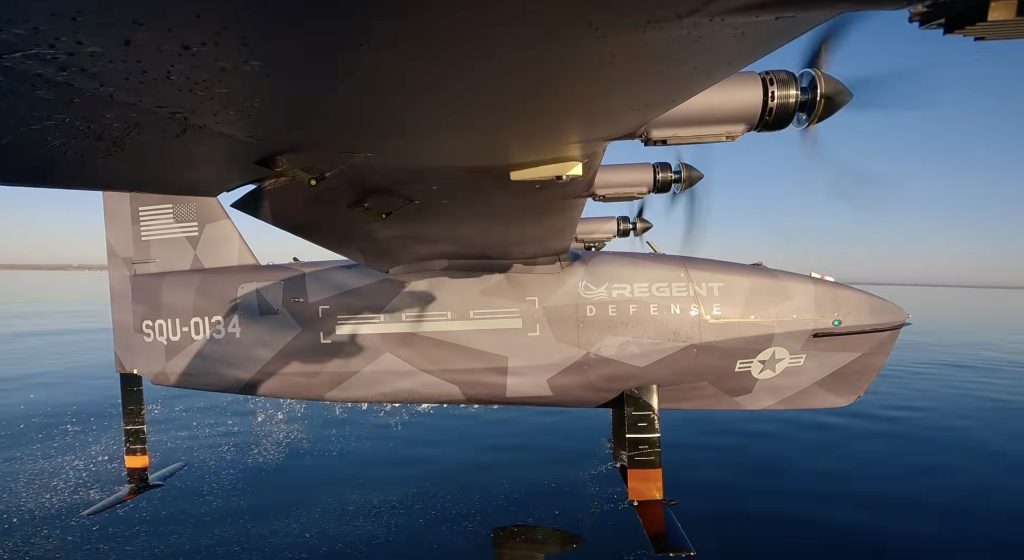
The ground-effect vehicle can reach speeds of 70kt with a range exceeding 100nm and a 22kg payload, start-up says.
American start-up Regent Craft demonstrated an uncrewed military variant of the company’s seaglider vehicle in recent Pentagon drone exercises.
Regent is best known as the developer of the Viceroy – a crewed passenger craft that can float while stationary and uses ground effect to take off and skim just above the surface of the water. The company has been pitching the seaglider concept to the US Navy and Marine Corps as a high-speed, low-cost logistics platform.
The company has developed an uncrewed, scaled-down version of the Viceroy dubbed the Squire, which Regent, on 18 August, said participated in a recent US Navy exercise dubbed “Silent Swarm”.
The navy described the two-week event, held on the shores of Lake Michigan in July, as an experiment with early-development electronic warfare (EW) capabilities able to be deployed by uncrewed systems.

Regent brought Squire, using the autonomous seaglider as a means of deploying multiple EW payloads, including electronic attack and protection.
“Silent Swarm gave us the chance to show key defence stakeholders exactly what our autonomous seaglider drone, Squire, can do in an operationally relevant setting,” says Regent chief executive Billy Thalheimer. “This demonstration proves Squire is ready to deliver the capability our warfighters urgently need.”
The Squire design features a 4m (13ft)-long fuselage with a 5.5m high wing that carries eight electrically driven propellers and two outboard pontoon floats. Retractable foils allow the seaglider to transition from floating on its hull to low-altitude ground-effect flight via a three-stage process.
Regent says the Squire is capable of cruising at 70kt (130km/h) with a 100nm (185km) range and a 22kg (50lb) useful payload. The company logged its first flight with the Squire in April 2026.
The larger Viceroy design uses a similar outer mould shape but with an extra motor on each wing and the option of both crewed and autonomous operations. With the extra propulsion and a larger 20m wingspan and 16.5m length, each Viceroy will have a substantially improved payload of 1,590kg for either cargo or passengers.

Regent lists a top speed of 160kt and range of 1,400nm for the Viceroy, although this likely varies as the craft is available in both hybrid-electric and fully electric versions.
Like other advanced air mobility companies, Regent has been courting defence business as a way of securing near-term revenue while the commercial market for novel transportation technologies develops. On the civil side, Rhode Island-based Regent is targeting ship-based ferry operators as potential early customers.
The company received a $4.75 million contract from the US Marine Corps in 2023 to develop the seaglider concept. A subsequent round of funding valued at $10 million covered operational testing, completed in November 2025, for casualty evacuation and search and rescue missions.
Defence giant Lockheed Martin has also taken a financial stake in Regent.
In October 2025 Regent’s Viceroy prototype was damaged during hydrofoil stress testing off the coast of Rhode Island.
The company resumed Viceroy testing in March 2026.
Regent has a 23,600sq m (255,000sq ft) manufacturing facility in Rhode Island where it plans to assemble commercial seaglider vessels, with the first delivery expected in 2027.
The post Regent demonstrates Squire autonomous seaglider at US Navy drone event first appeared on FlightGlobal.