


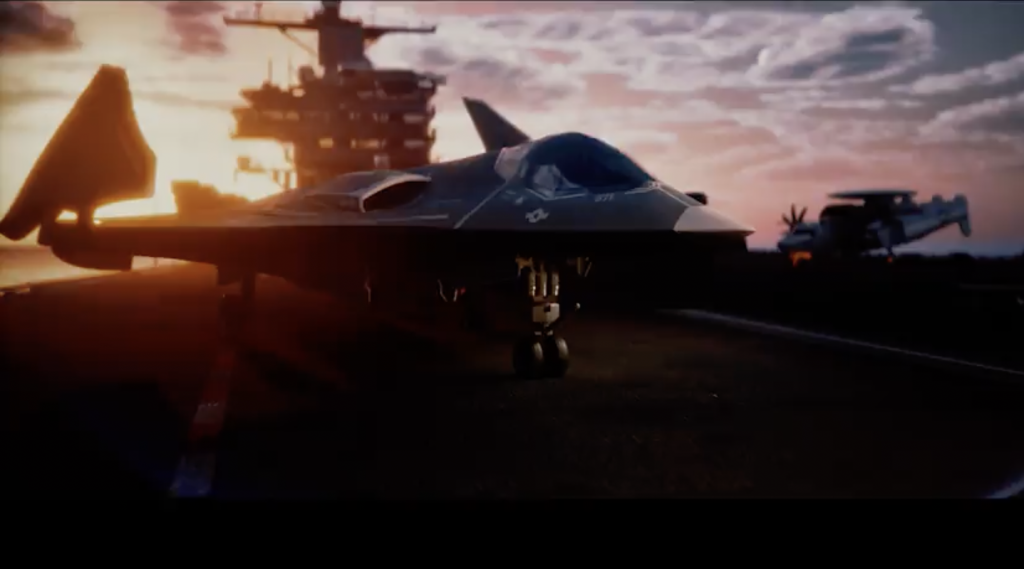
US secretary of defense Pete Hegseth says a contract decision for the US Navy’s F/A-XX Next Generation Fighter is planned for August.
The top defence official in Washington has affirmed the Pentagon’s commitment to fielding a carrier-based sixth-generation fighter.
Speaking during a congressional committee hearing on 29 April, US secretary of defense Pete Hegseth said the navy will move forward with the Next Generation Fighter programme, despite recent efforts by the Trump Administration to cut funding.
“It’s not a matter of if, it’s a matter of when,” Hegseth says. “It’s a critical capability that we need to fund for the future of naval aviation.”
The Pentagon chief confirms the US Navy plans to announce a contract decision around August of this year.
But that does not mean the new fighter will be coming to aircraft carrier flight decks anytime soon.
More commonly known as F/A-XX, the Next Generation Fighter (NGF) is envisioned as a replacement to the US Navy’s large but ageing fleet of more than 470 Boeing F/A-18E/F Super Hornet fourth-generation strike fighters.
Those twin-engined carrier-launched fighters are expected to fly for several more decades alongside a smaller number of fifth-generation Lockheed Martin F-35Cs, with Boeing expecting to deliver new Super Hornets until 2027.
However, the oldest examples have already been flying for 30 years, leading the navy to pursue the F/A-XX successor.
Thus far, the acquisition has been anything but smooth.
While the US Air Force’s F-47 Next Generation Air Dominance fighter has powered through vendor selection and the start of engineering design over the past year, the navy programme has languished.
After awarding Boeing the F-47 contract in March 2025, the air force now projects a first flight of its sixth-generation fighter by 2028. The navy, by contrast, has repeatedly delayed final design and vendor selection for the F/A-XX, missing its own deadlines.

Meanwhile the Trump Administration has moved to drastically slash the budget for F/A-XX development, with officials in Washington saying they want to priortise the land-based F-47.
That effort began with the fiscal year 2026 US defence spending plan, which one Pentagon budget official described to FlightGlobal as being “all in” on the F-47.
The defence official said the goal was to provide enough financial support for the navy to make source selection for the Next Generation Fighter, but not necessarily to advance the programme into production.
The reason for that approach was given as concern about the ability of the US aerospace industry to support simultaneous development of two sixth-generation fighters.
“Our belief [is] that the industrial base can only handle going fast on one programme at this time, and the presidential priority [is] to go all-in on F-47 and get that programme right while maintaining the option for F/A-XX in the future,” the Pentagon official said at the time.
Nearly a year later, that view does not seem to have significantly changed.
“It’s a matter of trade offs in industry and design and capabilities, [and] ensuring we’re not slowing other things down at the behest of others,” Hegseth said on 29 April.
Industry leaders have pushed back on that stance, arguing they can accommodate both programmes without issue.
Steve Parker, chief executive of Boeing Defense, Space & Security, says his company alone could handle both the F-47 and F/A-XX.
“Can Boeing do both? Absolutely,” Parker said at the 2025 Paris air show last June.
Boeing is among presumptive finalists for the highly classified NGF contract, alongside Northrop Grumman. The Pentagon eliminated Lockheed Martin from the competition in early 2025.
Both Northrop and Boeing are already engaged in notable advanced development programmes – Boeing with the F-47 and Northrop with the US Air Force’s B-21 Raider long-range stealth bomber.
Neither company appears daunted by the prospect of additional work. Northrop recently shared a rendering of a carrier-based sixth-generation fighter that is presumed but not confirmed to be connected with its F/A-XX design.
“We’re ready to close the distance of next-gen naval aviation with unmatched speed and capacity,” the company says.
Boeing has also shared multiple renderings of carrier-based sixth-generation fighter designs over the years.

While the navy appears to be inching toward a decision on an F/A-XX vendor, the Pentagon’s affirmation of an August source selection does not walk back the Pentagon’s previous stance of prioritising the F-47 while slow-walking a new naval fighter.
The Trump Administration continues to pour resources into the air force programme, requesting $5 billion for the F-47 project in the fiscal year 2027 budget request sent to the US Congress at the start of April. That is atop the $3.4 billion allocated for the effort in FY2026.
By contrast, the Trump Administration only requested around $214 million for the F/A-XX for that same two-year period.
Lawmakers overruled that spending proposal in FY2026 and instead steered nearly $1.7 billion toward the F/A-XX programme.
The post Pentagon chief affirms commitment to fielding sixth-generation naval fighter first appeared on FlightGlobal.