

The Czech company is on full thrust, thanks to a decision it made 25 years ago to focus on the emerging uncrewed air vehicle market.
PBS reckons its early decision to get into drone propulsion has given it a head start on its competitors, including major players in the defence market. The Czech engine manufacturer – which traces its roots as an engineering company to the mid-1800s – spotted the opportunity in uncrewed technologies around the turn of this century and began developing the compact powerplants the company has become known for.
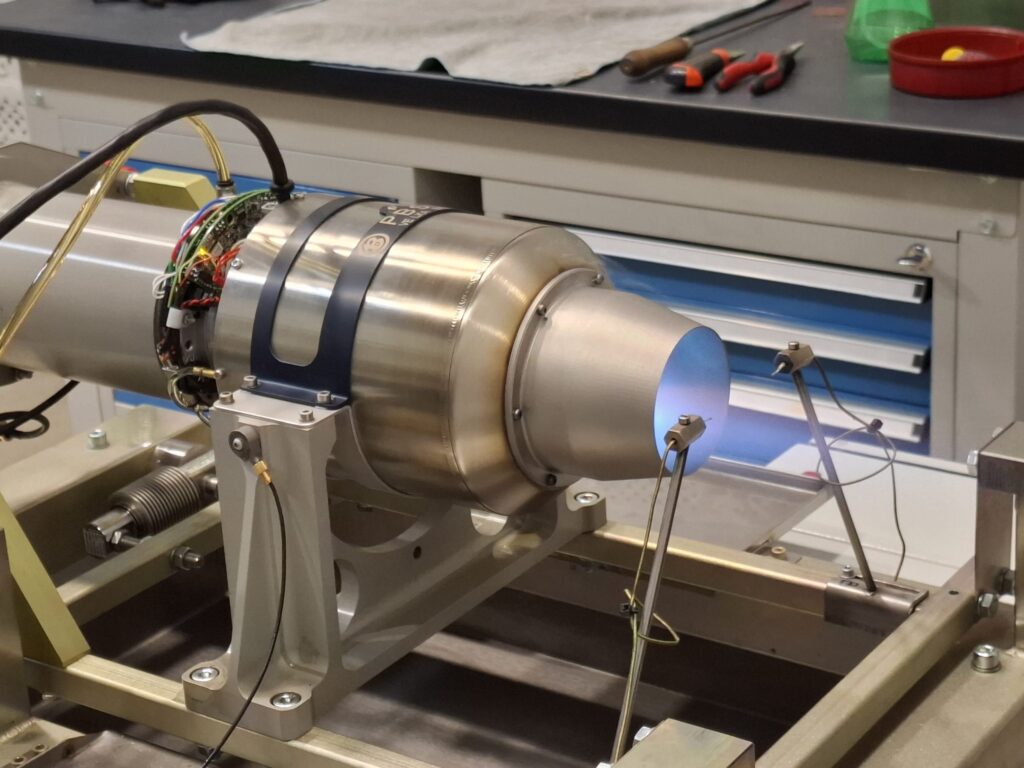
Since unveiling its first engine in 2003, the 281lbf (1,250N) TJ100 – a compact turbojet for uncrewed air vehicles, light experimental aircraft, and target drones – the firm, based in Velka Bites near Brno, has made rapid progress. It followed the TJ100 with a series of other products, including its latest, the TJ200. Last year, it produced 1,500 engines and that total is set to reach 2,000 in 2026, says Milan Macholan, chief executive of PBS’s Czech operation.
The 512lbf TJ200, revealed at last year’s Paris air show and aimed at high-speed platforms, is PBS’s most powerful engine yet. It joins the TJ40, TJ80, TJ100 and TJ150 in the company’s portfolio and, according to PBS, “represents a new performance category”. Features include full-authority digital engine control and resistance to seawater, making it suitable for naval deployment.
Many aerospace firms enjoyed a post-Covid bounce. For PBS its growth over the past four years has been stellar, with an almost sixfold increase in engine output. In April this year, it reached a major milestone with the production of its 2,000th TJ100. Aerospace represents about four-fifths of the business and this year it expects revenues to reach CZK3.7 billion ($170 million), up from CZK2.7 billion last year, with 80% of its output for export.

PBS attributes its success to that early decision to bet on a burgeoning drone market and to go on investing in equipment and infrastructure. While the Velka Bites site – complete with redundant industrial chimney – dates from the early Cold War era, the production floors brim with expensive, new milling and cutting machines. An under-construction hall will double production capacity at the Czech facility next year to almost 4,000 units.
Coupled with output from a US factory opened last year in the Atlanta suburb of Roswell and geared to the stateside market, total production could reach five figures within three or four years, says Macholan. Beyond small engines, there have been significant recent deals with Lockheed Martin to produce components for the fighter, and with Pratt & Whitney to develop an auxiliary power unit for future platforms.
The latter, announced in September at an event attended by two Czech government ministers, illustrates PBS’s growing stature as a partner to some of the industry’s biggest names. Macholan says PBS is one of only four companies in the world – alongside Honeywell, Safran and the RTX subsidiary itself – able to develop and certificate APUs from scratch. He expects work on a prototype to take two years, with production at Velka Bites.
The Lockheed Martin contract – tied to Prague’s order for F-35s and originally flagged in 2024 before being confirmed in March – will see PBS lead a consortium of Czech companies to design a replacement for a fuel system component. “The intention is to become part of the Lockheed Martin supply chain,” says Macholan. “It was a big step up for us as Lockheed Martin did a full audit of the business, including security compliance as well as capability.”
PBS – whose products have seen action in the Ukraine conflict – is also working with that country’s Ivchenko-Progress to develop a new engine called the AI-PBS-350 for unmanned vehicle applications including cruise and anti-ship missiles. It follows a memorandum of understanding signed between the two companies in 2023. PBS is also supplying its TJ100 to European missile house MBDA for its in-development Crossbow one-way effector.

Growing demand from the USA prompted the decision by PBS’s owner for the past 20 years, William Didden, to invest $20 million in the Roswell plant, which came on line in September. The move will make it easier for the company to produce International Traffic in Arms Regulations (ITAR)-compliant engines, as well as shortening lead times for US customers, says Macholan. Meanwhile, Velka Bites will focus on ITAR-free products for other markets.
Macholan is proud of PBS’s patented technology and other intellectual property, which resides with the Czech business and includes an in-built starter generator and salt water resistance that allows target drones shot down over water in particular to be recovered and recycled. The Velka Bites operation is also highly vertically integrated with production, testing, and customer support “all under one roof”.
With the Czech factory at near-capacity through 2027, even with the new production hall, and the US facility also ramping up fast, PBS is now taking orders for 2028 delivery, notes Macholan. Beyond that, the future looks assured for the Czech manufacturer. “We have 25 years’ experience in UAVs and we are making improvements in our product line-up all the time,” he says. “No one can match that.
The post PBS: the small-engine manufacturer with big dreams first appeared on FlightGlobal.