

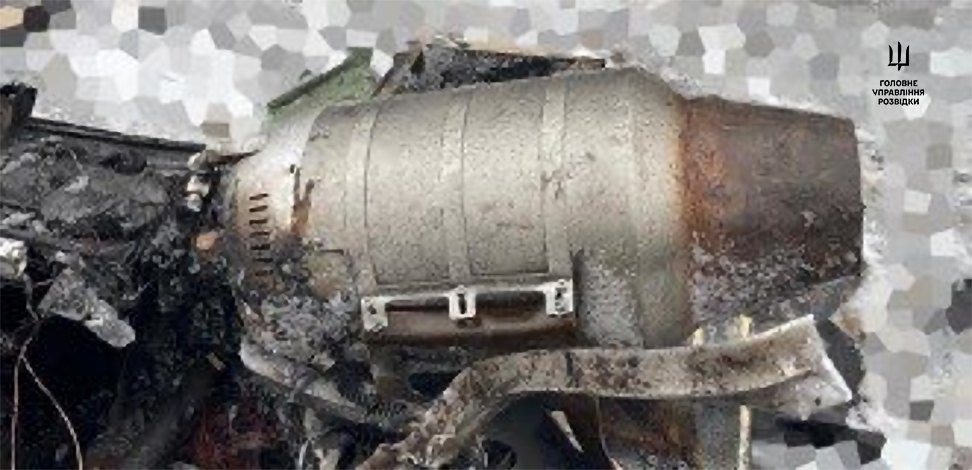
A captured Geran-4 one-way attack drone is confirmed to have Telefly TF-TJ2000A engines.
Some of Russia’s new high-performance attack drones are powered by Chinese jet engines.
A captured Geran-4 one-way attack system was found to contain a single turbojet engine from Chinese manufacturer Telefly when the kamikaze drone was dissected by the US government-backed news outlet Radio Free Europe/Radio Liberty.
The powerplant appears to be one of Telefly’s TF-TJ2000A turbojets, which generates 440lbf/1.96kN of thrust.
The finding backs up claims made by the Ukrainian government in May, when the Geran-4 entered widespread frontline use.
“The deployment of two types of turbojet engines has been observed in the Geran-4 UAVs: the discontinued Chinese Telefly LX-WP-160 engine and… the Telefly TF-TJ2000A,” Ukraine’s Defence Intelligence agency said in a 25 May brief.
Radio Free Europe says the turbojets found on Geran attack drones are a mix of Chinese-assembled engines and powerplants of the same design, but assembled inside Russia using Chinese-sourced components.
The news outlet also found numerous Western components aboard the Russian drone, including a circuit board made by US manufacturer Texas Instruments. That backs up claims made by the Ukrainian government, whose War Sanctions database lists the Geran-4 as carrying parts from American, Chinese, Swiss, British, German, Japanese and Taiwanese firms.

The Geran-4 is an improved version of Russia’s Geran-2, which is itself derived from Iran’s Shahed 136 – the weapon largely credited with spearheading the one-way-attack-drone concept that has disrupted conventional military approaches to long-range strike and air defence.
Washington even developed its own Shahed knockoff, which the Pentagon has dubbed the Low-cost Uncrewed Combat Attack System, or LUCAS.
While the Shahed 136, Geran-2 and LUCAS all use small propeller-driven piston engines, Russia upgraded to much faster and more-manoeuvrable jet propulsion with subsequent Geran models.
The Geran-3 featured the same airframe as the Geran-2, but augmented with a Telefly JT80 turbojet engine. This proved to be unworkable, with the strength of the original aerostructure “insufficient for high-speed flights and even less so for manoeuvring under high g-loads”, Ukrainian intelligence says.
The redesigned Geran-4 offers improved aerodynamic efficiency and a reinforced structure to enable jet-powered flight. A larger Geran-5 model, also powered by the TJ2000A, departed from the delta-wing shape of most other one-way attack systems, opting for an outer mould that resembles a traditional cruise missile.

Russia’s change to jet-powered attack drones is significant.
With a flight speed of around 270kt (500km/h), the Geran-4 is significantly faster than the Geran-2/Shahed 136, which have a rough cruising speed of around 100kt. That extra velocity helps the Geran-4 evade Ukrainian interceptor systems used to shoot down one-way attack drones.
Jet propulsion also gives the Geran-4 a significantly higher flight ceiling.
Radio Free Europe says the turbojet-powered drone can ascend higher than 26,000ft – roughly double the ceiling of propeller-driven models. Ukrainian intelligence reported a more modest 16,000ft ceiling in May, although more recent observations may have invalidated that figure.
There is one realm in which the jet-powered Geran may have less performance.
The Geran-4’s maximum documented range is just over 700km, compared to one-way flights as far as 2,500km for the Shahed 136 and Geran-2, according to the US-based Center for Strategic and International Studies (CSIS).
Russia is producing thousands of Geran attack systems monthly from a factory in Yelabuga in Tatarstan, some 620 miles (990km) east of Moscow. In March, CSIS said the plant was churning out more than 5,550 Geran drones each month.
As many as 3,000 Geran-4s and -5s are being produced monthly at Yelabuga and other drone assembly sites, according to Ukrainian military intelligence.
The post New Russian attack drones found to use Chinese turbojet engines first appeared on FlightGlobal.