


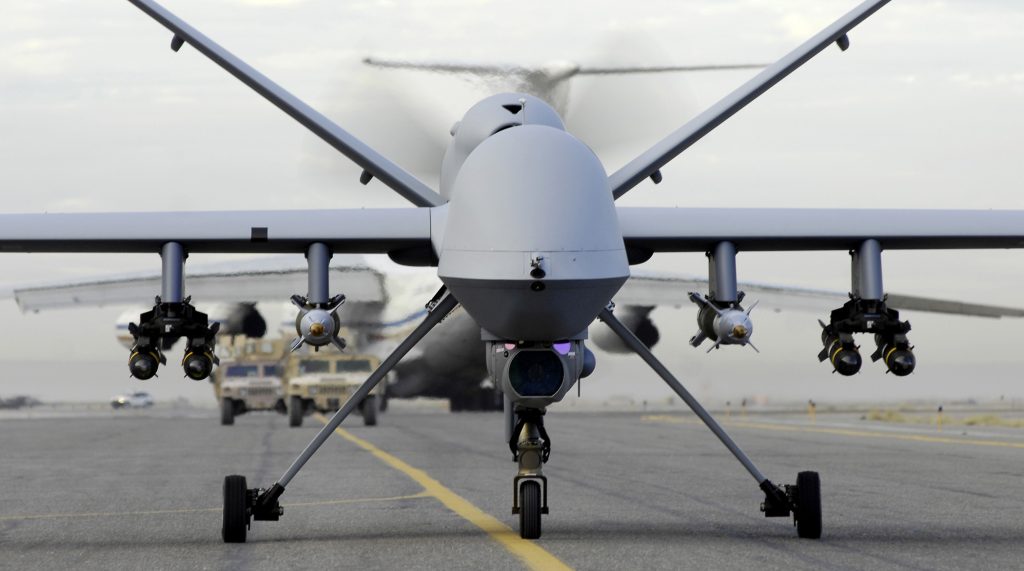
The tally includes 24 MQ-9A Reaper drones, seven KC-135 tankers and several fighter types.
The US military lost or suffered significant damage to 42 aircraft during the aerial bombing campaign against Iran, which is currently in a tenuous ceasefire.
Since Operation Epic Fury began in late February, the US Air Force has absorbed significant combat losses across a range of fixed- and rotary-wing aircraft. While many incidents were previously reported, the full scope of the impact was laid out in a report from the US Congressional Research Service released on 13 May.
Though the document in some cases cites media reports rather than Pentagon statements, it represents the first government source to quantify losses on platforms like the General Atomics MQ-9A Reaper UAS, Boeing KC-135 Stratotanker refuelling jets, Sikorsky HH-60W combat rescue helicopter and Northrop Grumman MQ-4C maritime patrol UAS.
“The number of aircraft damaged or destroyed may remain subject to revision due to multiple factors, which may include classification, ongoing combat activity and attribution,” the CRS report notes.
Other platforms with previously confirmed attrition figures include the Boeing F-15E, Fairchild Republic A-10C and Lockheed Martin F-35A fighters; the Boeing E-3 Sentry airborne warning and control (AWACS) aircraft; and the Lockheed Martin MC-130J special operations transport.
The uncrewed MQ-9A absorbed the most losses, with 24 aircraft downed in combat throughout six weeks of operations. Though the lack of a human onboard makes the MQ-9A well-suited for riskier ISR or strike missions in defended airspace, the remotely piloted aircraft is far from what the Pentagon typically considers “attritable”.
Each MQ-9A cost more than $56 million in 2021 dollar values, according to the US Naval Air Systems Command. That is only slightly less than the cost of new-build Boeing F/A-18E/F or Lockheed Martin F-16 Block 70/72 fighters.
LIMITED REPLACEMENTS
Notably, a lack of new orders from the US Air Force led General Atomics to shutter the MQ-9A production line in 2025. Although the company continues producing MQ-9Bs, General Atomics says there are limited options for directly replacing MQ-9As lost in combat.
“Right now, there are parts for about five brand new Reapers in the warehouse,” says C Mark Brinkely, senior communications director for General Atomics Aeronautical Systems. “We also have some number of company-owned Reapers that we’ve offered to give up, so that’s less than 10 total.”
Brinkely notes the closure of the Reaper production line “was not a General Atomics decision”.
“We argued against that and lost,” he adds.
The 24 MQ-9As lost does not include those lost during Washington’s 2025 air operation against Houthi militants in Yemen. The US Air Force is now looking for options to succeed the Reaper, with a focus on a platform cheap enough to be considered attritable.

Other aircraft lost during Operation Epic Fury are also permanently reducing fleet size.
One E-3 AWACS was destroyed on the ground by an Iranian strike, with no immediate replacement available. Though the Pentagon now says it will pursue fielding Boeing’s E-7A Wedgetail successor, covering two prototypes and five operational jets, those aircraft are years from delivery.
The loss of an E-3 is specifically flagged by the CRS as a numerically limited asset that could “create capability gaps or increase risk in other theaters”.
Seven Boeing KC-135 Stratotankers have been lost as a result of the Iran war, according to the CRS report, citing official statements and unofficial media reports.
US Central Command confirmed the destruction of one Stratotanker and significant damage to another during a mid-air collision over Iraq while providing air refuelling support to the bombing campaign. That incident resulted in six US Air Force fatalities.
Another five KC-135 jets were destroyed on the ground by the same strike that hit the E-3, with the CRS citing news reports. The legislative service notes that the Department of Defense (DoD) has not confirmed some of the cases.
“It is unclear whether DoD has provided Congress an accounting of the aircraft lost in [Operation Epic Fury],” the report notes.
One indicator that combat losses are taking a toll on the tanker fleet is a move by the US Air Force to begin restoring mothballed KC-135s to active service in the weeks since the Iran war began. A retired Stratotanker was moved from the Davis-Monthan AFB “boneyard” in the first week of April to a depot maintenance facility at Tinker AFB that specialises in restoring aircraft to flight status.
The USAF has also suffered some notable, though previously identified, fighter losses.
A single F-35A was damaged over Iran after being struck by a guided munition that some unverified reports described as a type of loitering anti-aircraft munition using thermal infrared tracking. The Pentagon has previously said the pilot landed the damaged jet in friendly territory.
Four F-15Es have also been shot down, including three accidentally targeted early in the war by Kuwaiti ground-based air defences. A fourth jet was shot down inside Iranian airspace, with the resulting ejection triggering a massive multi-day combat search and rescue mission that led to additional aircraft losses.
Most notably, one A-10C attack jet was catastrophically damaged over Iran during the recovery, with the pilot later ejecting over friendly airspace. One HH-60W rescue helicopter was damaged but not destroyed.
Also, two MC-130J tactical transports were intentionally destroyed on the ground inside Iran after being abandoned by US commandos sent in to rescue one of the downed F-15E officers. American officials say the transports became mired in soft sand and were obliterated to prevent them from falling into enemy hands.
The CRS report makes no mention of the Boeing M/AH-6 Little Bird helicopters carried inside the MC-130Js. Images released by Iranian media indicate at least one of the small rotorcraft was among the wreckage.
The US Navy also lost an MQ-4C naval reconnaissance drone in what the CRS report describes as a mishap rather than enemy action.

In assessing the nearly four dozen aircraft destroyed in the Iran war, the legislative research service identifies both challenges and opportunities.
While the loss of out-of-production aircraft like E-3s and MQ-9As will create short-term constraints, such attrition can help Pentagon planners better assess the effectiveness of their own systems and make strategic changes.
“Reported losses may provide insights into the survivability of US aircraft in contested environments,” the CRS notes. “Congress may assess whether reported losses reflect changes in the threat environment or in adversary capabilities.”
The White House and the Pentagon are already preparing a supplemental budget request to cover the cost of replenishing combat losses and munition expenditures.
Acting Pentagon comptroller Jules W Hurst says current estimates put the cost of Operation Epic Fury at $29 billion, with the bulk of that figure attributed to replacement of precision munitions and lost equipment.
The post More than 40 US aircraft lost during Iran air campaign combat: report first appeared on FlightGlobal.