


Military expenditure rises, but MoD also announces “hard but necessary decisions”.
The UK Ministry of Defence (MoD) has published its long-awaited Defence Investment Plan (DIP), committing fresh funding to the Global Combat Air Programme (GCAP) and confirming a previously announced plan to buy 12 Lockheed Martin F-35As, but also detailing a series of new platform cuts.
Released on 30 June, following months of delay caused by funding disputes, the document also commits London to making major new investments in uncrewed system technologies.
The announcement of an £8.6 billion (almost $11.4 billion) allocation for GCAP over the next four years was made on the same day that existing funding with development authority Edgewing was due to conclude. The programme will deliver an operational sixth-generation fighter for use by the air forces of Italy, Japan and the UK from 2035.
“We will sign the next international contract shortly and continue our significant investment in R&D, design and capabilities for GCAP and the wider FCAS [Future Combat Air System],” the document states.
An amended contract will see the UK’s next batch of F-35s split between 15 B-model short take-off and vertical landing examples – a type already in service with the Royal Air Force (RAF) and Royal Navy – and a dozen A-variant examples.
To enter service “in the early 2030s”, those conventional take-off and landing fighters will be able to carry nuclear bombs, and are to reinstate the UK’s commitment to NATO’s dual-capable aircraft mission.
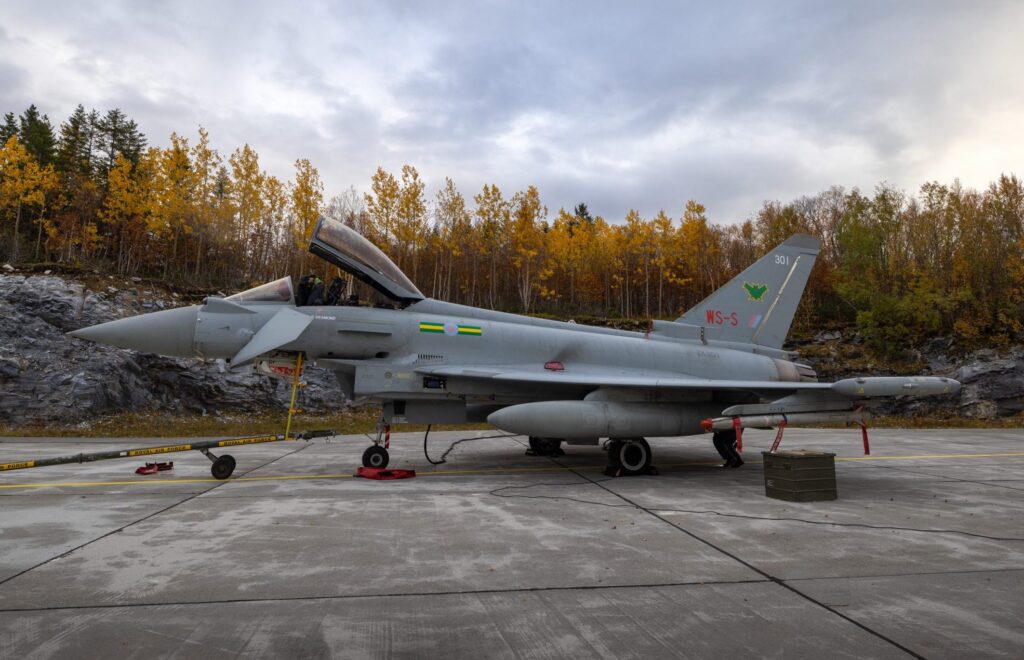
Meanwhile, a £1.1 billion allocation will “upgrade and sustain” the RAF’s fleet of Eurofighter Typhoons, extending the type’s use “into the 2040s”.
Including a formal commitment to the multinational programme’s Long Term Evolution activity, the step “will provide the UK and NATO with critical air and missile defence capabilities essential for effective control of the air, and will sustain the UK’s aerospace sector, supporting both exports and jobs”, the DIP says.

The plan also commits £300 million to demonstrating a UK collaborative combat aircraft (CCA) capability before 2030. It describes such assets as “autonomous fighter jets”.
“These will expand sensor coverage, carry extra missiles, and push far ahead of the crewed air component, to enhance survivability and lethality. Our CCAs will exploit a sovereign, world-leading propulsion system,” it adds.
While a demonstration campaign is expected to take place late this decade, the MoD notes that it is “seeking to accelerate an operational capability as soon as possible”.
It says it will be “working with industry and leveraging the technology and expertise being developed between GCAP partner nations to ensure that we stay at the leading edge of this emerging frontier”.
CCA platforms also are expected to “play a key role in IAMD [integrated air and missile defence]” activities for the UK in the future, the report notes.
Elsewhere, the DIP refers to the planned “development of a hybrid carrier air wing, including trialling jet-powered drones to work alongside our F-35B force”, via a roughly £240 million effort named Project Pantheon. That also will see “early trials of jet-powered drones to work alongside the F-35B force under Project Vanquish,” it adds.
An allocation of £360 million has been made to cover “full recapitalisation of the jet training system, to deliver both sovereign and international training and with a significant UK workshare”.
“By choosing to embrace new technology, I am equipping our troops with the autonomous systems which will give them the edge on the battlefield,” says defence secretary Dan Jarvis.
“We [also] will have new jets for the Red Arrows to replace the ageing Hawk aircraft,” the plan says, referring to the need to re-equip the RAF’s aerobatic display team.
But as well as detailing its future spending plans, the MoD has taken what it calls “hard but necessary decisions” relating to the removal from use of some current capabilities.

To enable purchases of already-ordered new Boeing CH-47F Chinook transport helicopters and Leonardo Helicopters AW149s, along with investments in the British Army’s uncrewed Nyx and Corvus programmes, it has announced “the phased early retirement of [Leonardo] Wildcat battlefield reconnaissance helicopters from 2027 and the oldest Chinooks as they reach maintenance milestones”.
Similarly, the RAF’s fleet of Raytheon UK-provided Shadow R1 intelligence, surveillance and reconnaissance aircraft will also be retired. The decision follows the previous cancellation of a major modernisation programme for the Beechcraft King Air 350CER-based twin-turboprops.
The MoD had originally intended to release the DIP within months of publishing its Strategic Defence Review in June 2025. The newly issued document sets the MoD’s total spending until the end of this decade at £298 billion, following the recent addition of an extra £15 billion.
The military’s annual allocation will be worth £74 billion in 2027, rising to £80 billion 2029. The latter figure is estimated to represent 2.7% of the nation’s gross domestic product – its spending currently equates to 2.5% and will grow further to 3% “during the next parliament”, the UK government says.
The post Lucky DIP – the winners and losers as UK releases delayed defence spending plan first appeared on FlightGlobal.