


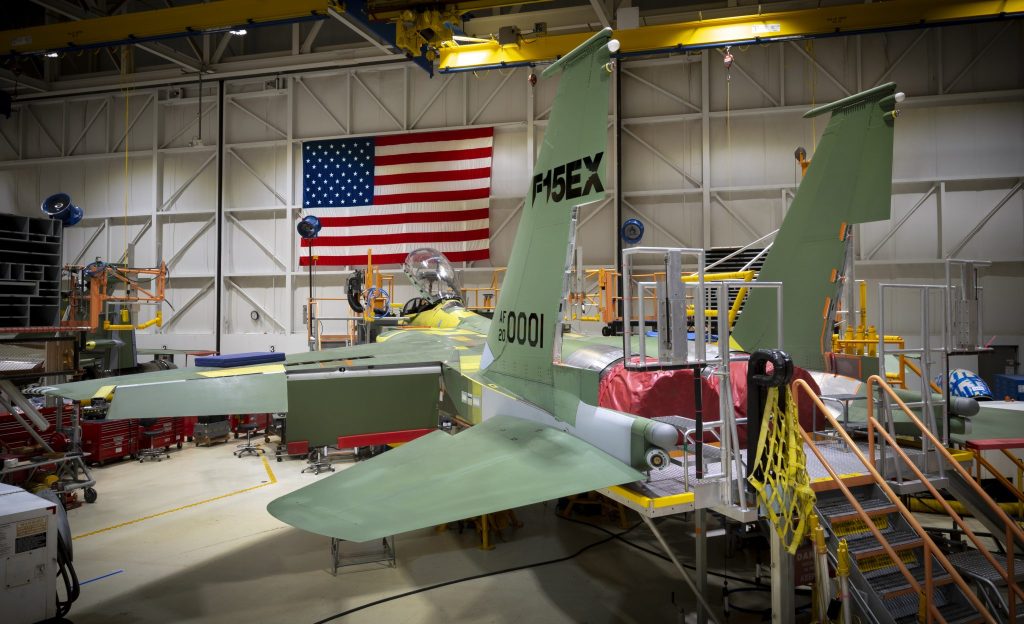
The US Air Force’s most recent funding request covers the purchase of 24 F-15EX fighters in both 2027 and 2028, meeting Boeing’s near-term goal of increasing production to two aircraft monthly.
The US Air Force wants to significantly expand its purchases of F-15EX Eagle II fighters from Boeing.
The Pentagon’s latest budget request for the air force would more than double the planned procurement of F-15EX strike fighters to 268 examples — moving Boeing to full-rate production of the revamped Cold War jet in the next year.
Boeing has a long-established goal of ramping F-15EX deliveries to two monthly, or 24 jets annually. For several years that outcome was uncertain, as the US Air Force’s acquisition plans fluctuated drastically.
The air force at one point cut its original procurement target of 144 aircraft to 80, then revised the figure up to 104.
The Pentagon’s fiscal year 2027 budget request would surge F-15EX acquisitions to as many as 268 aircraft, including Lot 1 test aircraft and 21 jets funded under the FY2025 one-time budget reconciliation package known as the One Big Beautiful Bill.
Current plans, which require Congressional approval, call for buying 24 jets annually in 2027 and 2028, bringing Boeing to full-rate production at its St. Louis, Missouri assembly line.
Boeing confirms to FlightGlobal it is working to expand production capacity to meet that target. Most of the company’s defence manufacturing apparatus, including fighter assembly, was shuttered for three months last year by a machinist strike.
Notably, FY2027 budget projections suggest Boeing could soon expand F-15EX production beyond 24 aircraft annually. The spending request submitted by the air force calls for purchasing 28 jets in 2029 and 36 in both 2030 and 2031.
Boeing has previously said it could increase F-15EX production to 36 aircraft annually if sufficient demand materialises.

In addition to the US programme, Boeing signed a contract with Israel in late 2025 covering the sale of 25 F-15s, with options for 25 more. The deal is valued at up to $8.6 billion.
The Israeli aircraft will be a customised F-15EX variant designated F-15IA. Israel’s aircraft typically carry sensors provided by Israeli manufacturers like Israel Aerospace Industries and Elbit Systems. That was the case with Israel’s specialty F-35I variant of the fifth-generation Lockheed Martin stealth fighter.
Each F-15EX included in the FY2027 budget request is to include the BAE Systems Eagle Passive Active Warning Survivability System or EPAWSS — an advanced electronic countermeasures package designed to improve the non-stealth fighter’s defence against modern air defences.
A 2025 evaluation by the Pentagon found that EPAWSS-equipped Eagle IIs are effective in both offensive and defensive counter-air missions, even against advanced fifth-generation platforms like Russia’s Sukhoi Su-57 or China’s Chengdu J-20.
A reserve fighter squadron in Oregon is the first operational US Air Force unit to receive the combat-configured F-15EXs, with deliveries underway since 2024. Air National Guard units in Detroit, New Orleans and Fresno, California are also scheduled to receive Eagle IIs.
Most of those units operate older F-15Cs, though the Detroit squadron flies Fairchild Republic A-10C attack fighters. Both F-15Cs and A-10Cs are being retired.
The Pentagon also plans to send 36 new-build F-15EXs to an active-duty fighter squadron stationed at the strategically important Kadena Air Base on the Japanese island of Okinawa.
That unit previously operated 48 F-15C/Ds, which the air force began withdrawing from Japan in 2022.
Until those jets are replaced with F-15EXs, Washington has been rotating fifth-generation stealth fighters through Kadena, including F-35As and Lockheed Martin F-22s.
The post Latest F-15EX acquisition plan would move Boeing to full-rate production first appeared on FlightGlobal.