

Three-nation effort is powering ahead after major funding boost.
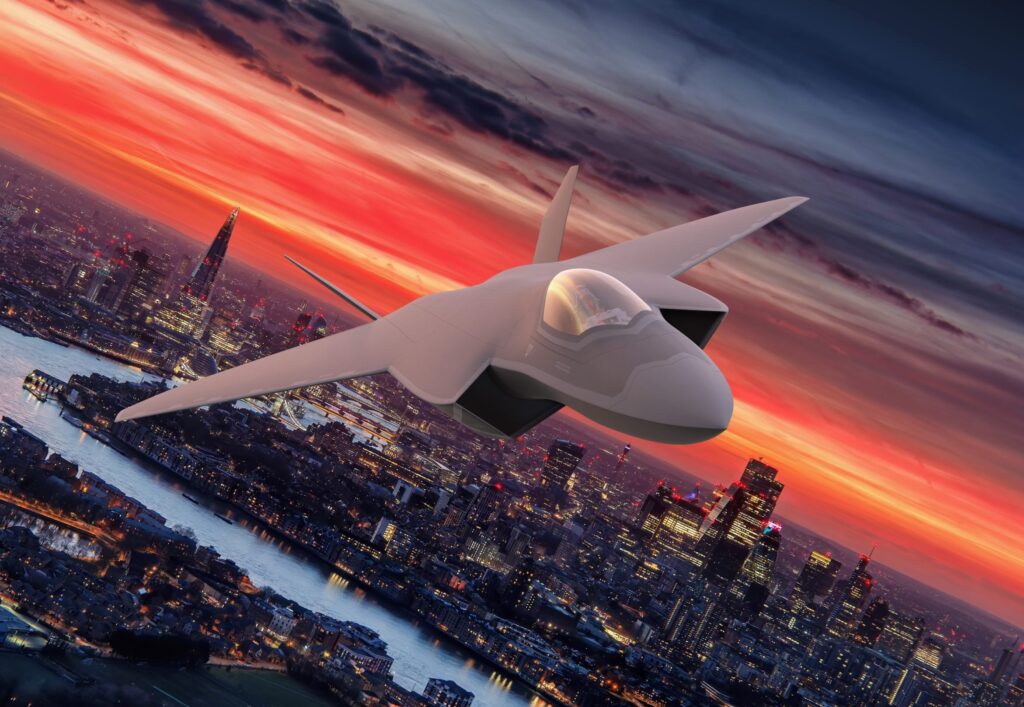
If doubts existed around the viability of the Global Combat Air Programme (GCAP) between Italy, Japan and the UK barely a month ago then they were firmly put to bed at this week’s main aerospace event of the year in Farnborough.
Indeed, the three-nation effort’s positive momentum was repeatedly highlighted throughout the 20-24 July event, including gaining Canada as an observer.
Certainty around the endeavour’s development status only came formally as this month started, with a £4.6 billion ($6.1 billion) contract placed to cover the completion of its current concept and assessment phase. That joint allocation was unlocked after the UK Ministry of Defence on 30 June published its Defence Investment Plan (DIP), which confirmed its commitment to the project after a delay of several months.
The late arrival of the DIP, and the separate termination in early June of the Future Combat Air System (FCAS) development between France, Germany and Spain led some to speculate that GCAP could also be heading for oblivion.

During a panel discussion on the opening day of the Farnborough air show, FlightGlobal asked the speakers representing the nations and their industrial champions whether there had been worries about the project’s survival amid the funding wait.
“I had no concerns,” says Masami Oka, chief executive of the GCAP Agency – the body tasked with overseeing delivery of the joint project on behalf of the partner governments and defence ministries under the terms of a trilateral treaty.
“This is a very important project, and its value has been fully shared among the three nations,” he says. “It will certainly contribute to the strengthening of the industrial and technological base of the three countries.” The programme also “will contribute to peace and security in the Indo-Pacific as well as the European-Atlantic area”.
SIGNIFICANT PROGRESS
“In the last few months we have been making significant progress, and we have not really delayed,” Oka adds. That was enabled by a bridging contract worth £686 million – the first to be placed directly with the Edgewing industrial joint venture – which covered the period from 2 April until 30 June.
Marco Zoff, chief executive of Edgewing – the prime contractor and design authority for GCAP’s sixth-generation fighter, which will enter use from 2035 – says “no-one ever doubted”.
“The commitment was pretty clear from the three parties, from the industrial and institutional sides,” he said as the show opened on the first anniversary of Edgewing’s formation.
With company and the GCAP Agency shared a bustling exhibit space at the show, Zoff notes: “We have a daily relationship, in which we try to speed up and be agile and solve problems.”

He tells FlightGlobal that success hinges “not only the full institutional and political alignment, but also the industrial alignment. You have to have both on the table.”
In the case of GCAP, that means an equal partnership “creating the conditions to not fight between the shareholders”, while retaining “the sovereign possibility to manage the technology, and the freedom of action and modification”, Zoff says.
Notably, that level of harmony was lacking in the case of the FCAS project, which collapsed after Dassault Aviation and Airbus Defence & Space were unable to resolve their differences.
Following the conclusion of its concept and assessment activities in December 2027, GCAP will progress into its detailed design phase. But even at this stage, he says: “We know we are competitive because of this construct where we are not duplicating effort. All the activities are concentrated in one place.”
The heatwave conditions in the UK did not slow the pace of activity around GCAP at the show, with further announcements made related to its crucial onboard systems.
Andrew Howard, general manager of the GCAP Electronics Evolution (G2E) consortium, says the interim ‘Task 0’ contract which ran until mid-year set the stage for the work now taking off during its ‘Task 1’ activity.
“That’s really given us a very strong platform,” he says.
A joint venture between ELT Group, Mitsubishi Electric and Leonardo, G2E will develop and supply the sophisticated sensors and communication technologies needed to give the future fighter an operational edge.
“We’re at a really important point in the journey: we know the mix of sensors we are trying to design, and we know what the future communication requirement will look like, and that investment is starting to bear fruit,” Howard says.
Momentum is also strong with regard to the power and propulsion system activities related to the future fighter – being advanced by a consortium of Avio Aero, IHI and Rolls-Royce.
“The team is working together to define the key technologies to prepare for the challenge that is in front of us,” Edoardo Curti, general manager of Avio Aero’s defence business unit, said at the show on 22 July.

More than 100 subscale tests have already been conducted as the companies work towards the creation of national demonstrators, after which they will combine to produce a trilateral demonstrator for a future engine.
“The development is progressing on track,” Curti says. “The collaboration between the teams has been really amazing.”
Also at the show, the programme’s Sovereign Effects Partners – MBDA Italia, Mitsubishi Electric, Mitsubishi Heavy Industries and MBDA UK – signed a new collaboration agreement around weapon technologies.
They will work together “to support Edgewing’s delivery of the core GCAP platform, including providing expert advice and engineering services relating to effects optimisation technologies and the digital integration of effector systems”.
However, for now their pact stops short of the joint development of new weapons.
FUTURE PARTNERS?
While GCAP is a shared endeavour between Italy, Japan and the UK, the governments involved have from the start stated their willingness to involve further nations at some level, potentially up to welcoming additional partners.
Canada on 21 July signed an agreement to take observer status on the programme, making it the first nation to do so. Ottawa will gain “enhanced insight” into the sixth-generation fighter’s development, and also of the programme’s governance, capabilities and industrial framework. Its involvement could lead to unspecified “wider partnering opportunities”, according to a statement by the four governments.
Speaking ahead of the announcement, Zoff commented: “We are open to take recommendations and direction from the governments. We are able to accommodate it, but for the next year and a half we are fully focused on making it happen. We need to be obsessed and focused on delivery.”
Referring to the task of developing the future stealth fighter and the level of interest seen from the wider industry, he describes GCAP as “one of the real technological adventures in the world at this moment. So there is a lot of excitement in the technological community at large to be part of it”.
Access all our coverage from the Farnborough air show here, including four issues of Flight Daily News.
The post How GCAP shone through Farnborough’s week in the sun first appeared on FlightGlobal.