


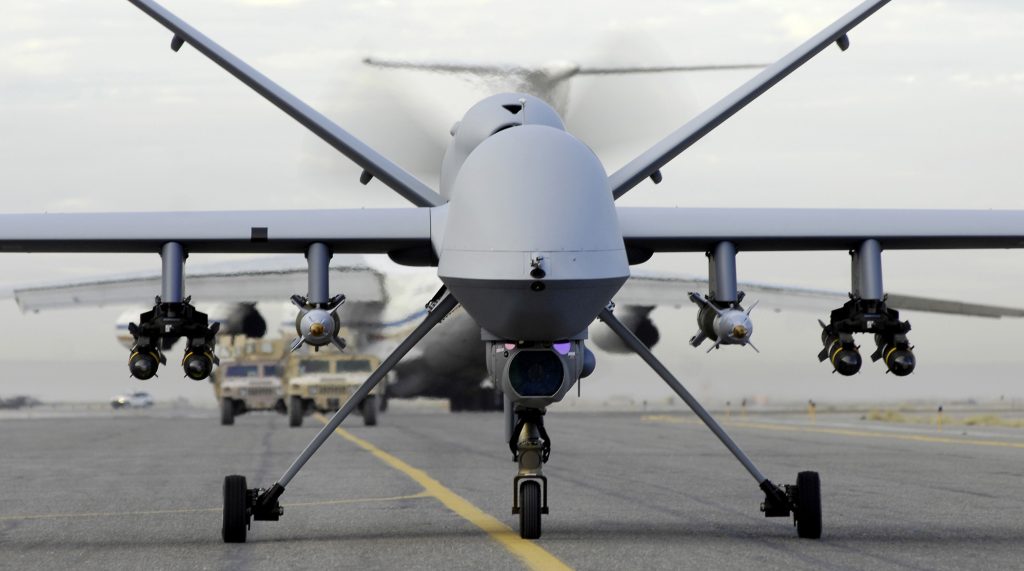
The demonstration opens up a potential counter-UAS role for the MQ-9A, which is searching for a new niche in environments of high-intensity conflict.
Uncrewed aircraft manufacturer General Atomics Aeronautical Systems has successfully fired low-cost guided rockets from the MQ-9A Reaper remotely piloted drone.
The tests were revealed on 11 May and involved an MQ-9A firing BAE Systems Advanced Precision Kill Weapon System (APKWS) rockets in “multiple types and variations of shot profiles”, according to General Atomics.
That included air-to-air shots at unspecified aerial targets. The rockets themselves were fired from what General Atomics describes as a specialised launcher and guided onto their target using a laser designator.
The live fire testing took place at Nellis AFB in Nevada.
“We recognise the value that a system like APKWS brings to the MQ-9 aircraft as a tool to counter one-way attack drones,” says David Alexander, president of General Atomics Aeronautical Systems. “APKWS can increase the number of weapons the MQ-9A is able to carry, as well as being able to carry new lower-cost weapons.”
BAE originally designed the APKWS rockets to be a low-cost munition for air-to-ground engagement by rotary-wing platforms. The rockets were subsequently integrated into fixed-wing attack and strike fighters like the Fairchild Republic A-10 and Lockheed Martin F-16.
With the recent proliferation of low-cost, one-way attack drones like the Iranian Shahed-136 (and its Russian, Chinese and now even American offshoots), military leaders are increasingly turning to cheap weapons like the APKWS as a way to defend against massed waves of small aerial targets.
L3Harris paired the rockets with an integrated laser designator for its Vampire system, which was one of the earliest pieces of military hardware provided to Ukraine by Washington.
More recently, APKWS launchers have been integrated into the Boeing F-15E and Eurofighter Typhoon, and in 2025 the Pentagon committed nearly $2 billion to acquire up to 55,000 of the APKWS munitions between now and 2031.
Earlier this month, Washington granted emergency rapid approval for the sale of more than $2 billion worth of the rockets to Israel and Qatar, with each country obtaining around 10,000 munitions.

Last year, BAE unveiled a new dual-mode seeker that incorporates a passive infrared sensor into the guidance package, allowing for a limited “fire-and-forget” capability. Under that configuration, individual APKWS rockets still acquire their target via active laser painting but then use the onboard IR sensor to maintain tracking without the need to actively maintain laser targeting.
Such a capability would allow airborne pilots to more rapidly engage larger numbers of incoming threats, which is particularly advantageous in the counter-UAS role.
Adding that capability to the MQ-9A opens up a new mission set for the remotely piloted aircraft, which has absorbed heavy losses during recent conflicts over Iran and Houthi-controlled Yemen.
While effective at intelligence collection and air-to-ground strike, the MQ-9A has proven vulnerable in high-intensity conflicts involving modern air defences. Although the exact number is not known, it is believed that the US Air Force has lost around two dozen of the uncrewed aircraft in combat over the past year.
The counter-UAS mission would shift Reaper operations from the more dangerous frontline airspace to rearward areas, defending friendly bases and civil infrastructure from drone attack.
The MQ-9As long-endurance loitering time and lack of human crew could make it a strong candidate for that role, as opposed to fixed-wing fighters and rotorcraft that are currently sortied to defend against incoming one-way drone threats.
The post General Atomics test fires APKWS counter-UAS rockets from MQ-9A first appeared on FlightGlobal.