


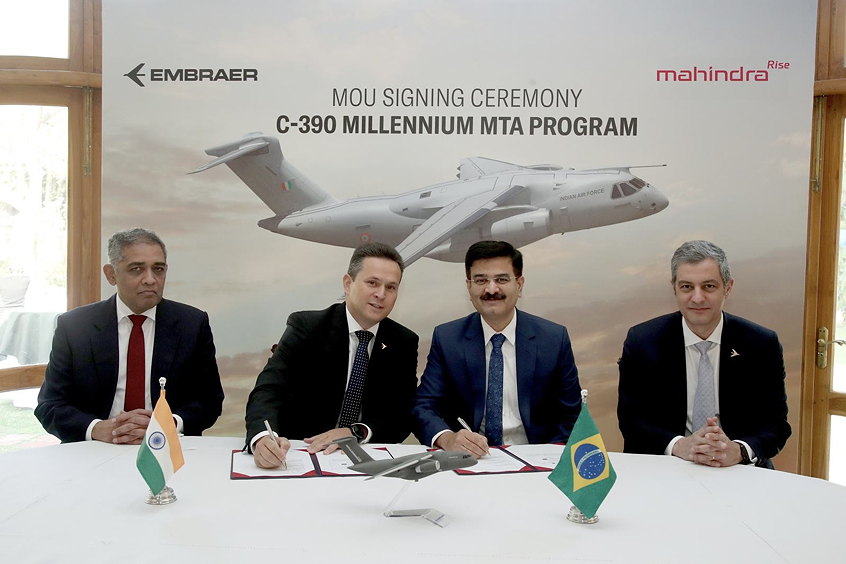
Though a formal tender has not yet been released, the fleet recapitalisation from New Delhi is expected to cover as many as 80 transport aircraft.
As part of its effort to secure a major new deal with India, Brazilian aircraft manufacturer Embraer is willing to open a production site for the C-390 military transport in India.
“We are willing to transfer everything, as much as possible,” says Marcio Monteiro, chief marketing officer of Embraer Defense & Security. “We are also talking to our supply chain, checking with them what can be transferred to India, given the size of the potential… order.”
Embraer is seeking to sell the military transports to India, which aims to recapitalise a fleet of Soviet-origin airlifters that includes more than 100 Antonov An-32 turboprops and 17 Ilyushin Il-76 jets. The effort is known as the Medium Transport Aircraft (MTA) programme.
Although New Delhi has not yet released a request for proposal (RFP) laying out terms for the acquisition, Embraer executives tell FlightGlobal their working assumption is that the Indian government will hold a public competition, with industrial offsets and local economic impacts being key evaluation criteria.
India’s defence acquisition guidelines generally require at least 50% locally sourced content for major purchases, although that figure can be higher.
Embraer has partnered with Indian manufacturer Mahindra on a plan to locally produce the C-390 multi-role tactical transport, which is currently assembled at Embraer’s Brazilian defence production complex in Gavio Peixoto.
Though the size of the Indian tender will be unknown until the RFP is released, Embraer’s Monteiro tells FlightGlobal a deal could cover 60-80 aircraft. That would represent a massive win for Embraer, whose current backlog of C-390 orders and options covers about 90 aircraft.
Monteiro says Embraer is willing to make a substantial investment to secure a win, including building a second C-390 assembly line with Mahindra in India.
“We are working very hard with… Mahindra in India to be ready for this bid,” says Embraer chief executive Francisco Gomes Neto.

At a minimum, the Brazilian manufacturer expects to duplicate its Gavio Peixoto operation, which includes two hangars housing both structural assembly of C-390 fuselage sections and final aircraft assembly.
“That’s how the factory in India would look, at least,” Monteiro says. “Depending on the requirements of percentage of localisation, we may need to do more.”
‘More’ could include developing additional factories in India to fabricate core structural components. These are currently made by Embraer offsite and shipped to Gavio Peixoto.
“Maybe some of those elements or structural segments would have to be done in India… to meet the [localisation] requirement,” Monteiro notes.
Those facilities would not necessarily be limited to producing aircraft for India. An Indian production line could also support C-390 export sales to other Embraer customers around the world.
“I think India would be interested in doing that sort of business,” Monteiro says.
Embraer will likely face competition from the C-390’s chief rival: the Lockheed Martin C-130J Super Hercules.
India already operates 12 C-130Js, and Lockheed has a joint venture with Indian manufacturing conglomerate Tata to produce C-130 empennage assemblies in Hyderabad. That plant provides tail sections for all new-build Hercules transports globally. Final C-130J assembly is housed at a Lockheed facility in Marietta, Georgia, in the USA.
In May, Lockheed and Tata marked the 260th C-130J empenages delivered from the Hyderabad site.
Lockheed has already said it too will offer final aircraft assembly in India as part of its MTA bid.
“We would establish that facility in India while we maintain full-rate production in Marietta,” Rob Toth, Lockheed’s vice-president of strategy development for air mobility and maritime missions, told FlightGlobal in December.
Lockheed currently delivers between 20 and 24 C-130Js from the Marietta line each year. Toth says this rate could be increased if New Delhi wishes to rapidly field a new transport capability.
Airbus is also expected to compete for the MTA opportunity with its A400M transport. Though that type is not in the Indian air force inventory, Airbus has industrial partnerships on the subcontinent.
India operates 16 of the European airframer’s smaller C295 transports, which are assembled in Vadodara under a partnership between Airbus and Tata. The pair are preparing to deliver the first Indian-made C295 this year, following a maiden flight earlier this month.
New Delhi’s C295 order covers up to 56 aircraft, with 40 being delivered from Vadodara. The initial 16 examples were produced on the Airbus line in Seville, Spain.
While Embraer faces stiff competition, company officials express confidence the C-390 represents the best option for India from a performance perspective.
“The airplane is much more flexible,” Monteiro says. “It’s much more capable in terms of payload, range, speed, agility and mobility.”
The jet-powered C-390 offers greater payload and cruising speed than the turboprop C-130J, and a larger cargo bay, while the Hercules comes with shorter runway requirements.
In terms of range, the C-390 comes out ahead with similar payloads, though that advantage erodes when approaching the jet’s maximum payload of 26t (57,000lb). The C-130J comes with a 20t payload.
The four-engined A400M turboprop has the largest payload and greatest range within the group but also comes with the highest purchase price, lowest availability rate and higher operating costs.
Embraer touts a mission capability rate of 93% for the frontline C-390 fleet, which includes 14 examples. Half of those are less than three years old.

A 2025 report from the US Congressional Budget Office listed C-130J availability within the US Coast Guard at roughly 60%. The US Air Force C-130J fleet has logged a mission capability rate of 72% in recent years, according to a 2025 report from Air & Space Forces Magazine.
There are more than 800 C-130s in service worldwide, many of them decades old.
One interesting area of competition in the Indian MTA programme is an expected requirement to operate from high-altitude runways. The C-130 has a track record in this regard, most recently supporting NATO operations in Afghanistan. Before that, C-130 crews flew missions in the Himalayas during the Cold War as part of a secret anti-communist guerrilla operation run by the CIA.
Although the C-390’s heavier weight and longer take-off requirements might place it at a disadvantage when it comes to high-altitude operations, Monteiro says the Embraer jet is more than capable of hitting India’s needs.
“We have looked into [it] with the Indian air force,” he says. “The airplane is completely capable of meeting those requirements.”
Gomes Neto goes a step further.
“In terms of operations, in terms of maintenance cost, in terms of performance, we believe it is the best solution for the Indian air force,” the Embraer CEO says.
New Delhi is expected to release its RFP in the coming months; doing so requires approval from many bodies within India’s labyrinthian bureaucracy.
However, based on Embraer’s interactions with New Delhi, Monteiro describes India as being in “hurry mode”.
The post Embraer to offer India its own C-390 assembly line as part of bid for new military transport first appeared on FlightGlobal.