


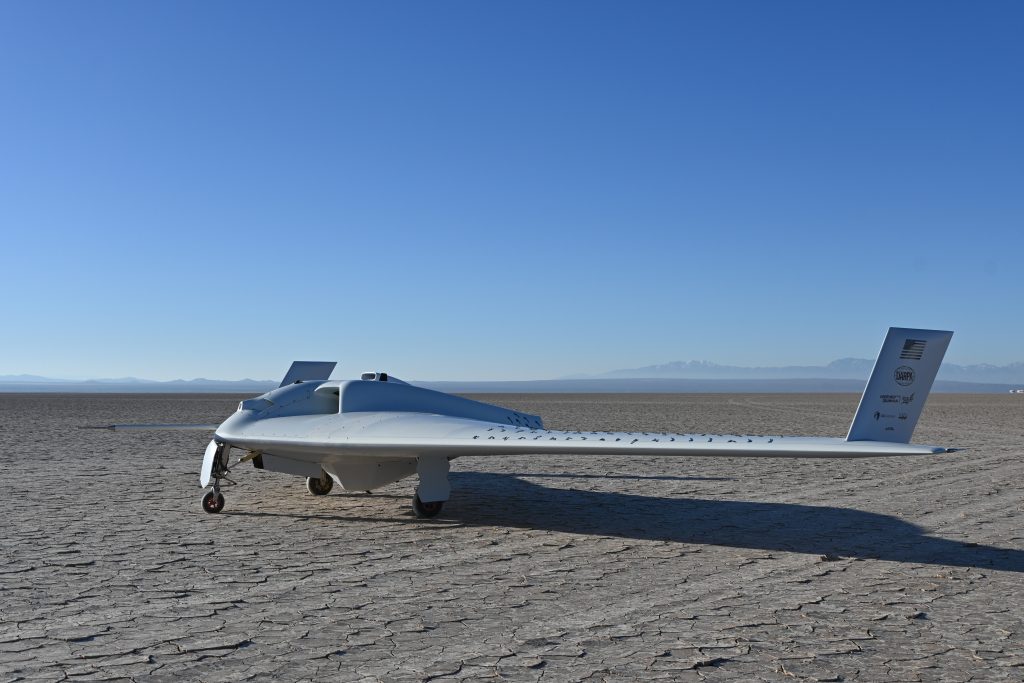
The milestone comes nearly two years after Northrop completed assembly of the experimental uncrewed jet.
The Pentagon’s secretive technology incubator has flown a new uncrewed aircraft intended to demonstrate military applications for hybrid-electric propulsion.
The Defence Advanced Research Projects Agency developed the XRQ-73 in conjunction with Northrop Grumman, logging first flight of the experimental design in April as part of the Series Hybrid Electric Propulsion Aircraft Demonstration (SHEPARD) programme.
DARPA revealed the milestone on 6 May, noting the flight took place at Edwards AFB in California.
“This milestone is not just about a single flight,” says Lieutenant Colonel Clark McGehee, DARPA’s programme manager for SHEPARD. “The architecture proven by the XRQ-73 paves the way for new types of mission systems and delivered effects.”
The Pentagon now plans to conduct a flight test campaign to fully evaluate the performance of the hybrid-electric propulsion system featured on the uncrewed vehicle.
The XRQ-73 grew out of a separate technology development programme called Great Horned Owl that sought to “significantly extend” the operational endurance and payload capabilities of intelligence, surveillance and reconnaissance uncrewed aircraft. That effort specifically focused on developing a drivetrain using gasoline or diesel to quietly generate electricity for electric propulsion systems.
The SHEPARD flight programme tested the XRQ-73 using the Great Horned Owl drivetrain at its core. Northrop completed assembly on the experimental aircraft in 2024.
A subscale XRQ-72 demonstrator was also built under the Great Horned Owl programme, with DARPA saying that design’s maximum gross take-off weight was less than the Group 3 UAS upper limit of 599kg (1,320lb).
Northrop says the larger XRQ-73 weighs 567kg and notes the flying-wing was built in collaboration with experimental aircraft subsidiary Scaled Composites.
Images provided by DARPA and Northrop Grumman show a tailless, blended-wing-body fuselage with large swept wings and sizable vertical winglets near the wingtips. Two air intakes are on the fuselage, on either side of the centreline.
Winglets aside, the XRQ-73 resembles famous Northrop designs including the B-2 and B-21 stealth bombers and the X-47B naval drone designed to operate from aircraft carriers.

The experimental Northrop aircraft also has a similar layout to the secretive Lockheed Martin RQ-170 long-range surveillance UAS that has occasionally been sighted supporting US combat operations, including in Afghanistan and in the January raid that captured former Venezuelan leader Nicolas Maduro.
The Pentagon’s goal with the SHEPARD programme is not necessarily to procure the XRQ-73 vehicle itself, but to mature the technology to where it can be applied to broader military applications or used to address specific tactical problems.
DARPA says hybrid-electric propulsion system could enable new aircraft designs with reduced-fuel requirements and greater operational flexibility.
The concept is gaining traction.
Sikorsky is flight testing a new class of uncrewed “rotor-blown wing” vehicles called the Nomad family that are powered by a hybrid-electric system. The company envisions the vertical take-off and landing Nomads as providing support to conventional rotorcraft and ground forces, with lethal strike and ISR capabilities.
Separately, L3Harris and Joby Aviation are flight testing a hybrid-electric variant of Joby’s all-electric S4 passenger aircraft dubbed the S-4T. That vertical take-off and landing design has been modified for fully autonomous flight, with an eye toward supporting aerial logistics operations.
Joby and L3Harris completed a series of S-4T demonstration flights for the US Army at the end of April.
The post DARPA and Northrop Grumman fly XRQ-73 hybrid-electric demonstrator first appeared on FlightGlobal.