


RTX division is vying with incumbent Honeywell to upgrade the F-35’s power system.
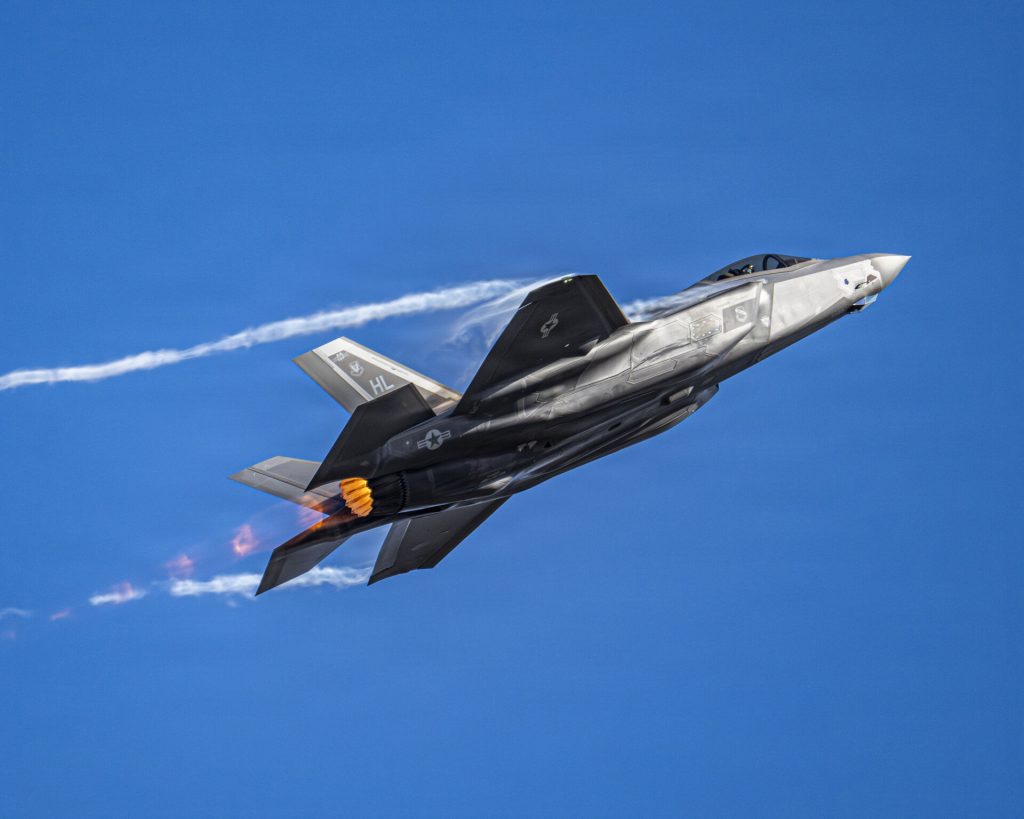
Collins Aerospace has completed high-altitude testing of a proposed solution for increasing electrical power and cooling on Lockheed Martin’s F-35 stealth fighter.
The RTX subsidiary announced the developmental milestone for the Enhanced Power and Cooling System (EPACS) on 24 August. The system, which is not yet under contract, is being pitched as an alternative to the F-35’s current Power and Thermal Management System (PTMS) built by Honeywell.
“The EPACS system delivers significantly increased cooling capacity to meet the demands of today and tomorrow,” Collins says.
Repeated enhancements to the F-35’s onboard sensors and electronics have pushed the jet’s single Pratt & Whitney F135 engine to operate outside design tolerances to generate sufficient electrical power and waste heat abatement.
That has increased engine wear, requiring powerplants to undergo more frequent overhauls while driving up sustainment costs.
Collins says altitude testing is a critical step in developing EPACS.
“Successful altitude testing validates system performance in real-world flight conditions,” says Ira Grimmett, vice-president of environmental and airframe control systems at Collins.
“Completing this phase of testing advances EPACS maturity and reinforces confidence in the system’s capability and performance.”

As part of the trials, the EPACS was run for several days in a lab at power levels replicating mission requirements. Collins says it pushed the prototype to operational limits at various altitudes to collect performance data and demonstrate that EPACS can deliver emergency power expected during operation.
“This test validates system performance models,” the company says.
Collins proposed EPACS in 2023, saying it could provide more than twice the cooling capacity of the F-35’s Honeywell PTMS. The system is designed to work in tandem with the F135 engine core upgrade (ECU) being developed by P&W that will further boost onboard power generation.
Honeywell has countered that a relatively simple software upgrade to the existing PTMS can provide 25% more cooling. The company has a developmental project to provide a long-term performance boost to PTMS without requiring a wholesale replacement.
While P&W is under contract to develop and field the ECU across the US F-35 fleet, the Pentagon has not yet launched a procurement effort to upgrade or replace the PTMS.
A US Government Accountability Report from 2023 found the Pentagon will need to develop a plan for upgrading the current Honeywell PTMS to support any F-35 capability improvements beyond the Block 4 package currently in the works.
The post Collins completes altitude tests of proposed F-35 power and cooling upgrade first appeared on FlightGlobal.