
How RingCentral builds AI-native work from engineering to ops
See how RingCentral uses ChatGPT Work and Codex to accelerate AI product development and centralize operational intelligence across engineering and operations.

Date of sighting: Oct 2023Location of sighting: USA (no other info given)Source: Dept of WarLink: https://www.war.gov/UFO/?releaseDate=Release+06&release=06#LLE-UAP-PR002-Unresolved-UAP-Report-Colorado-October-2023I was looking at the Dept of War website at…
Read More
Background Movements for civil rights were a worldwide series of political movements for equality before the law that peaked in the 1960s. In many situations…
Read More
Background The following document was obtained by The Black Vault through the Freedom of Information Act (FOIA), and was part of the “Stargate Collection” release.…
Read MoreSee how RingCentral uses ChatGPT Work and Codex to accelerate AI product development and centralize operational intelligence across engineering and operations.
OpenAI research reveals how enterprises are adopting agentic AI, using ChatGPT and Codex, and how frontier firms are pulling ahead in AI adoption.
arXiv:2608.10004v1 Announce Type: new Abstract: Concept Bottleneck Models (CBMs) provide an interpretable framework by grounding predictions in human-understandable concepts, enabling semantic inspection and test-time intervention. Recent variants have improved CBMs through richer concept representations, uncertainty estimation, and dependency modeling. However, robust reasoning under unreliable concept states remains underexplored. Without such reasoning, misleading semantic evidence can…
arXiv:2608.09998v1 Announce Type: new Abstract: Artificial Intelligence (AI) and Machine Learning (ML) have become powerful tools for supporting and automating complex human tasks. Despite their benefits, growing attention has been directed toward their environmental implications, primarily due to their high energy demands and associated carbon emissions. This concern is particularly relevant in light of the…
arXiv:2608.09986v1 Announce Type: new Abstract: Most existing multimodal sentiment analysis approaches assume access to complete multimodal inputs. However, real-world applications frequently encounter incomplete or corrupted modalities, posing a critical challenge. Although several methods have been proposed to tackle this issue, they mainly rely on data imputation and heuristic coordination constraints, which fail to effectively extract…
arXiv:2608.09967v1 Announce Type: new Abstract: Deep reinforcement learning (DRL) agents achieve strong performance in complex environments, yet their decision-making processes remain difficult to interpret. We introduce SPOT (Sampling Policy Observation Tree), a novel model-agnostic, sampling-based framework for interpreting DRL policies. Given access to the policy and an environment simulator, SPOT constructs an interpretable finite-horizon tree…
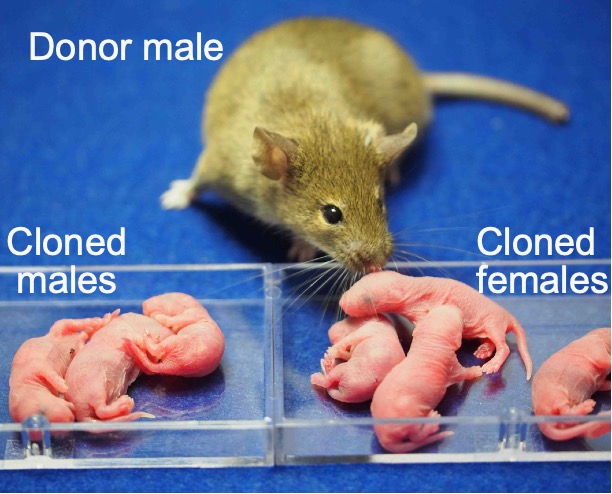
Scientists have deliberately turned male mouse embryos into females for the first time. A team based in Japan used a CRISPR-based approach to remove the Y chromosome from male cells and create female clones of male mice. “No one has done this before,” says Monika Ward, a reproductive biologist at the University of Hawaii, who…
Next month, on September 8, MIT Technology Review will reveal its 2026 list of Innovators Under 35, recognizing 35 young people from around the world who are doing groundbreaking scientific work and building clever technical fixes for sticky problems. By finding the top young innovators globally and learning what they’re focused on in their work,…
This is today’s edition of The Download, our weekday newsletter that provides a daily dose of what’s going on in the world of technology. How we picked 35 of the world’s top young scientists and engineers On September 8, MIT Technology Review will reveal its 2026 list of Innovators Under 35, recognizing 35 young people…
Business and technology leaders need no convincing that the time of agentic AI is here. Organizations are rapidly adopting agents, and few executives doubt the technology’s potential to transform work. But many organizations find that realizing the desired return on investment (ROI) from AI hinges on having the right foundation, with inadequate infrastructure and data…