


Delayed certification of complex business-class seats also continues hindering 787 deliveries.
GE Aerospace must get back on track with deliveries of GEnx turbofans before Boeing can achieve its goal of accelerating 787 production to 10 jets monthly this year, says Boeing chief executive Kelly Ortberg.
The engine-supply issue, plus ongoing delays in certificating 787 business-class seats, has also hampered Boeing’s ability to deliver some of the widebody jets.
“We may not go to the rate [of] 10 as early as we could have had we not had the challenges,” Ortberg said on 27 May during an investor conference hosted by financial firm Bernstein. “We’ve fallen behind in delivery on engines in the first quarter.”
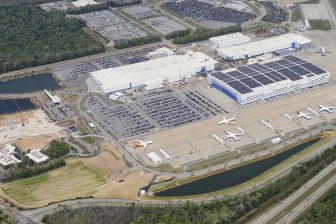
Boeing’s North Charleston 787 production site is now turning out jets at a rate of eight monthly and the company has been working to hit rate 10 – the site’s current maximum output – before year-end. Boeing plans in 2028 to open a second 787 production facility, adjacent to the existing location in North Charleston, that it says will enable production of 20 jets monthly.
“We’ve got a recovery plan that we’re working with GE on. We’ll need to see the engine recovery plan come to fruition before we can get to rate 10, and that’ll be late in the year,” Ortberg says. “We’ve got some instabilities, still, that we’re working through.”
Like other engine makers, GE has been working to increase its own output amid supply chain and labour constraints.
GE CEO Larry Culp addressed the GEnx holdups at the same 27 May conference.
“There’s no question that we want to make sure, in Charleston, that [Boeing’s] got an engine every time they’re ready to hang,” he says. “We are working with the supply base… to be in a position to step up.”
Culp is not more specific about GE’s GEnx recovery plan, and the company does not provide additional comment.
But Culp adds that GE has made recent progress ramping output, with its engine deliveries increasing 25% year on year in 2025.

Seat certifications are another nagging issue affecting Boeing’s 787 programme. The company and seat suppliers underestimated the time required for regulators to approve some business-class seats, specifically those equipped with doors, Ortberg says.
“We have quite a few of those [certifications] yet to go through this year,” he adds. “The seating configurations have been very complex.”
Delayed seat approvals have prevented Boeing from delivering some 787s, with Ortberg saying, “The seats are in the airplane; the airplanes are built. We just don’t have the paperwork allowing us to make the delivery.”
The delays have also affected, though to a lesser degree, 787 production, with Ortberg calling the issue “an important stability item for [Boeing] to go to a 10-a-month”.
Boeing has delivered 21 787s in 2026 through April, its data shows.
The post Boeing’s 10-monthly 787 goal hinges on GE addressing engine delivery holdups first appeared on FlightGlobal.