


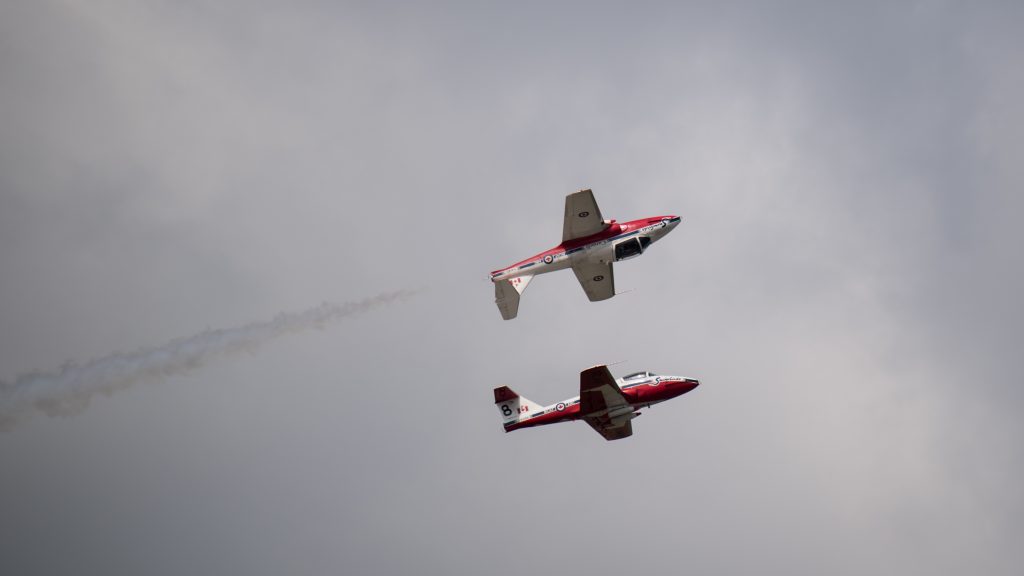
Opposition MPs in Canadian Parliament claim the Liberal Party government will not fund the Snowbirds air show demonstration team in 2027, which Ottawa’s defence chief denies.
Rumours are swirling around the Canadian capital that the country’s national aerobatic display team will cease flying after 2026.
Broadcaster CTV News broke news on 7 May that the Royal Canadian Air Force’s Snowbirds team is in dire financial straits, citing members of parliament from the opposition Conservative Party.
Conservative MP Fraser Tolmie, who represents the Snowbirds’ home district of Moose Jaw, Saskatchewan, told CTV that the team, which is designated the 431st Air Demonstration Squadron, will not perform in 2027.
“The Snowbirds are being cancelled. This is the last season,” Tolmie says.
The former Moose Jaw mayor claims the team’s Canadair CL-41s, called the CT-114 Tutor within the RCAF, will be grounded after the conclusion of the 2026 season. The Snowbirds’ government website lists a packed schedule for this year, with appearances across Canada and the USA from May until October.
House of Commons member Marcus Powlowski, who is a member for Prime Minister Mark Carney’s Liberal Party, tells CTV that the cost of operating the demonstration team is at issue, though he does not elaborate.
Ironically, the fiscal squeeze comes at a time of ballooning military expenditures in Ottawa.
Canada is in the midst of a once-in-a-generation RCAF overhaul, planning tens of billions of dollars in new defence spending over the next decade and beyond. That includes new fleets of aerial refuellers, manned and unmanned long-range patrol aircraft and an entirely recapitalised trainer fleet.
Procurement of a new frontline tactical fighter to replace the RCAF’s aged Boeing F/A-18A Hornets and a new medium-lift tactical helicopter are also in the works. An expansion of Canada’s ground-based airspace monitoring radar network is also planned.

That fiscal surge was prompted both by an ageing and numerically limited air force struggling to remain relevant and deteriorating relations with Washington.
US President Donald Trump has threatened to withhold military support from allies not meeting NATO defence spending targets and made thinly veiled overtures about wanting to absorb both Canadian territory and neighbouring Greenland.
In response, the Carney government has moved to drastically increase military spending.
Last year, Canada reached the NATO target of spending the equivalent of 2% of gross domestic product on defence for the first time in the alliance’s history. Ottawa is also on track to meet the new goal of 5% of GDP, set to take effect in 2035.
Although the Department of National Defence (DND) has not yet confirmed this, it is possible the Snowbirds are viewed as a lower-priority expense at a time when Ottawa is facing a significant bill to modernise combat forces.
Following reports of the Snowbirds’ impending demise, defence minister David McGuinty said he will address the matter on 19 May during an appearance at 15 Wing Moose Jaw – home to both the Snowbirds and the RCAF’s primary aircrew training squadron.
McGuinty tells FlightGlobal his remarks will address the future of the demonstration team. He is also pushing back on claims that the Snowbirds will no longer be taking to the skies after this year.
“Canadians can rest assured that they will be able to enjoy the iconic Snowbird formation for generations to come,” McGuinty says.
The DND tells FlightGlobal that work is underway internally to develop a future roadmap for both the Snowbirds and the CT-114 fleet. McGuinty is to reveal details on 19 May.
There are 21 of the single-engined jets in RCAF service, according to data from aviation analytics company Cirium. All those CL-41/CT-114s are more than 60 years old and operated solely by the Snowbirds for aerobatic display.
Other services with similarly aged small jets, such as the US Air Force’s Northrop T-38C Talon trainers and the US Navy’s Boeing T-45 Goshawk trainers, are experiencing significant maintenance challenges and declining availability rates.
Ottawa may have decided that keeping the CL-41 fleet airworthy is no longer worth the expense, perhaps setting up a temporary hiatus while the jets are replaced.
During a 7 May appearance in the House of Commons, McGuinty seemed to suggest that Tutor maintenance issues were at the heart of the Snowbird tumult.
“The RCAF’s fleet of Tutor aircraft was first introduced in the 1960s. The fleet will reach its end of life in the coming years,” he said. “The Snowbirds will continue air demonstrations with the Tutor fleet for as long as it is feasible and safe to do so. The Snowbirds remain committed to their performances.”
It is unclear when Ottawa expects the CL-41s will reach their “end of life” or what could replace them. The RCAF is planning to acquire a new jet trainer for future generations of fighter pilots but has not launched that competition.
That programme has been complicated by the stalled effort to replace the Hornet fleet, with a planned acquisition of US-built Lockheed Martin F-35As now in doubt because of the political blowup between Washington and Ottawa.

The RCAF is now acquiring new trainer aircraft, including Grob G120TPs for basic flight certification and Pilatus PC-21s for advanced instruction; one of those might offer an option for replacing the Snowbird’s CL-41s.
It is unlikely such a switch could be made in time for the 2027 air show season, meaning Ottawa would have to continue funding Tutor operations to avoid a lapse in the Snowbird schedule.
Meanwhile, Canada’s existing air force recapitalisation projects will continue as planned, the government says.
“Review and rationalisation of Royal Canadian Air Force fleets is continuous as we embark on the largest modernisation effort in the RCAF since the Second World War,” the DND tells FlightGlobal. “This modernisation effort requires skilled people to help build our strength, train new members and operationalise new and upgraded capabilities.”
A CL-41 replacement is now among the list of highly anticipated RCAF procurement actions, a list which is topped by a pending decision about whether to continue the F-35A acquisition or shift to purchasing Gripen E/F fighters from Swedish airframer Saab.
Ottawa is also considering options for fielding a new airborne early warning capability, with offers from Saab and L3Harris via its Canadian subsidiary MAS.
The post Aged CL-41 fleet fuels rumours that Canada’s Snowbirds aerobatic team will cease flying after 2026 first appeared on FlightGlobal.