

The company has tentatively dubbed the concept a ‘collaborative adversary aircraft’.
Private adversary air provider Top Aces is looking for ways to incorporate the threat of new uncrewed tactical aircraft into its aggressor training.
The Montreal company’s vice-president of adversary air business development tells FlightGlobal the concept is still nascent but is part of Top Aces’ long-term development plan.
“We made up the term CAA – a collaborative adversary aircraft,” says Aaron Steffens, a former US Air Force squadron commander and Lockheed Martin F-16 pilot.
That is a nod to the collaborative combat aircraft (CCAs) currently being developed by US and European defence companies to serve as uncrewed wingmen for conventional fighters.
The US Air Force has issued initial contracts for the General Atomics FQ-42 and Anduril Industries FQ-44, with plans to field at least 500 of those jets for supporting air-to-air combat missions.
Much as Top Aces has developed a method of replicating the threat presented by fifth-generation fighters, Steffens says the company is looking to do the same for CCAs.
What that will look like is still an open question. However, Steffens notes the solution will be some form of uncrewed aircraft, not a reconfigured conventional fighter.
“There are certain attributes that you can put into an unmanned vehicle that you just can’t get on an older ex-military airframe,” he notes.

A future collaborative adversary aircraft could be either self-flying, like the FQ-42 and FQ-44, or remotely piloted, like the General Atomics MQ-9 and MQ-20.
“Think larger unmanned vehicles that are controlled from either our manned platforms, like a human-machine-teaming kind of construct, or from the ground,” Steffens says. “Or more likely both.”
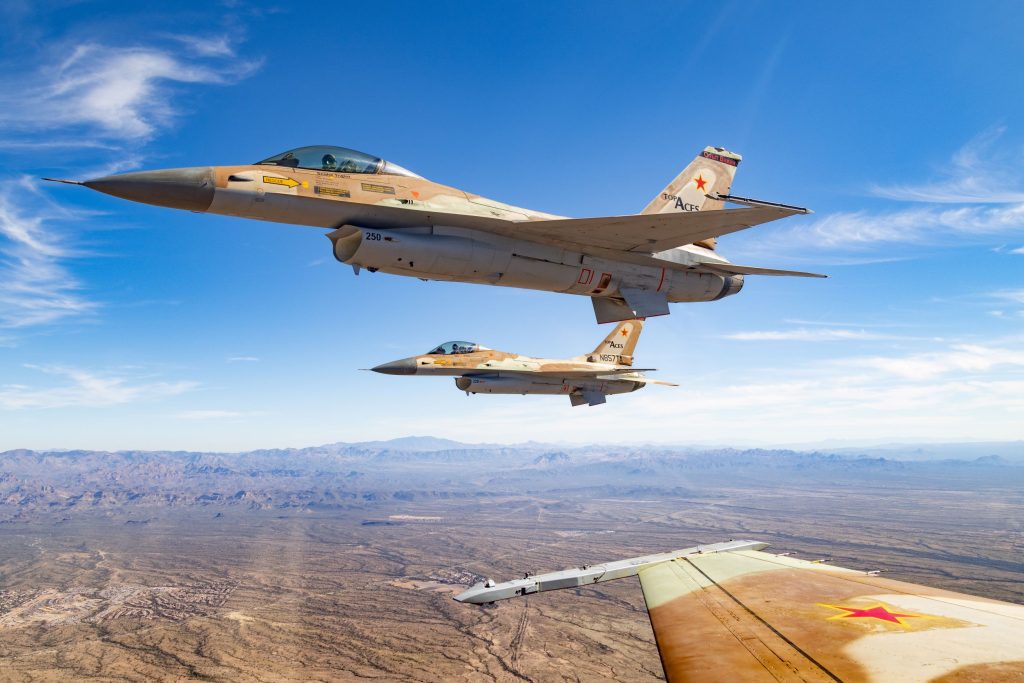
Top Aces uses a mixed fleet of F-16s, Douglas A-4Ns and Dornier Alpha Jets to fly against Western air forces as a dedicated aggressor force. The company developed a proprietary Advanced Aggressor Mission System (AAMS) that allows the F-16s and A-4Ns to replicate fifth-generation threats.
Steffens says a future CAA will need to reliably fly training sorties up to three times daily at a cost less than to convert and fly a manned fighter.
“We have to be able to put thousands of hours on it, and it’s got to be relatively low cost,” he notes.
Although the combat-configured CCAs are already priced less than traditional fighters (Anduril says its FQ-44 will cost “well below” $20 million), Steffens says uncrewed aggressor air jets will need to be even cheaper to make the numbers work.
That could be achieved, he says, by eliminating costly “exquisite” sensors and weapons capabilities that a CAA does not necessarily need to fulfil training objectives.
“The attributes you’d want to build into a CAA versus a CCA are quite different,” Steffens notes. “I don’t know if it exists in the exact form we want yet, but we’re certainly investigating who we could work with to bring that to the ADAIR environment.”
Top Aces is also looking into options for a “red air” UAV that could be used to support counter-UAS training, replicating threats like one-way attack drones. The company already has ability to simulate waves of cruise missiles using its Alpha Jets, reproducing another threat to which modern combat pilots are increasingly being tasked to respond.

Elsewhere, Top Aces is looking to expand its successful programme using AAMS-equipped F-16s to drill US fighter squadrons on fifth-generation-equivalent threats. The Top Aces F-16 fleet is currently on an exclusive contract to fly against US F-35 fighter squadrons.
However, the company is hoping for approval from Washington to expand that offering to European customers like Germany that are already flying against the A-4N and Alpha Jet.
“We’re anticipating additional demand here in the US, so we’re already working on growing that fleet,” Steffens says of Top Aces’ F-16s, which are the only privately owned fourth-generation fighters in the world.
“I think it wouldn’t be too tall a task for us to be able to export F-16s if we get that permission,” he adds.
Top Aces uses secondhand F-16s procured from the Israeli air force.
In February, Top Aces’ vice-president of international business development James McGovern told FlightGlobal there is an ample supply of used F-16s set to be phased out in the coming years, as countries modernise their air forces.
“There are a lot of F-16s out there in the world,” McGovern said. “Those F-16 fleets become available for purchase, and we believe that there is a long-term growth capability in the F-16 going forward.”
The Mach 2-capable F-16 offers high-altitude, high-speed, high-manoeuvrability flight characteristics that Steffens says are key to the company’s proposition of offering a credible fifth-generation-style threat when paired with an active electronically scanned array radar, infrared search and track capability, electronic-attack pod and helmet-mounted cueing system of the AAMS.
“It presents a dissimilar platform with unmatched manoeuvrability,” he says. “I think that’s important, particularly for F-35 pilots… to be able to turn with something that oftentimes has a better rate and turn radius than they do. They’ve got to figure out a way to beat it.”
The post Top Aces hunts for new uncrewed aircraft to replicate autonomous fighter threat first appeared on FlightGlobal.