


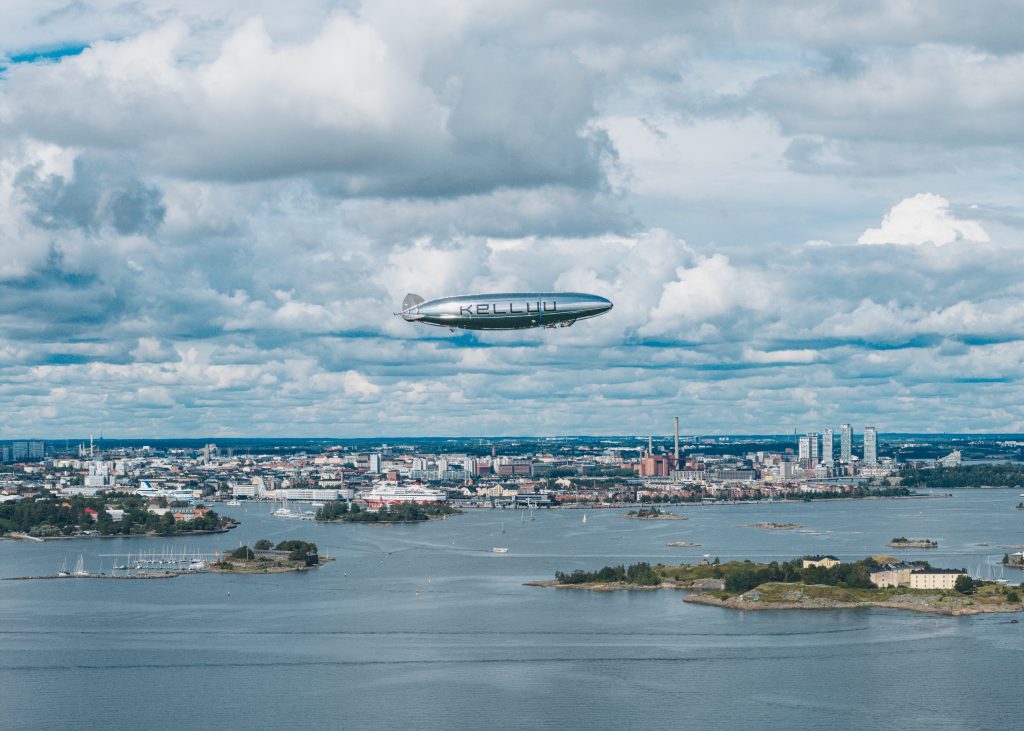
The company’s founder envisions the long-endurance vehicles as airborne sensor platforms well-suited for detecting incoming threats and cueing defensive measures.
Finnish start-up Kelluu wants to use airships as floating drone defence platforms.
The company’s co-founder envisions the long-endurance craft as airborne sensor stations able to identify threats and cue defensive measures.
The Reijola-based firm Kelluu is positioning its lighter-than-air dirigibles as the solution to the security challenge posed by one-way attack drones, which are being used to deadly effect in Ukraine and across the Middle East.
The small, low-cost drones can carry a significant explosive payload over distances greater than 540nm (1,000km) to strike soft targets like port facilities or energy infrastructure. The simple designs and cheap price tags allow aggressors to launch massed waves of attack drones, which can overwhelm traditional air defences at key sites like airbases.
While defenders have turned to low-cost guided rockets and even direct fire machine guns mounted on helicopters and fighter jets to intercept one-way drones, the threats still need to be identified and tracked first.
That is where Kelluu comes in. The company is taking a new approach to airship design, pairing modern sensors and hydrogen fuel cells with classic lighter-than-air lift to offer a persistent surveillance capability, both for collecting battlefield imagery and monitoring airspace.
“We bring the same sensors that are now used on the ground level to higher altitude,” says Jiri Jormakka, one of Kelluu’s co-founders. “When we use both, we can actually see pretty far away and provide information on what is happening in remote areas [or] across borders.”
Jormakka spoke to FlightGlobal on 18 May at the annual Special Operations Forces Week conference in Tampa, Florida.
Kelluu was founded in 2018 and just completed its Series A funding round in April of this year, raising €15 million ($17.5 million) with support from Finland’s state-owned investment company and the NATO alliance’s Innovation Fund (NIF) among other venture capital groups.
The NIF investment in Kelluu marked the first instance of the NATO fund taking a stake in a Finnish company.
“Kelluu offers NATO nations persistent, wide-area monitoring and data gathering in challenging environments,” says NIF partner Patrick Schneider-Sikorsky. “Their platform provides consistent coverage even when GPS is jammed or weather is harsh, at much lower cost than traditional systems.”

Rather than selling aircraft to NATO militaries, Kelluu is offering contractor-owned/contractor-operated imagery and intelligence, surveillance and reconnaissance services. The company is also pitching imagery services to commercial customers, seeking to find a sweet spot between cheap but limited drones and high-performance but costly satellite constellations.
“The system is scalable in a way that it’s really cost-efficient to build many on an industrial scale,” Jormakka says. “And we are in the lower airspace, anything between 100ft to 3,000ft above ground level… so the image quality or the data quality with the sensor payload is usually pretty good.”
Kelluu says five of its airships can effectively cover 30,000 sq km (3 million hectares), or an area roughly the size of Belgium.
That area is monitored using a mix of sensor options, based on the specific needs and operating environment. These could include modern electro-optical/infrared (EO/IR) thermal video, standard RGB cameras or multi-spectral imaging devices like LiDAR.
“We have optical and non-optical sensors,” Jormakka notes.
That could also include more advanced military sensors like airspace monitoring radar. All of those options are operated in concert to identify potential threats like one-way attack drones.
“We can do, for example, counter UAS missions in a way that we detect using passive radio frequency detection sensors plus EO/IR,” he explains. “So, we see emissions and then we can try and find it optically.”
For the moment, that concept does not extend to including weapons like rockets or missiles that could be used to strike incoming threats or enemy ground targets. However, Jormakka Kelluu is exploring the possibility of integrating smaller interceptor drones that could launch from each airship in response to an enemy attack.
Power for the onboard sensors and propulsion comes from hydrogen fuel cells, rather than batteries.
The company has already deployed its first-generation airships as part of NATO training exercises, including Exercise Steadfast Dart 26 held in Germany this past February. Other field demonstrations have occurred in Finland and Norway, including with NATO Maritime Command.
Kelluu’s first-generation design has a flight endurance of 12-24h, depending on conditions, before the hydrogen fuel cells need refilling. However, Jormakka says the company is aiming for “multi-day mission capabilities” with the second-generation airships, which Kelluu is currently building.
In addition to reviving the dirigible concept, which first saw widespread military use during World War One, Kelluu is also bringing back the use of hydrogen gas to provide lift. Notoriously volatile, hydrogen fell out of favour after the 1937 Hindenburg disaster.
Subsequent attempts at lighter-than-air travel opted for non-flammable helium, which is both more expensive and scarcer than hydrogen but less reactive.

Although Kelluu declines to reveal much in the way of specifics, the company says its patented design addresses the hydrogen flammability risk by using a chassis specially designed to keep the gas away from hot surfaces. This allows the use of relatively cheap and abundant hydrogen for both lift and powering onboard systems, including propulsion.
A large, sealed container of explosive gas floating around cities or sensitive targets would naturally make an inviting target for enemy fire. To counter this, Jormakka says Kelluu is positioning its airships as platforms that would operate well behind the frontline engagement area, supplementing ground-based systems and freeing up air assets with more limited loitering times.
Another notable difference between the Kelluu airship and the helium-filled aerostats that saw limited service during the wars in Iraq and Afghanistan is the elimination of a tether. While those designs remained stationary, the Kelluu airship is mobile.
The vessels can also autonomously hold their position, if desired, without the use of a tether.
While the Lockheed Martin-made lighter-than-air surveillance platforms deployed to Iraq and Afghanistan had limited ability to operate in high winds or bad weather, Jormakka says the Kelluu airship is designed to operate in all manner of harsh conditions, inspired by the company’s Nordic roots.
“As we are a Finnish company; we have four proper seasons,” he notes. “So, we can provide services in -35°C to plus 35°C.”
While aircraft production is currently taking place in Finland, Jormakka says Kelluu is open to adding additional capacity should additional contracts materialise.
“We are happy to discuss building factories in North America, for example,” he says.
Although he declines to provide specifics, Jormakka says the company expects to announce several “really big milestones” over the next year in the wake of its successful capital raise.
The post Finnish start-up Kelluu wants to use airships as floating drone defence platforms first appeared on FlightGlobal.