


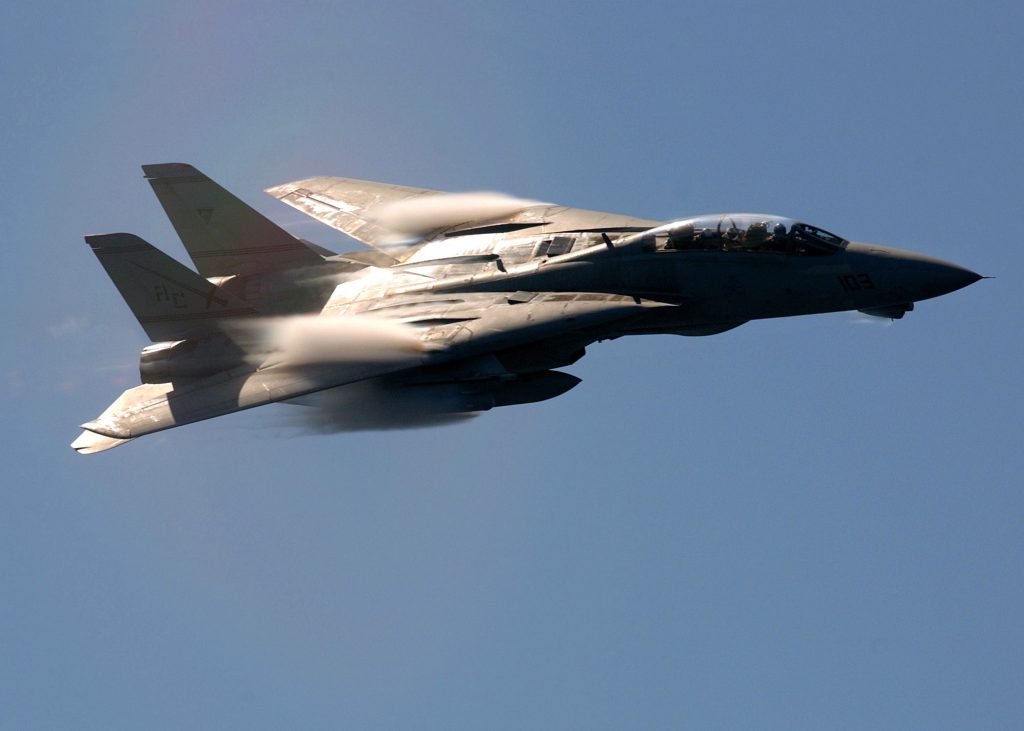
The “Maverick Act” would transfer three Tomcat fighters from US Navy storage to a state-owned museum, although the jets face an uphill battle to fly again.
US lawmakers are moving to preserve a handful of previously scrapped Grumman F-14 Tomcat fighters retired by the US Navy 20 years ago.
While the two-seat, variable-sweep-wing fighters, made famous by the 1986 film Top Gun, will not be returning to combat duty, there is a slight chance they fly again.
Proposed legislation titled “Maverick Act” seeks to authorise the US Navy to transfer three mothballed F-14s to the US Space & Rocket Center, a museum owned and operated by the state government of Alabama.
The centre is located in Huntsville, home to US Space Command and a major hub for the US aerospace and defence industries.
The Maverick Act, named for the F-14-flying protagonist from Top Gun, identifies three surplus Tomcats bearing US Navy bureau numbers 164341, 164602 and 159437 for conveyance to the Space & Rocket Center.
There are only six remaining F-14s in storage at the US military aircraft “Boneyard” in Arizona, out of the more than 630 that flew with the US Navy before the fleet-defence fighter was retired in 2006.
According to a registry maintained by the US Air Force’s 309th Aerospace Maintenance and Regeneration Group (AMARG), which operates the Boneyard at Davis-Monthan AFB, that contingent includes two F-14As, two F-14Bs and two F-14Ds.
The Maverick Act was approved by the US Senate on 28 April and now moves to the House of Representatives for consideration.

Congressman Abraham Hamadeh, who co-sponsored the bill in the House, says the aim is to save a few remaining F-14s for the purposes of cultural preservation and promoting popular interest in science, aviation education and military recruitment.
“The Maverick Act allows three of the world’s final Tomcats to be demilitarised and transferred for public display and education under strict national security safeguards,” Hamadeh said in a 17 April announcement detailing the legislative effort. “It does not restore combat capability or reopen foreign transfer.”
The bill stipulates that none of the transferred aircraft may have “any capability for use as a platform for launching or releasing munitions or any other combat capability that it was designed to have”.
However, the version of the bill passed by the Senate does leave open the possibility that one of the F-14s could be restored to flying condition for civil purposes.
While it does not authorise any funds to support that effort, it would direct the navy to transfer maintenance and operation manuals, and stipulates that the navy “may provide excess spare parts to make one of the F–14D aircraft flyable or able to complete a static display”.
The navy is explicitly not authorised to procure any items or spare parts to return the jets to flightworthy condition. Each of the three Tomcats are to be transferred in existing condition, the exact nature of which is unclear.
Fleets data from aviation analytics company Cirium lists all of the US Navy F-14s as either retired or written off due to damage. Aircraft that can be easily restored to service are typically listed as being in storage.
The inventory database from the AMARG lists all six F-14s as having been scrapped.
Restoring one of the mothballed F-14s to flight status would be costly undertaking. Grumman stopped producing new F-14Ds in the early 1990s when the Pentagon cancelled the progamme and ceased procurement.
The line was shuttered a few years later when Grumman finished work on a contract to remanufacture a number of older F-14As to the newer D-standard, which involved replacing the jets’ twin Pratt & Whitney TF30 engines with GE Aerospace F110s and installing radar and avionics upgrades and new Martin Baker ejection seats.
While US military aircraft are typically stored in excellent condition, with an eye toward potential future need, the Tomcat fleet was an exception.
Washington destroyed much of its F-14 fleet upon retirement in an effort to deprive Iran of a source for usable spare parts. Tehran had purchased 80 F-14As under the government of the Shah Mohammad Reza Pahlavi, who was overthrown by the 1979 Islamic Revolution.
Iran is the only remaining F-14 operator, though it is believed Tehran’s last Tomcat was destroyed on the ground in March by Israeli air strikes as part of the joint US-Israeli bombing campaign against Iran.

A lack of spare parts and long-defunct industrial capacity would make it extremely costly to restore one of the scrapped US F-14s to flight status, if the appropriate materials can be found at all.
However, US lawmakers appear committed to preserving the jets, if only for the purposes of a static ground display.
“The Maverick Act of 2026 creates a narrow exception to the post-retirement restrictions that have destroyed nearly all F-14s, ensuring that its legacy is preserved,” says Congressman Hamadeh, a US Army veteran.
The legislation has support from several notable legislators, including former astronaut and Grumman A-6E Intruder pilot Senator Mark Kelly of Arizona.
Montana Senator Tim Sheehy, a former US Navy commando and founder of private aerial firefighting company Bridger Aerospace, also supports the Maverick Act.
A vote on the F-14 preservation bill has not yet been scheduled in the House. If passed by both chambers, the legislation would go to US President Donald Trump for a signature.
The post US Congress moves to preserve three F-14s, with possibility of a return to flight first appeared on FlightGlobal.