


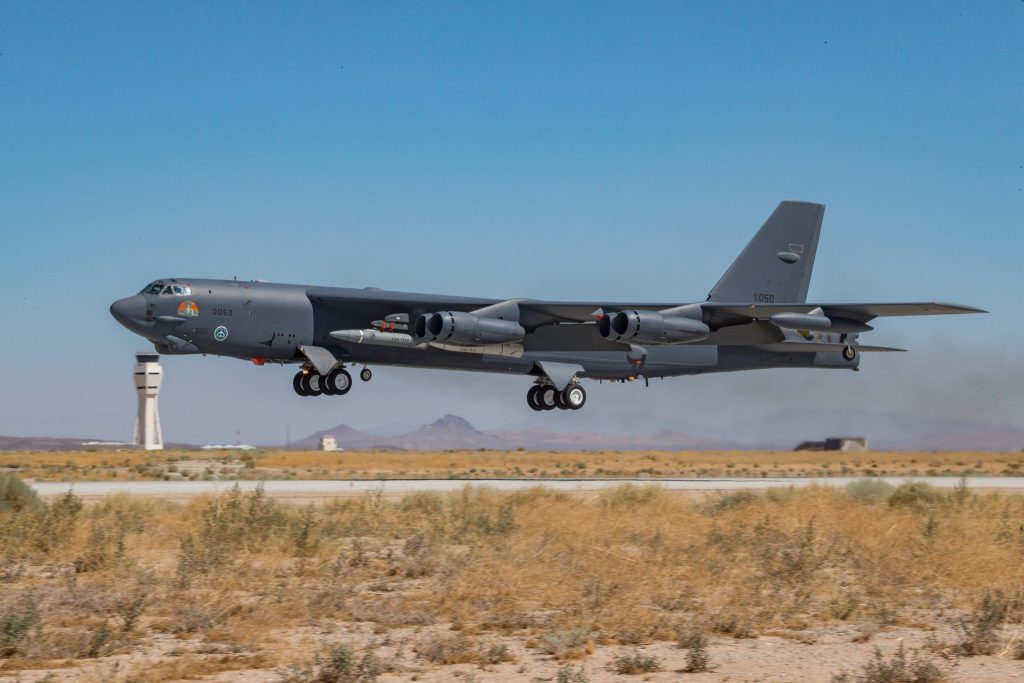
The Rolls-Royce F130 low-bypass turbofan is set to replace the eight Pratt & Whitney TF33 engines currently installed on B-52 heavy bombers.
The US Air Force effort to re-engine the Boeing B-52H heavy bomber has passed a key technical milestone.
The air force confirmed on 4 May that the B-52 upgrade effort, known officially as B-52J Commercial Engine Replacement Program (CERP), has passed what is known as a critical design review.
As part of the review process, representatives from the USAF, Boeing and propulsion supplier Rolls-Royce completed a technical assessment designed to ensure the new engine meets all performance requirements before any production or modification work begins.
“It’s that point that you go from having a concept turned into a design, to then turning that design into something physical – something that we will test and field for Air Force Global Strike Command,” says Lieutenant Colonel Tim Cleaver, CERP programme manager for the Air Force Life Cycle Management Center.
The re-engined B-52 configuration has been dubbed the B-52J by the US Air Force.
Rolls-Royce already passed its own separate critical design review in 2024, kicking off initial low-rate assembly on the F130 engine at the heart of “Juliet” upgrade. The low-bypass turbofan is derived from the 16,900lb (75kN)-thrust BR725 commercial turbofan that powers Gulfstream G650ER business jets.
That 2024 review of the F130 covered the technical performance of the engine itself, including mounting in the B-52’s distinctive twin-pod configuration. Subsequent ground tests evaluated the F130 under realistic mission conditions such as long-duration, high-altitude flights and operating with turbulent airflow.

The latest critical design review covered the CERP project as a whole, including integrating the F130 into the B-52 airframe. That milestone now allows the USAF to go ahead with plans to modify two B-52Hs with the new the F130 engines.
Boeing is the prime contractor for the effort under a $2 billion deal signed in late 2025.
“CDR is a milestone that showcases the kinds of complex systems engineering, propulsion integration, structural analysis and electrical architecture challenges our teams get to dive into every day,” says Jamie Burgess, general manager of Boeing’s mobility, surveillance and bombers unit.
“[That] work led to a finalised design and puts us one step closer to modifying the first two B-52H aircraft into the B-52J configuration in San Antonio later this year,” he adds.
In addition to new engines, the USAF is separately working to outfit the B-52H fleet with new Raytheon AN/APQ-188 active electronically scanned array (AESA) radars to replace the bomber’s current Northrop Grumman AN/APQ-166 mechanically scanned sensor, which the air force describes as “antiquated and failing”.
The AN/APQ-188 is based on Raytheon’s widely-used AN/APG-79 radar, which Boeing F/A-18E/F Super Hornets and EA-18G Growler electronic attack fighters carry.

Other onboard systems being modernised include communications for both conventional and nuclear missions, and avionics. The jets’ crew compartments are also being updated.
Flights with the first AN/APQ-188-equipped B-52H began in December following extensive modification work at a Boeing facility in San Antonio, Texas. That aircraft was ferried to Edwards AFB in California where pilots and flight engineers from the 419th Flight Test Squadron are conducting ground and aerial trials throughout 2026.
Two F130-equipped B-52J test aircraft will undergo their own regimen of evaluations at Edwards, according to the air force. Once that campaign is complete, the service says it will develop a plan for modifying the remainder of the B-52H fleet with the new engines.
There are 76 B-52Hs currently in active service, with the B-52J programme projected to meet initial operating capability (IOC) in 2033.
Boeing says the various improvements will keep the B-52 mission capable into the 2050s.
That means individual aircraft could reach a staggering 100 years of frontline service, with the first B-52 entering service in 1955.
The oldest B-52s are already 65-years old, according to fleets data from aviation analytics company Cirium. None of the 76 jets still flying are less than 63-years old.
The post B-52 re-engine initative passes critical design review first appeared on FlightGlobal.