


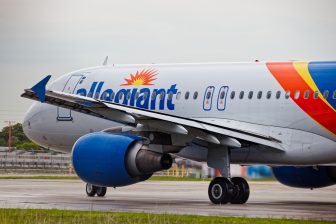
Allegiant insists demand for leisure travel remains strong despite elevated fuel prices.
US discount carrier Allegiant Air is cutting some flights as part of a capacity-reduction effort aimed at countering elevated fuel costs, but the airline insists it is better positioned than competitors to weather market stress.
“The sharp rise in fuel prices will weigh on near-term industry profits. We are not immune,” Gregory Anderson, chief executive of Allegiant parent Allegiant Travel Company, said on 30 April during the Las Vegas firm’s first-quarter earnings call.
“We are navigating the volatility by reducing off-peak capacity where margin pressure is most acute. We have also reduced service on some of our longer-stage-length routes where the hurdle on fuel cost is higher,” he adds, noting Allegiant has not yet found the need to trim flying on high-demand days.
Anderson’s comments came the day Allegiant Travel reported first-quarter results that included a $42.5 million profit, up 32% year on year. The company’s operating revenue during the period jumped 5% year on year to $732 million. Its first-quarter operating expenses inched up 2.7% year on year to $651 million, with fuel costs alone jumping 8.4% to $180 million.
“Our cost structure remains the best in the industry,” Anderson says. “We have a very strong financial position, and that will even be stronger as we join forces with Sun Country.”
Allegiant Travel intends to close its acquisition of Minneapolis-based Sun Country Airlines Holdings on 13 May. The deal stands to give the combined company scale that could help it better compete against much bigger players.
FARES UP
Jet fuel prices had been relatively stable at roughly $2.30 per gallon until they surged at the end of February, ultimately roughly doubling, in response to the US-Israel war against Iran and the resulting near-total closure of the Strait of Hormuz.
Like other airlines, Allegiant has raised fares in response, reporting an average first-quarter fare of $162, up 15% from $142 the prior quarter.
“Despite the macro uncertainty, our customer base continues to show strong intent to travel,” says chief commercial officer Drew Wells.
Allegiant’s capacity drawbacks will leave it with roughly 6.5% fewer available seat miles in the second quarter, compared to the same period of 2025. It expects its capacity will be flat or decline slightly year on year in the third quarter.
Allegiant ended March with cash and cash equivalents valued at $283 million, up from $173 million three months earlier.

Analysts generally view Allegiant as financially healthier than other US discounters like Frontier Airlines and Spirit Airlines, the latter of which is now operating under bankruptcy court supervision. Those carriers grew rapidly in the past decade to compete head-to-head in major markets with the “Big Four” US airlines — American Airlines, Delta Air Lines, Southwest Airlines and United Airlines.
By contrast, Allegiant’s growth has targeted secondary leisure markets with limited competition. It operates most of its flights on days when demand is greatest and flies little on other days.
The airline is now updating its once-all-Airbus A320-family fleet with Boeing 737 Max 8-200s. It received one 737 Max and retired one A320 during the first quarter, ending March with 123 jets, including 17 737 Max and 106 Airbus narrowbodies.
In the second quarter, Allegiant plans to receive three more 737 Max and retire one A320. It expects its expanding Max fleet will account for about 20% of its total 2026 capacity, increasing to 50% by 2028.
The post ‘Not immune’: Allegiant trims capacity amid elevated fuel prices first appeared on FlightGlobal.