Thursday, October 8, 2026

RAMP: Hybrid DRL for Online Learning of Numeric Action Models

arXiv:2604.08685v1 Announce Type: new Abstract: Automated planning algorithms require an action model specifying the preconditions and effects of each action, but obtaining such a model is often hard. Learning action models from observations is feasible, but existing algorithms for numeric domains are offline, requiring expert traces as input. We propose the Reinforcement learning, Action Model…
Sustained Impact of Agentic Personalisation in Marketing: A Longitudinal Case Study

arXiv:2604.08621v1 Announce Type: new Abstract: In consumer applications, Customer Relationship Management (CRM) has traditionally relied on the manual optimisation of static, rule-based messaging strategies. While adaptive and autonomous learning systems offer the promise of scalable personalisation, it remains unclear to what extent ``human-in-the-loop'' oversight is required to sustain performance uplift over time. This paper presents…

From Business Events to Auditable Decisions: Ontology-Governed Graph Simulation for Enterprise AI

arXiv:2604.08603v1 Announce Type: new Abstract: Existing LLM-based agent systems share a common architectural failure: they answer from the unrestricted knowledge space without first simulating how active business scenarios reshape that space for the event at hand -- producing decisions that are fluent but ungrounded and carrying no audit trail. We present LOM-action, which equips enterprise…

OpenKedge: Governing Agentic Mutation with Execution-Bound Safety and Evidence Chains

arXiv:2604.08601v1 Announce Type: new Abstract: The rise of autonomous AI agents exposes a fundamental flaw in API-centric architectures: probabilistic systems directly execute state mutations without sufficient context, coordination, or safety guarantees. We introduce OpenKedge, a protocol that redefines mutation as a governed process rather than an immediate consequence of API invocation. OpenKedge requires actors to…

Why opinion on AI is so divided

This story originally appeared in The Algorithm, our weekly newsletter on AI. To get stories like this in your inbox first, sign up here. In an industry that doesn’t stand still, Stanford’s AI Index, an annual roundup of key results and trends, is a chance to take a breath. (It’s a marathon, not a sprint, after…

Want to understand the current state of AI? Check out these charts.
AI

Want to understand the current state of AI? Check out these charts.

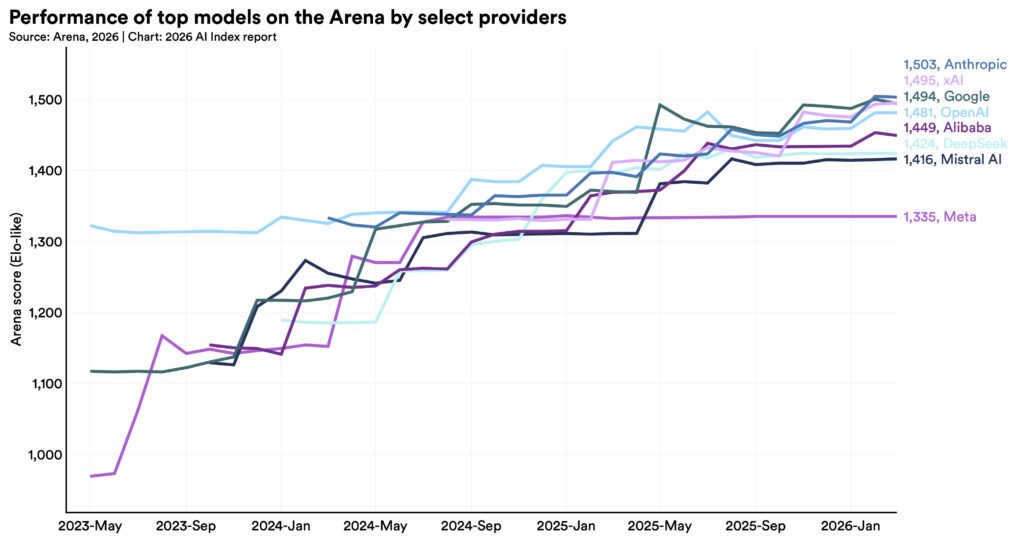
If you’re following AI news, you’re probably getting whiplash. AI is a gold rush. AI is a bubble. AI is taking your job. AI can’t even read a clock. The 2026 AI Index from Stanford University’s Institute for Human-Centered Artificial Intelligence, AI’s annual report card, comes out today and cuts through some of that noise. …

You have no choice in reading this article—maybe

Uri Maoz loved doing his human research, back when he was getting his PhD. He was studying a very specific topic in computational neuroscience: how the brain instructs our arms to move and how our gray matter in turn perceives that motion.  Then his professor asked him to deliver an undergrad lecture. Maoz assumed his…

Job titles of the future: Wildlife first responder

Grizzly bears have made such a comeback across eastern Montana that in 2017, the state hired its first-ever prairie-based grizzly manager: wildlife biologist Wesley Sarmento.  For some seven years, Sarmento worked to keep both the bears, which are still listed as threatened under the Endangered Species Act, and the humans, who are sprawling into once-wild…