


A win in two sixth-generation programmes secures Boeing’s fighter enterprise for the next 50 years, while leaving other manufacturers out in the cold.
In choosing Boeing to supply its next tactical fighter, the US Navy has handed the US aerospace giant a solid lock on the development and production of a new generation of aircraft, the like of which has not been seen in decades.
The Pentagon’s decision to award Boeing the contract to build the navy’s still-unnamed F/A-XX carrier-based sixth-generation fighter follows Boeing’s 2025 win in the US Air Force’s Next Generation Air Dominance (NGAD) competition that spawned the F-47 fighter.
Not since Lockheed Martin made a clean sweep of fifth-generation fighter development with the F-22 and F-35 series has one company so thoroughly dominated the competitive landscape for new tactical aircraft.
It is a stunning reversal of fortune for Boeing, which only a few years ago seemed to be on the verge of losing its fighter manufacturing enterprise altogether. The company’s venerable F/A-18E/F Super Hornet is winding down production. As recently as 2024, the US Air Force planned to order fewer than 100 examples of the latest F-15EX.
That left only the T-7 Red Hawk advanced trainer and MQ-25 uncrewed refueller to carry Boeing’s air dominance unit longer term.
“It wasn’t looking good for a while,” says Tony Bancroft, a former US Marine Corps fighter pilot who now manages the GCAD defence and aerospace ETF for Gabelli Funds.
A short two years later and Boeing has secured two sixth-generation development programmes, each worth around $20 billion just in their initial phases.
“It’s just an incredible rags-to-riches story,” says Richard Aboulafia, managing director of AeroDynamic Advisory. “I don’t think there’s anything like it in the industry, historically.”

Aboulafia, who has in the past been a prominent critic of Boeing, credits the removal of former chief executive Dave Calhoun and the appointment of CEO Kelly Ortberg in 2024 as an inflection point in the company’s turnaround.
“Dave Calhoun was an extreme disaster,” Aboulafia says. “He was seen as a guy who was just in harvest mode, and he was. Kelly Ortberg is an engineer with an idea about the future, and he’s appointed people who have ideas about the future and a willingness to invest in the future.”
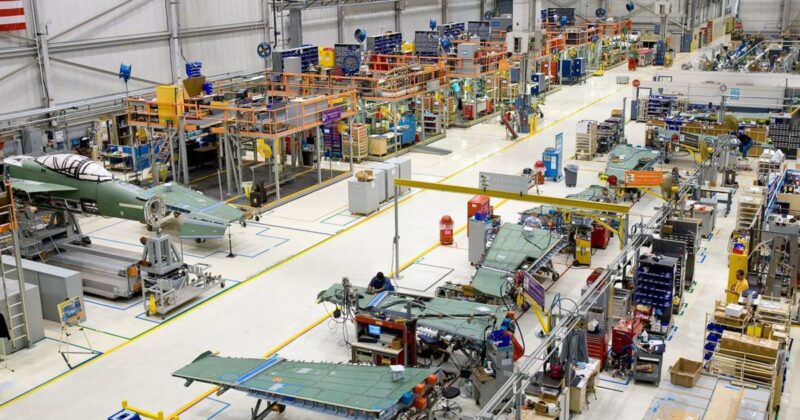
One such investment was a nearly $2 billion outlay to build a classified factory for advanced combat aircraft — before the company had won any firm contracts. Although that project was initiated before Ortberg took the helm, Aboulafia says the combination of “skin in the game” and a steady hand at the top ultimately convinced decision-makers at the Pentagon.
“It’s huge,” concurs Bancroft. “They went from two dead fighter lines, for the most part, and now they’ve got the two next generation [fighters].”

The company’s fortunes on the F-15EX have also notably reversed, with 120 jets now under contract for the USAF and the service signalling it intends to buy up to 268 Eagle IIs.
Although the Trump Administration was initially adamant that the US aerospace industry could not support two sixth-generation development programmes simultaneously, Boeing clearly addressed those concerns.
“Delivering two advanced fighters in parallel was always our plan, and we invested accordingly,” says Steve Parker, chief executive of Boeing Defense, Space & Security. “We are ready and able to build multiple concurrent future combat aircraft franchise programmes.”
Grumman Grounded
So what does that mean for Boeing’s main rivals?
There are only three US companies with the demonstrated ability to design and produce crewed tactical jets: Lockheed Martin, Northrop Grumman and Boeing.
Although the details are classified, Northrop was all but certainly the other finalist for the F/A-XX contract, after Lockheed was eliminated by the navy in 2025. Northrop had shared renderings of an advanced carrier-based fighter earlier this year and in August unveiled a new engineering facility aimed at supporting the design and production of a sixth-generation aircraft.
The company has been out of the fighter game since its YF-23 Black Widow II prototype lost out to Lockheed Martin’s YF-22 in 1991. The last frontline fighter with a Northrop pedigree was the US Navy’s iconic variable-sweep Grumman F-14.
The company’s YF-17 prototype also became the basis for the venerable McDonnell Douglas (now Boeing) F/A-18 Hornet and Super Hornets that are still flying today.
Northrop had been hoping to get back into the fighter business with its F/A-XX bid after voluntarily withdrawing from the US Air Force’s sixth-generation tender.

With the recent loss, the prospect of the company ever building another manned fighter is “not looking great”, Aboulafia concludes.
That, however, is not necessarily a significant concern for Northrop.
The company is already on contract to build the USAF’s crewed B-21 stealth bomber, which, although not a fighter, is often billed as a sixth-generation aircraft. Northrop was also selected to modernise the Pentagon’s arsenal of land-based intercontinental ballistic missiles — another massive revenue stream.
“Those are going to be two amazing systems… and they are going to keep the US in the lead for a very long time,” says Bancroft.
After winning both the Cold War-era B-2 stealth bomber and the forthcoming B-21, which is currently in late-stage flight testing ahead of a 2027 service entry, Northrop can credibly claim to be the world’s leading bomber manufacturer.
“It’s not the end of the world,” says Aboulafia of the F/A-XX loss, describing Northrop as a “very well-run company” with a successful strategy of targeting Washington’s so-called nuclear triad.
Northrop is notably also a key aerostructure and component supplier on the F-35 programme. Aboulafia suggests the company may similarly get a piece of the F/A-XX or F-47 as a supplier to Boeing, leveraging its experience on the B-21.
One key unknown is how far along Northrop’s F/A-XX prototyping programme was. Unlike the air force, which confirmed that both Boeing and Lockheed were secretly flying NGAD competitive prototypes for several years before the contract decision, the navy has not publicly commented on the maturity of the two designs.
Lockheed Locked Out
While Northrop can still lay claim to a sixth-generation aircraft with the B-21, Lockheed Martin has been fully iced out, at least for now.
“It doesn’t get any more eyes off the prize than Lockheed these days, I’m afraid,” says Aboulafia.
In his estimation, Lockheed committed an “end of history” strategic error, assuming all future fighters would be some evolution of the company’s prolific F-35 fifth-generation multi-role type, rather than taking a radically different design approach.
“I think they went down the F-35 path to the exclusion of a generation beyond that,” Aboulafia says. “It certainly seems that they lost sight that there would be a generation beyond that.”
In the near term, neither Aboulafia nor Bancroft are overly concerned about Lockheed’s fortunes.
“They still have Skunk Works, and obviously collaborative combat aircraft are coming into view,” Aboulafia says, referring to the new class of uncrewed fighters commonly known as CCAs. “So hopefully they’ll rethink and take a more aggressive approach. I think they’re already starting to do that.”
“They’ve got a lot of irons in the fire right now,” agrees Bancroft.

Lockheed is developing a high-performance, survivable CCA called Vectis, which the company is positioning as an ideal supplement to the F-35. In September, the company announced plans to expand its fleet of Vectis prototypes to five jets.
Key structures for the first Vectis are already being fabricated.
Elsewhere, Lockheed is still the largest defence contractor in the world with strong positions in munitions production and hypersonic development, in addition to active lines for the C-130J transport, the F-16 fourth-generation fighter and the globally popular F-35.
“That programme is going to go on for a long time,” Bancroft says of the multi-variant single-engined stealth jet.
Although he flew the Hornet, Bancroft is unequivocal in his praise for the F-35, despite its high-profile challenges with sustainment and availability rates and Lockheed’s long-running struggles to certify the latest Technology Refresh 3 configuration.
“All my friends fly it. It is unbelievable,” he says. “In the community, they call it colloquially the “Panther” because you can’t see it. It kills you before you see it.”
Although Lockheed has lost out on the F-47 and F/A-XX, Aboulafia thinks the company may still have a shot at a next-generation fighter.

As its name implies, the F/A-XX will be a multi-role strike fighter for the navy’s carrier air wings. However, the F-47 is expected to be a pure-play air superiority platform, much as the F-22 was originally conceived.
Aboulafia expects we may see another development opportunity emerge in the future for a sixth-generation strike fighter as a successor to the F-35, one that would be a counterpart to the F-47 as the F-35 complements the F-22.
“They’re both beyond exquisite,” Aboulafia says of the F-47 and F/A-XX.
“That to me says that sometime within the F-35’s production life, there’s going to be a competition for new lower-cost, multi-role fighters. And if I were Lockheed Martin, I’d start planning for that, thinking about that, and thinking about design work that has pretty much nothing in common with the F-35.”
The US Air Force and Boeing say they will fly the first F-47 in 2028, while the navy says only that the F/A-XX will hit the fleet sometime in the 2030s, serving for a time alongside the Super Hornets it is meant to replace.
The post What Boeing’s F/A-XX win means for the US aerospace industry first appeared on FlightGlobal.