

Swiss methanol-to-jet fuel producer intends to supply eSAF to airlines from 2030 and build multiple plants, after successfully opening its first demonstration facility.
Sustainable aviation fuel (SAF) mandates help create demand and attract the investment needed to scale up an industry that is important not just for sustainability, but also for energy security and resilience, says the chief executive of a Switzerland-based start-up that has just opened its first site.
In an interview with FlightGlobal, Metafuels chief Saurabh Kapoor acknowledges the price differential between traditional jet fuel and SAF – particularly for synthetic e-fuel (eSAF) such as the Swiss firm’s under-development methanol-to-jet product – but says that government mandates and early-mover actions from airlines will help develop the industry to a point where prices will come down.
“In terms of cost, are we talking about jet fuel today, jet fuel pre-Iran or jet fuel in 2035? It’s very difficult to predict,” says Kapoor. “What’s important for us is to develop and commercialise the technology… and have the ability to scale and fit very nicely and naturally with the energy systems of tomorrow, which are not petroleum-based.”
While the first eSAF plants “are going to be expensive”, he notes, “costs will come down”. Key to that will be attracting the investment needed to build more facilities, which is where government action and pump priming initiatives from airlines are important.
Table of Contents
Mandate supporters
“We are supporters of the mandate,” says Kapoor, referencing the European Union’s ReFuel EU initiative. “Let’s assume there is no mandate for eSAF; would eSAF happen? Would the first steps be taken for an industry to be established and have the possibility to scale up? Probably not.”
ReFuel EU calls for 2% of jet fuel uplifted from the bloc’s airports to be SAF from 2025, rising gradually to 70% in 2050. A sub-mandate calls for eSAF to account for 1.2% of jet fuel from 2030, increasing to 35% from 2050.
The UK has its own mandate calling for 2% of the country’s jet fuel to be SAF in 2025, rising to 10% in 2030 and 22% in 2040, with a sub-mandate for advanced power-to-liquid synthetic e-fuels to account for 0.2% of jet fuel from 2028, rising to 3.5% by 2040.
Airlines have expressed concerns about whether SAF supplies will be sufficient for them to meet the mandates, and IATA has railed against these, arguing that their introduction before the supply chain has developed enough pushes up the cost by creating more demand for limited supplies.
But Metafuels is attracted to countries and regions where mandates are in place, or where governments are taking solid action to decarbonise aviation, and has its eyes on Asia for its first plant outside Europe.
“If you look from today’s perspective, Europe has a mandated market – EU, UK, Switzerland – so a lot of demand is here,” says Kapoor. “Then, when you look at which other countries are taking first steps towards decarbonisation of aviation, Singapore stands out and, similarly, you see Japan and South Korea taking steps.
“Asia is a growth market and we would like to go there, but this is early development – it’s not like Rotterdam where we’re in the final stages of development.”
Metafuels intends to supply methanol-to-jet eSAF to market in time for the EU’s 2030 sub-mandate. The company opened its first “aerobrew” demonstration plant at the Paul Scherrer Institute in Villigen, Switzerland on 20 August, where it will convert renewable methanol – produced from green hydrogen and captured carbon dioxide – into drop-in eSAF.
The process delivers up to 90% lower lifecycle emissions than fossil kerosene, according to Metafuels. Unlike existing SAF pathways, which are reliant on “limited feedstocks” such as used cooking oils, the start-up says its methanol-to-jet route offers a “highly scalable way to meet long-term aviation demand”.
Removing risks
The Swiss plant will serve to de-risk the process ahead of building Metafuels’ first commercial facility in Rotterdam, known as Turbe, which is in the front-end engineering and design phase and aims to produce 10t of eSAF per day from 2030.
This capacity is “relatively small|”, says Kapoor, but is “commercially relevant” and precedes a bigger scale-up under Phase 2 of the project.
“Phase 1 is a stepping stone – it’s a journey we have to go through from a risk-management perspective,” he notes. “The target is to develop a lot of plants. When Rotterdam Phase 1 is under construction, we will be developing Phase 2, as well as a series of scale-up projects both in Europe and outside Europe.

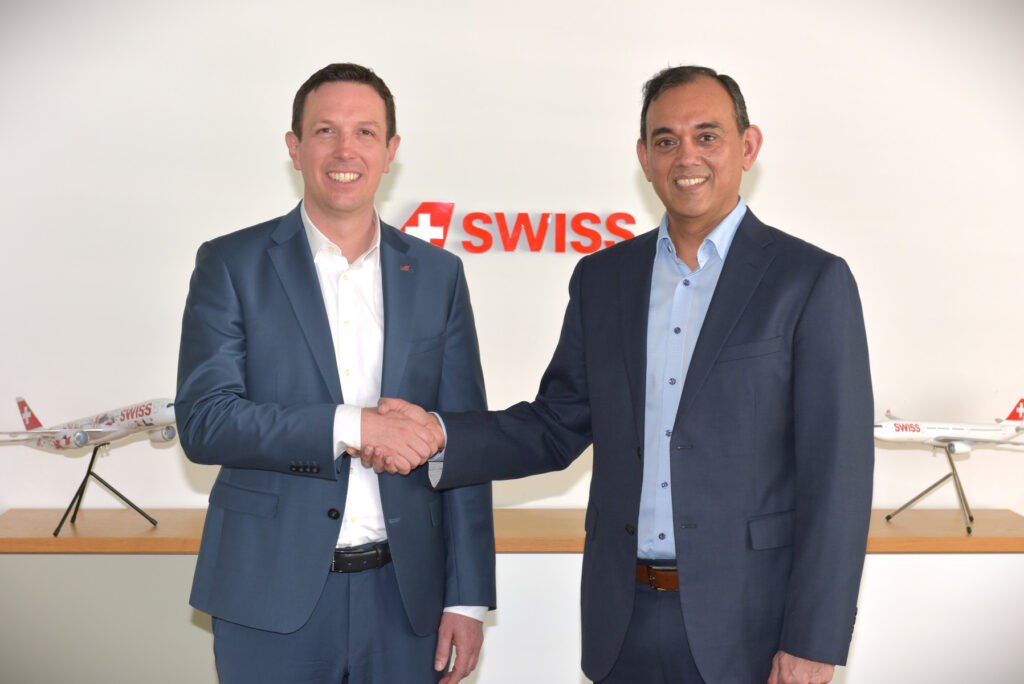
Metafuels has signed an MoU with Swiss aimed at scaling the firm’s eSAF technology (l-r Swiss chief executive Jens Fehlinger and Metafuels’ Kapoor). Source: Swiss International Air Lines
Zurich-based Metafuels is working in partnership with Swiss International Air Lines and its parent company, Lufthansa Group, and is keen to partner with other carriers. While Kapoor says its “ultimate objective” is to sign fuel off-take agreements with airlines, neither Swiss nor the wider Lufthansa Group have committed to buying the company’s product at this stage.
“What we have with Swiss and Lufthansa is a partner where we work actively to have these first projects done,” he says. “We look for a partner who’s a long-term partner – not just off-taking but also trying to develop these things efficiently to our collective advantage.”
Swiss tells FlightGlobal its memorandum of understanding with Metafuels is aimed at “supporting the further development, scaling and market introduction of Metafuels’ SAF technology”.
The spokesperson adds: “As part of the partnership, Swiss and the Lufthansa Group are also considering entering into long-term off-take agreements in the future, once the technology progresses towards commercial production. However, no specific volumes or commitments have been agreed at this point.”
Merits of methanol
Kapoor says the benefits of using methanol over other feedstocks are that it is “already one of the largest traded chemical commodities” and, because it is a liquid, “it’s easy to move around”.
“If you talk about e-methanol specifically, it makes sense to produce it where renewable energy is abundant, so this could be in the sunbelt, and then you supply that methanol to a project like ours in Rotterdam, which is in a port,” he explains.
Kapoor emphasises that sustainable aviation fuel is “not just about sustainability; it’s also about energy resilience, energy safety and reducing dependence on volatile areas”.
“There’s always an advantage in making sure your primary feedstocks are domestic, or you’re able to source your feedstock from a wide range of countries, rather than being dependent on a couple of countries like with petroleum,” he says.
Returning to the subject of SAF mandates and how they are rolled out, Kapoor praises the European Commission for taking a “carefully tailored” approach.
“This gradual introduction, starting with lower quantities, gives industries time to plan, time to adapt and time to adjust and improve from the regulatory side,” he says. “So, the 2% that has been enforced since 2025 is not a lot, but it’s making a value chain operate and providing real-time feedback to all stakeholders.”
Providing incentives
He also points to the Commission’s decision to accelerate the use of SAF by allocating free allowances under the EU emissions trading system (ETS) to airlines that commit to using it, noting: “What needs to happen is these initial plants get built and the first-mover airlines are actually encouraged rather than punished for being first movers, and then you take the whole industry from there.”
The Commission also approved in July, under EU state aid rules, two Dutch schemes with a combined budget of €290 million ($338 million) to support the development of eSAF and advanced bio-SAF projects that do not use the hydroprocessed esters and fatty acids (HEFA) process.
Metafuels was itself the recipient of a €1.92 million grant from the Dutch government to advance its Rotterdam eSAF project.
Metafuels is among a number of eSAF start-ups working to develop this type of fuel ahead of the introduction of the sub-mandates. Another supplier, Syntholene – which completed construction of a geothermal demonstration facility in Iceland earlier this year – told FlightGlobal in June that it aims to provide eSAF at a price that is 70% lower than competing products.
This points to a competitive market where cost will be king. But Kapoor is not concerned by his rivals: “If I am selective with my technology and if I have the right partnerships, then I already go a long way in making sure the fuel is more competitive and better than what’s available from the competition.”
The post SAF mandates work and costs will eventually come down: Metafuels chief first appeared on FlightGlobal.