



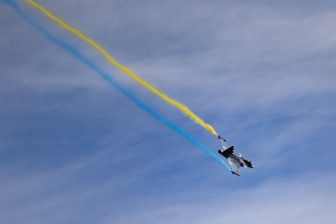
Airframer has promised to establish a domestic final assembly line if it secures a deal from Ottawa amid growing demand for fighter.
Saab continues to eye an opportunity to build its Gripen fighter in Canada as the collapse of trade talks threatens to further cool Ottawa’s appetite to acquire more Lockheed Martin F-35s.
Relations between Ottawa and Washington were already strained prior to the breakdown in negotiations on 21 August, but the subsequent imposition of tit-for-tat tariffs has plunged them to a new low.
Canada has already ordered 16 F-35s against a stated total requirement for 88 aircraft.
However, it has also been reviewing the options, notably whether to reduce its commitment to the Joint Strike Fighter and instead pivot to a two-type fleet.
As part of its pitch to Canada, Saab has proposed the creation of a new domestic final assembly line for the Gripen E/F – a third such facility on top of existing plants in Brazil and Sweden.
Speaking to journalists at Malmen air base shortly after news emerged that the US-Canada trade talks had broken down, Saab chief executive Micael Johansson said he thought Ottawa would still buy a quantity of F-35s.
“I don’t think Canada will give up the F-35 completely; they will go forward with that to some extent,” he says.
But Johansson thinks that a combination of the F-35 and Gripen would be the “perfect” option: “You get the availability, the combat mass flying Gripen,” he says.
Additionally, the Swedish jet would offer greater operational flexibility thanks to its ability to operate from roads as well as runways: “You get to use all kinds of airstrips that you cannot use with the F-35,” he notes.
“So having both is actually, from my perspective, Canada’s perspective, a perfect match.”
Engine supply
One potential stumbling block, however, is the “quite substantial” level of US content on the Gripen, including its GE Aerospace F414 engine.
But Johansson remains sanguine over the potential for Washington to restrict the transfer of engines or other parts to Canada as a retaliatory measure.
Any such move, he says, would be “completely transformational to the level playing field” and so far, “we have seen no signs of that”.
“We have all the [export] licences, so I’m just moving forward to assume that the rules of play will be fine because if they start doing that, it would be really detrimental.”
Besides, he says, if the US is not selling the whole aircraft to a country “this is absolutely the second best [solution]”.
Saab has been clear on the industrial capability it is offering Ottawa “and how we want to create an aerospace hub in Canada, fully building fighters in Canada.”
While it would not be a direct copy of the facility it set up in Brazil following the Gripen’s acquisition by the Latin American country, “we’ve shown that we’ve done it before in Brazil so we can do it in Canada.”
Establishing another production line would be a “win-win for us”, giving Saab more capacity to cope with growing global Gripen demand.
Its 117-unit backlog includes E- and F-model aircraft for Brazil, Colombia, Sweden and Thailand, with a firm contract signing expected in the coming months with Ukraine for 16 jets. Additionally, Sweden is likely to top up its order book to backfill for 12 earlier C/D-variant Gripens it has donated to Kyiv.
But with Ukraine in October last year having declared a requirement for up to 150 Gripens, there is clearly a need to raise output.
Saab is already “investing heavily” to raise output at Linkoping to 25-30 Gripens annually, a project that is “on track”, says Johansson.
“But… the business case in Ukraine and potentially demand in other areas will also require Brazil to step up, which is important to us.
“We have a hub in Brazil, and definitely, if Canada selects co-supply [the Gripen and F-35], we will build a fully fledged hub in Canada”, with output from it starting within five years.
“But… the business case in Ukraine and potentially demand in other areas will also require Brazil to step up, which is important to us,” he adds.
“We have a hub in Brazil, and definitely, if Canada selects co-supply [the Gripen and F-35], we will build a fully fledged hub in Canada.”
Output from a Canadian Gripen line could start within five years, Johannson says.

Meanwhile, with the implosion earlier this year of the Future Combat Air System programme between France, Germany and Spain, there has been speculation that Sweden – and by extension Saab – could end up in partnership for the development of a sixth-generation fighter.
Johansson says although the airframer is not in an “urgent situation” where it needs to jump into a new programme, it is nonetheless talking to other companies to monitor market developments.
However, there are no “real collaboration discussions right now”, he stresses, describing Saab as “agnostic but knowledgeable about what’s going on”.
Additional exchanges between governments and their defence ministries are also ongoing.
Saab’s participation in a joint programme would be decided by the Swedish government, he points out.
“At the same time, we have open doors, but I have no exact plan right now which way it is going to go. I do respect the fact that market volume and scale is important, but we will see.”
Assuming Sweden pursues its own Gripen successor and France forges ahead with its own development while the Global Combat Air Programme (GCAP) involving Italy, Japan and the UK remains on track, there could be at least three sixth-generation fighters developed in Europe in the coming years, or potentially even four depending on what Germany and Spain decide.
“Money will drive this, of course. Capability alignment will drive it,” says Johansson.
“But if you have completely different views on what you need as a manned fighter capability in 2045, there will be several sorts of fighters, and I’m not so sure that’s so bad if we can do it in an efficient way.
“How many different manned fighters will there be in Europe? I have no clue. There could be consolidation as well in the end because it’s not affordable. I don’t know.”
However, given Sweden’s doctrine of agile combat employment driving the development of smaller fighters, “I can’t see that we would be looking at something like 35-, 40-ton type of fighter capabilities,” he says, a nod to the size of the aircraft being proposed by the GCAP partners.
“But why wouldn’t we add a CCA to a consortium like that? That could absolutely happen.”
Capability enhancement
Meanwhile, Saab continues to add new capabilities to the Gripen. This includes the recent test firing of a Taurus KEPD 350 cruise missile from the jet – a joint development between Saab and MBDA – and last year’s campaign to integrate and test fly Helsing’s Centaur AI agent, during which it demonstrated beyond visual range (BVR) combat capability.
Johan Segertoft, head of the Gripen business unit, says the design of the aircraft’s digital backbone enables upgrades to be fielded at unprecedented speed. The AI agent integration was completed in just 10 weeks, he notes.
And development of that capability has continued: “We haven’t told anyone what we’re doing since then. But of course, you can understand that we are doing a lot of things behind the scenes.
“We chose BVR because it’s one of the most complex things to prove that we could take third-party software and do it, but there’s a lot of things in an aircraft and outside an aircraft that benefit from the advancement of software,” he says.
Since the Gripen E’s first flight in 2017, Saab has implemented 300 capability upgrades, he says, compared with a theoretical maximum of around five in competing aircraft.
“Think about the difference that means – our normal pace within the company now is that we are flying a new version every week,” he says.
Saab’s mantra is “code in the evening, deploy in the morning, learn by lunch”, Segertoft adds.
The company is also working with the Swedish air force and the US Air Force Research Laboratory on a project related to the control of collaborative combat aircraft by a manned fighter.
“We’ve been doing this for quite some time. We are now entering the phase where we’re doing flight tests simply because the Gripen E is the only platform that you are capable of doing rapid development like this,” he says.
The post Saab still shooting for Gripen E sale to Canada as it targets production ramp-up first appeared on FlightGlobal.