



High-end capability could enter service by the middle of the 2030s if awarded a development contract, the Swedish airframer says.
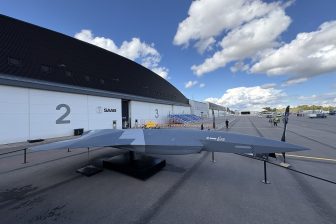
Saab has unveiled a mock-up of a new autonomous collaborative platform (ACP) that it believes could become the successor to a pair of uncrewed technology demonstrators it is developing for the Swedish defence ministry.
Revealed at an event to celebrate the Swedish air force’s 100th anniversary at Malmen air base near Saab’s Linkoping home, the model – referred to by the airframer as aircraft A3 – is designed to illustrate capabilities that could be incorporated on any future production platform.
Briefing journalists on 21 August, Peter Nilsson, head of business unit advanced programmes, said Saab aims to be a “first-mover in the segment” for high-end ‘loyal wingman’ aircraft.
It is already contracted by Sweden’s FMV defence materiel administration to build a pair of demonstrators – A1 and A2 – the first of which will fly “within the next 15 months”, says Nilsson.
Powered by a single 22,000lbf (98kN)-thrust GE Aerospace F414 engine, the same powerplant that equips the company’s Gripen E manned fighter, the goal of the A1 aircraft is to “demonstrate that we can build a [low-observable] configuration”, he says.
Additionally, Sweden stipulated that “we go from concept to first flight within 36 months”, a timeline he calls “quite challenging”.
This will be followed by the A2 demonstrator, which will showcase other technologies including new materials, sensors and an internal weapons bay.
“On A1 we have made room for an internal weapons bay but we will not shoot anything from it. A2 will have an internal weapons bay,” he says, without elaborating further.
Nilsson says the two demonstrators will be “not quite” identical, but offers little additional detail on the A2’s configuration save that it will also be powered by the F414.
He says the engine was selected for the demonstrators as “we know it quite well”, but the supportability of any future production aircraft for Sweden was also a factor.
However, the company is also talking to other potential propulsion suppliers as it continues to scope out the market.
Saab’s current demonstrator contract runs until 2030 and Nilsson stresses that there has been no agreement with Sweden to advance the ACP programme to a prototype or development stage.
“We have floated the view that this would be a great asset to the Gripen E, but right now there is no commitment.”

He says Saab may self-fund early development activities related to the A3 “but if a customer does not come along I don’t know when my CEO will stop me spending – you need a customer to buy into this”.
Saab sees an advanced ACP – featuring a low-observable configuration and supersonic performance – as being able to perform “high-risk missions in heavily defended airspace” such as electronic warfare, suppression of enemy air defences, deep precision strike and air-to-air combat.
Should a development contract be forthcoming around 2030, first flight of the A3 aircraft could take place in the early part of next decade, with initial operational capability from the mid-2030s, according to a timeline disclosed by Nilsson.
He thinks the architecture of the high-end platform could help to bridge to a future Gripen successor in the period beyond 2055, development of which could start in the middle of next decade.
Sweden continues to evaluate its options for a future fighter, with a decision on the way forward expected in the 2028-2030 timeframe.
Brigadier Niclas Magnusson, deputy commander of the Swedish air force, says it is encouraging Saab’s experimentation to inform any future decision.
“We have to research and find the limits of what we are able to do. The collaboration between the air force and industry has to become much closer.”
Although he emphasises that no decision has been taken, Magnusson expects Sweden’s future air force to comprise a mix of crewed and uncrewed aircraft.
Meanwhile, Saab is edging closer to the first flight of its ‘Ruby’ uncrewed technology demonstrator, a platform developed by its Rainforest technology incubator.
Nilsson says the milestone has been delayed by the need to rebuild the aircraft’s wing after the first iteration “didn’t work”, but should it get airborne it will prove a concept that includes the “world’s largest 3D-printed airframe” and avionics derived from mobile phone technology.
He sees it as a means for Saab to tackle the low-cost end of the uncrewed aircraft segment: despite its 6.5m (21ft) length it has been relatively inexpensive to produce.
“I won’t say the cost… but you wouldn’t believe it; it’s more or less that I could pay for it myself.”
The post Saab takes wraps off new ‘loyal wingman’ concept first appeared on FlightGlobal.