

The funds come from the Runway Independent Maritime Expeditionary Strike initiative.
Autonomy start-up Shield AI has secured a $50 million investment from the US Navy and the Defense Innovation Unit (DIU) to support development of the X-Bat combat drone.
The funding was announced on 13 August as part of the Runway Independent Maritime Expeditionary Strike (RIMES) initiative, a joint project of the navy and DIU to field an unmanned aircraft able to take off and land vertically from ship decks.
The navy’s Portfolio Acquisition Executive office for aviation says the investment is meant to “rapidly scale our unmanned aviation portfolio”.
Shield AI launched development of the X-Bat in 2025 using internal company funding. The jet-powered drone is meant to launch and recover from a mobile rail system, which can be deployed via truck or shipping container, eliminating reliance on fixed airfields.
Each X-Bat will offer a range beyond 2,000nm (3,700km) and operate at altitudes of 50,000ft without any pilot inputs, controlled instead by Shield AI’s Hivemind autonomy software. A single GE Aerospace F110 turbofan will power each X-Bat.
An initial prototype aircraft will also be equipped with a unique thrust vectoring system developed by GE in the 1990s as part of experiments aimed at improving the aerodynamic performance of the Lockheed Martin F-16.
Two such prototypes have already been assembled by Shield AI, with work on a third under way.
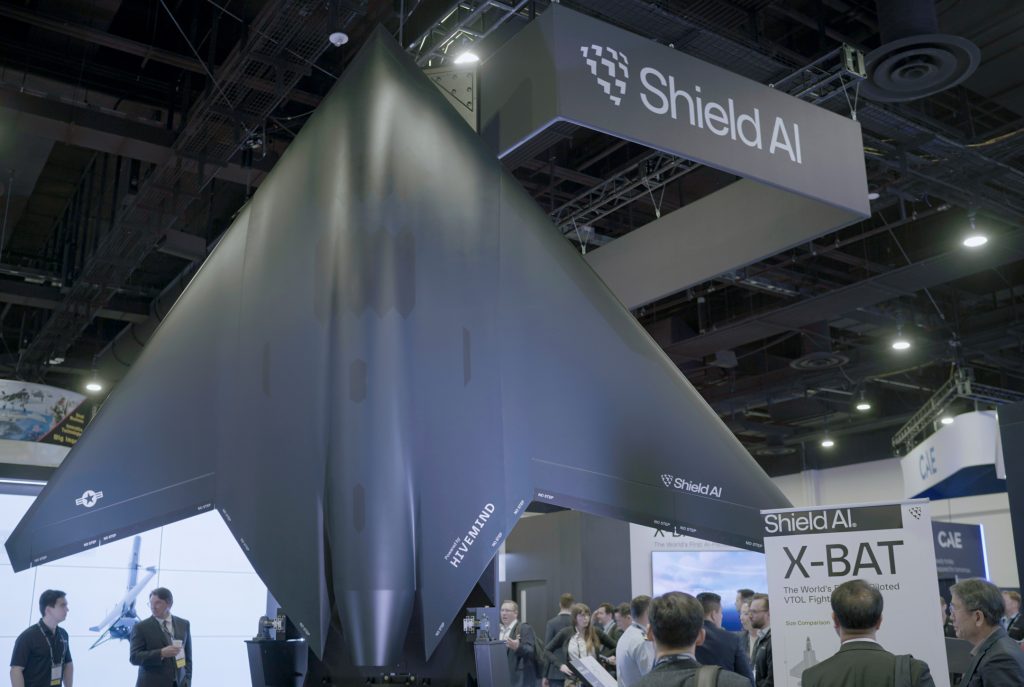
Video renderings and physical models on display at various trade shows indicate the X-Bat will use a tailless blended-wing-body fuselage with split flaps, internal weapons bays and an air intake embedded in the nose section.
The conformal weapons bays will be similar in size to those used on the Lockheed Martin F-35 stealth fighter, which can carry Raytheon AIM-120 AMRAAM (Advanced Medium-Range Air-to-Air Missile) and guided bombs. Larger weapons such as the Raytheon AIM-174B long-range air-to-air missile could be mounted on external hardpoints below the X-Bat’s fuselage.
Shield AI describes the X-Bat as “the world’s first AI-piloted VTOL fighter jet”.

Among the burgeoning new category of collaborative combat aircraft (CCA), the X-Bat is unique in a number of aspects, including the type’s vertical launch and recovery capability, use of a full-sized fighter engine and tail-sitting configuration.
Competitors like the General Atomics Aeronautical Systems’ FQ-42, Anduril FQ-44 and Boeing MQ-28 use stowable wheeled landing gear for conventional take-off and landing on tarmac airstrips. The Kratos XQ-58 is the only actively flying CCA to use a rail system for take-off.
The latest funding from the navy and DIU does not come with a guarantee the X-Bat will enter frontline service.
The DIU functions as a technology scout for the Pentagon, using government funding to identify and accelerate existing commercial products that could fill a military need.
The RIMES programme was launched in February, seeking an armed UAS able to carry out long-range strikes from naval surface ships that lack the floating infrastructure of an aircraft carrier. The idea was to allow such vessels to still take offensive action while remaining out of range of enemy anti-ship missiles.
The brief calls for a combat aircraft that can execute long-range strikes with “standard munition payloads while providing tactical flexibility by operating from expeditionary locations with minimal infrastructure or from ships without large flight decks”.
Shield AI plans to start X-Bat flights before the end of this year, with an initial combat capability ready by 2029.
The post Shield AI scores $50m X-Bat investment from US Navy first appeared on FlightGlobal.