


Retired General James McConville says new hybrid-electric designs can offer meaningful improvements to flight range and speed of sortie generation.
After years of searching for a way into the defence market, the start-up companies developing electric vertical take-off and landing (eVTOL) rotorcraft may finally have found their entry point.
Beta Technologies and Archer Aviation both unveiled new military-focused hybrid-electric rotorcraft in July, leveraging the technology developed under their commercial eVTOL efforts. Similar concepts are already being tested and flown by Sikorsky and Joby Aviation.
Unlike the conventional helicopters that are a mainstay of modern armies around the world, these hybrid-electric prototypes will be uncrewed and capable of fully autonomous flight.
That combination can offer real tactical benefits to frontline operators, according to the former top officer in the US Army.
“This aircraft goes further than any of our conventional helicopters does right now,” says retired General James McConville, who served as the chief of staff of the US Army from 2019 to 2023.
McConville, who flew attack and reconnaissance helicopters during his military service, was the first aviator to hold the army’s top job. He now sits on the board of directors at Beta, where he shaped the development of the company’s latest product – the MV250.
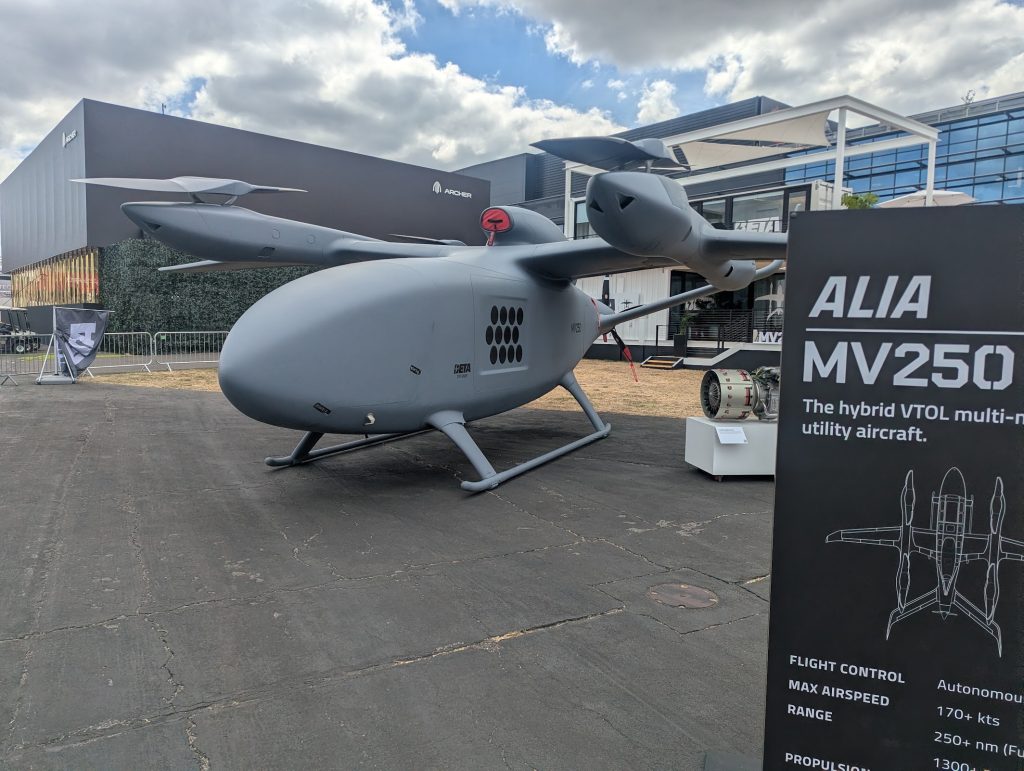
The uncrewed logistics platform is derived from Beta’s developmental A250 eVTOL but replaces the cockpit with a cargo area and upward-swinging access door in the nose section. Side-facing launch tubes have also been added to allow for the airborne deployment of small UAS and loitering munitions.
The all-electric drivetrain of the A250 is supplemented by a GE Aerospace turbogenerator, which charges the batteries that power the four lifting rotors and rear-mounted propeller.
It is the hybrid powerplant that really makes this new class of rotorcraft tactically relevant, notes McConville.
“The aircraft, because of the hybrid electric design, is very fast,” he says. “Faster than any of our helicopters, which to me is a big deal.”

Beta lists the maximum airspeed of the MV250 as being over 170kt (315km/h), with a range of more than 250nm (463km).
Senior aviation generals in the US Army are prioritising speed and range when it comes to new rotary-wing aircraft, with those traits viewed as essential to surviving a modern battlefield awash with armed drones and precision munitions.
Pivoting to hybrid-electric propulsion has allowed eVTOL developers to unlock the flight performance necessary to make their aircraft relevant and interesting to military customers, who have thus far shown little interest in manned all-electric rotorcraft.
“The feedback was there really isn’t a mission for a battery-electric eVTOL that solves a defence problem today,” says Tom Muniz, chief technology officer at Archer.
Archer’s main product is the Midnight passenger eVTOL, which the company is marketing as a commercial air taxi for urban environments. At the Farnborough international air show in July, Archer also revealed a new dual-use hybrid-electric tiltrotor called Halo.
A commercial variant will target air cargo and other logistics support customers, while a partnership with defence start-up Anduril Industries will offer an armed derivative of Halo that Anduril is calling Thunder.
Both aircraft will operate autonomously without any crew onboard and use a hybrid-electric drivetrain.

Muniz tells FlightGlobal the shift to hybrid propulsion was driven by feedback on Midnight from the US Air Force.
“If we could solve some of the sort of range limitations that come with battery electric, there are some really interesting things that we could do,” is how he summarises the air force’s response.
Muniz says in addition to greater range, Halo will offer “substantially more payload” than an all-electric design.
One unique benefit of the hybrid approach is that the onboard turbogenerator can be used while on the ground, turning each aircraft into a mobile electrical plant – something not even conventional helicopters can offer.
But even more important is the ability to fly missions without a pilot.
Helicopter manufacturer Sikorsky pioneered that technology with its Matrix system, which the company has been using to fly a UH-60 Black Hawk demonstrator without human crew for more than five years. The Lockheed Martin subsidiary is also using Matrix to autonomously fly the developmental Nomad rotor-blown wing UAS – Sikorsky’s own offering in the hybrid-electric rotorcraft space.
Sikorsky is a partner on the MV250, providing its Matrix autonomy stack to Beta. The company is also offering a fully autonomous cargo variant of the Black Hawk.

McConville says the ability to deploy a vertical take-off and landing aircraft for resupply, or potentially casualty evacuation, without risking a crew will dramatically expand the battlefield utility of rotary-wing aviation.
“When I look at aircraft like this, I see options for commanders,” he says. “You can take on missions you may not want to take on because you didn’t want to risk the troops that were in the aircraft or the pilots that were in the aircraft.”
Anduril is making a similar pitch for the attack-focused Thunder tiltrotor it is developing in concert with Archer.
“Near-surface flight has become one of the most dangerous environments on the battlefield,” says Anduril UK general manager Rich Drake. “The UK and NATO need a new strike platform – deep strike needs to be augmented.”
Anduril also says the uncrewed Thunder will be available at a “small fraction” of the cost of a conventional attack helicopter like Boeing’s newest E-model Apache or the Bell AH-1Z Viper.
The company is pitching the Thunder as a “loyal wingman” that can escort troop carriers like the US Army’s developmental Bell MV-75 tiltrotor or increase the firepower and standoff of attack helicopters like the Apache.
Although not specifically intended for uncrewed operations, Bell has said the MV-75 will come equipped with the capability to incorporate autonomous flight into its operations. Bell is currently working to deliver the first prototype, with operational aircraft reaching frontline units by 2030 or sooner.
The companies behind the new crop of purpose-built unmanned rotorcraft hope to be ready by then.
Sikorsky just logged the first test flight with its Nomad 100 in July, while Joby and partner L3Harris logged demonstration flights with the hybrid-electric S4-T in April for the US Army.

Beta says it will fly the MV250 by the end of this year, while Archer plans to launch flight testing on the commercially configured Halo tiltrotor sometime in 2027. Anduril will presumably follow with the militarised Thunder variant.
Notably, Beta is also continuing to expand operations with its all-electric CX300 conventional take-off and landing aircraft, including new military demonstrations.
In addition to starting limited commercial medical flights in July under the FAA’s eVTOL pilot programme, the company also logged 30 sorties with the CX300 during Sweden’s Aurora 2026 military exercise.
That design shares an 80% commonality with the VTOL-capable A250 that is the basis for the uncrewed MV250. Beta tells FlightGlobal the CX300 performed exceptionally well in Sweden, requiring almost no maintenance across the 30 flights.
That is in large part due to the electric drivetrain, which is much simpler than the mechanically driven system of conventional helicopters. While those use complex transmissions, driveshafts and gearboxes to transmit mechanical energy from the engine to spin the rotors, electric and hybrid-electric systems achieve that energy transfer using only wires.
That reduced maintenance burden is another important benefit of the hybrid approach, says McConville.
“You don’t have to have a whole lot of maintainers, for every hour flown, working six to eight hours to produce the aircraft,” he notes.
Additionally, McConville says hybrid rotorcraft will consume less fuel than conventional helicopters, even when powered by a turbogenerator.
“As a former commander, what you like about that is you don’t have a bunch of fuel trucks on the road getting attacked,” he adds.

When it comes to the future of rotary-wing aviation on the battlefield, McConville echoes what other pilot generals have told FlightGlobal – namely, that the helicopter is not obsolete but will need to operate with new protective technologies in closely coordinated operations alongside other combat elements.
McConville says the drone warfare that has bogged down the Ukrainian and Russian armies in that conflict is analogous to World War I.
“It was trench warfare because of the machine gun, and the machine gun kept you from moving across large swaths of land without losing a lot of soldiers,” he says. “Then we created this thing called the tank, and the tank allowed us to manoeuvre.”
“The Ukrainians have made great use out of drones, and the drones have almost become the machine gun,” he adds.
Adding counter-drone systems to aircraft will be part of the solution, McConville says. But another answer will be new tactics and operational concepts, which new platforms like the MV250 can enable by providing increased mobility and long-range sustainment.
“You can’t be everywhere,” he says of enemy action. “If you can spread out the battlefield, you can manoeuvre.”
Hear the full interview with retired General James McConville on the 10 August episode of the FlightGlobal Focus podcast.
The post Former US Army chief touts tactical benefits of hybrid-electric rotorcraft first appeared on FlightGlobal.