
The service has been phasing out the jets since 2024.
The US Air Force is winding down operations of T-1A Jayhawk multi-engine trainers and plans to remove the last examples from service in late August.
The service began flying Jayhawks, manufactured by Beech when still owned by defence contractor Raytheon, in 1993 as advanced trainers for pilots assigned to airlift, tanker and special-reconnaissance platforms.
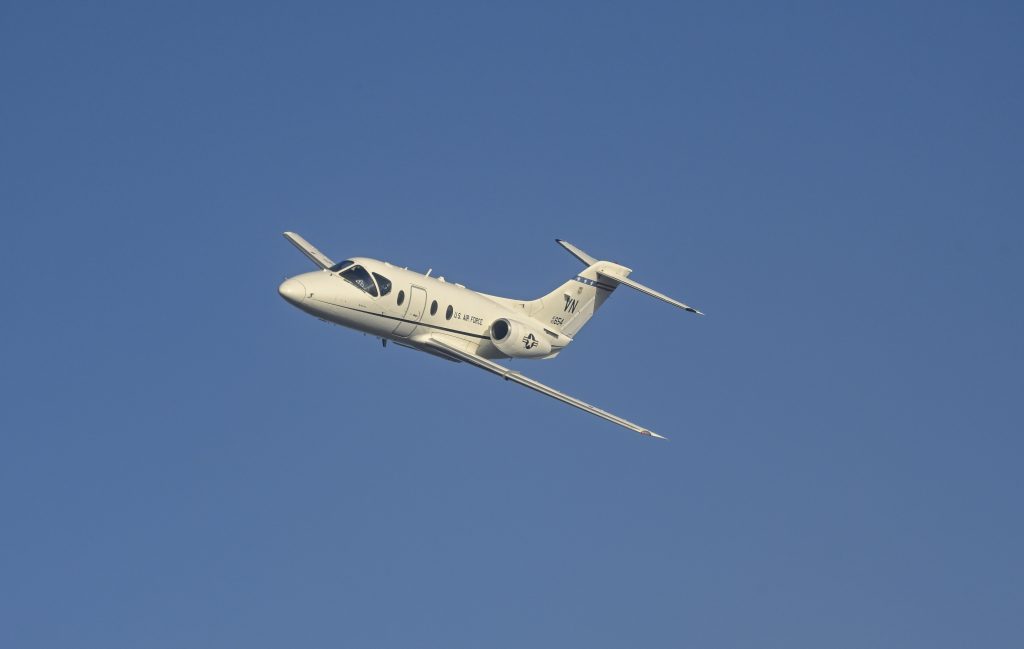
Ahead of the twin-engined jet’s planned retirement on 21 August, a final set of aerial photos were taken of the T-1A flying out of Vance AFB in Oklahoma in late July by aviation photographer Greg Davis, who provided the images to FlightGlobal.

A T-1A with registration 93-0654 flew a late-afternoon sortie from the rural Air Education and Training Command (AETC) base in Oklahoma. It was chased by a Textron Beechcraft T-6A Texan II – the basic flight trainer for the USAF and the US Navy.
After a planned sundown ceremony on 21 August, the Jayhawk will make a final flight to Davis-Monthan AFB for induction into the Pentagon’s sprawling aircraft “Boneyard” storage site. Other T-1A’s have already been retired or are being prepared for static display.
Only five flyable T-1As remain at Vance as of 5 August, according to AETC, a small fraction of the one-time peak of 178. All remaining aircraft are planned to be retired by the end of this month.
The Beech T-1A jet has served the USAF for over three decades as a commercial solution to advanced pilot training requirements. Based off the Beech 400, the T-1A was modified for military pilot training, with structural enhancements to support an additional fuel tank and a strengthened cockpit for safe operations at low altitudes.
The cockpit seats two students and an instructor.

The introduction of the twin-engined T-1A in the early 1990s alleviated stress on Northrop T-38 Talons, which had for years been used to train all new USAF pilots.
Although the USAF still trains fighter pilots using T-38s, that twin-engined type has been in service more than 60 years. The fleet suffers maintenance challenges and limited flight availability.
Pilots destined to fly larger multi-engined aircraft shifted from T-38s to T-1As in the 1990s, allowing for cockpit resource management practices to be taught early in pilots’ careers in an aircraft more reflective of the transport, refuelling and reconnaissance/special-mission aircraft those officers were destined to fly.

During the T-1A’s more than three decades of service with the USAF there were only two major accidents, with no casualties, a notable track record.
The USAF has been phasing out T-1As since 2024 as it moves ahead with fielding new Boeing T-7A Red Hawk jet trainers.
The air force has no plan to replace Jayhawks. It intends to redirect operations and sustainment funds from that fleet to support procurement of T-7As, which will also replace T-38s.
Should the USAF someday opt for a dedicated multi-engine advanced trainer, one likely candidate is Textron’s T-54 Marlin II. That aircraft is used by the US Navy for certifying multi-engine and tiltrotor pilots.
The post US Air Force to retire last of T-1A Jayhawk multi-engine trainers first appeared on FlightGlobal.