
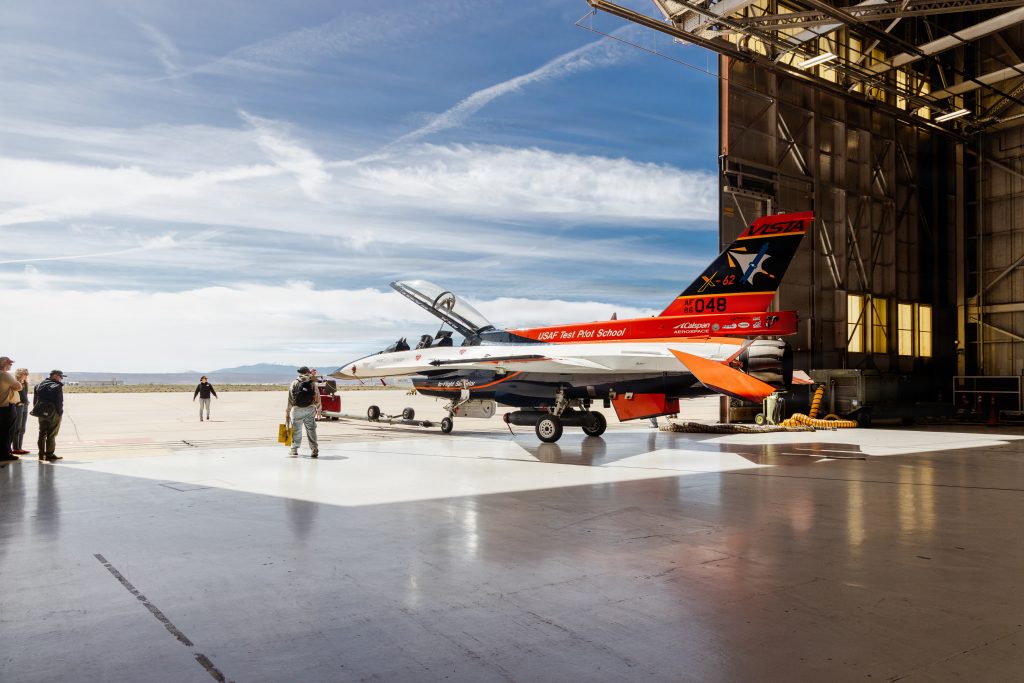
An AI agent was able to interpret infrared sensor data and direct the X-62 test aircraft to intercept the target.
The US Air Force continues to expand the capabilities of artificial intelligence in aviation, most recently proving the ability of an AI agent to direct the interception of an airborne threat.
The latest experiment made use of the X-62 VISTA (Variable In-Flight Simulation Test Aircraft) — a highly modified Lockheed Martin F-16D the Air Force Research Laboratory has been using to push the limits of autonomous flight, including testing the ability of AI to engage in air combat drills in 2023.
More recently, the USAF used the X-62 to see if autonomy software could lead the complex task of intercepting a potentially hostile airborne target.
The event, which took place in April but was only revealed on 4 August, tasked an AI agent to collect and interpret sensor data, and cue a response. A Northrop T-38 trainer jet was used as the target, which was observed by a Lockheed infrared search and track Legion pod fitted on the X-62.
An autonomy agent aboard the X-62 had to track the T-38 and then autonomously pilot the fighter into a tactical intercept position. Lockheed Martin’s secretive Skunk Works unit, which developed the VISTA jet, says the X-62 conducted 27 AI-controlled intercepts across an eight-flight series designated “Have Heat” by the air force.
“Have Heat represents a meaningful expansion of avionics capability towards integrated, AI-driven control of multiple sensors and air vehicles for mission autonomy,” says Lieutenant Colonel Joshua Strafaccia, dean of faculty for research at the USAF Test Pilot School.
“This bridges a capability gap and positions us to test advanced autonomy faster,” he adds.
The Have Heat tests took place at the USAF’s Edwards AFB test hub in the California High Desert.
Skunk Works says the experiment shows that AI software can “effectively and reliably close the sensor‑to‑action loop” on currently flying combat aircraft.
“Our autonomous agents consumed classified infrared search and track feeds and executed combat-critical manoeuvres in real time,” says Skunk Works general manager Ron Fehlen. “This achievement marks a decisive advance toward delivering AI‑augmented air dominance for the United States.”
The air force did not specify which autonomy agent was used in the Have Heat tests. Previous X-62 experiments, including the 2023 autonomous dogfighting trials, featured Shield AI’s Hivemind software.

Lockheed says the Have Heat trials employed a Skunk Works AI generation capability dubbed “Supermassive”, which allowed for the integration of agents with the X-62 to be completed and ground tested in only three months.
While AI has shown it can both fly a jet and engage in complex tasks like air combat manoeuvres and sensor management without human involvement, Lockheed says the technology can also be used to assist pilots, rather than replace them.
“By delegating complex tasks to AI, pilots gain bandwidth to focus on tactical information that increases their effectiveness and survivability,” the company notes.
At the same time it was probing the limits of AI to engage in combat, the USAF says it was also using the X-62 to test “enhanced safety rules” that will prevent autonomous vehicles from “violating user-established operational limits”.
That initiative, which has been dubbed “Have Holidays”, also saw several new systems integrated into the X-62 mission system computer, including a “non-prime, third-party autonomous agent” and chips that will allow the jet and its AI brain to incorporate more advanced sensors.
Those will include Raytheon’s PhantomStrike low-cost, multi-function active electronically scanned array (AESA) radar.
First announced in December, the USAF now confirms it will proceed with PhantomStrike integration on the X-62 in the wake of the successful Have Heat trials and the Have Holidays upgrades.
The addition of a modern AESA fire control radar, along with computing improvements planned under the X-62 Mission Systems Upgrade programme, will position the test jet as a “foundational enabler” for the USAF’s “highest-priority programmes”, the service says.
The air force Test Pilot School will be hosting the inaugural X-62 Research Symposium from 11-13 August at Edwards AFB.
The post US Air Force demonstrates AI-led intercept of airborne targets with X-62 first appeared on FlightGlobal.