


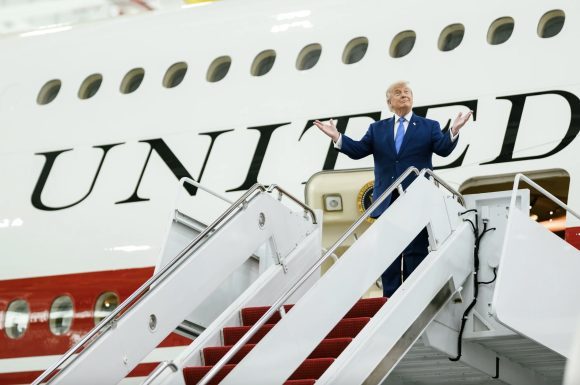
Company says a new charge reflects it adding “significant resources” to the VC-25B programme.
Boeing’s VC-25B Air Force One replacement programme continues dragging down the company’s financial performance, with Boeing in the second quarter logging another loss against the project, this time for $280 million.
The charge builds on previous losses taken by Boeing of nearly $3 billion against a troubled programme that involves modifying two 747-8s to the VC-25B standard.
Boeing is doing so under a $3.9 billion fixed-price contract it signed in 2018 with the US Air Force (USAF).
“One of our fixed-price development programmes where we have seen costs grow is the VC-25B,” Boeing chief executive Kelly Ortberg said during the company’s second-quarter earnings call on 28 July.
He spoke after Boeing disclosed taking a $280 million loss against the programme “due to higher estimated costs required to complete structural and wiring installation and to satisfy airworthiness certification requirements”, the company’s second-quarter securities filing says.
“Risk remains that we may record additional losses in future periods,” the filing adds.
Ortberg framed the charge as reflecting a move by Boeing to invest more in the programme and to meet its goal of delivering the jets in 2028.
“We’ve made the decision to add significant resources to support the build and test schedule of VC-25B,” Ortberg says. “We recognise how critical schedule performance is to our customer. We are investing accordingly to maintain our commitment to deliver this airplane in 2028.”

The VC-25B project reaches back more than a decade. The USAF in 2015, under its Presidential Aircraft Recapitalization programme, selected modified 747-8s to replace two 747-200-based VC-25As that have served as Air Force One since the 1990s.
The service gave Boeing a $26 million contract in 2016 to begin risk-reduction work and a contract in 2017 covering the purchase two aircraft for eventual modification. Those aircraft are two 747-8s Boeing built for Russian airline Transaero; they became available following that carrier’s bankruptcy in 2015.
In 2018 Boeing won the USAF contract that has caused it such trouble: a $3.9 billion fixed-price deal to develop and certificate the jets, with deliveries then expected by 2024.
Since then, development has progressed slower than anticipated and Boeing has taken charges against the work in every year since 2020, for a total of some $3.2 billion in losses.
The company has attributed the delays and charges to factors including engineering and design changes, supplier issues (including those stemming from the Covid-19 pandemic), increased suppliers’ costs and “factory modification labour”, according to securities filings.
With deliveries running late, the US Air Force and industry partner L3Harris in the last year modified a separate 747-8, donated by the Qatari government in 2025, into an Air Force One configuration called the VC-25B Bridge.
That aircraft, modified in 10 months, will relieve pressure on aging VC-25As and provide presidential transport until VC-25Bs enter service, the USAF has said.
US President Donald Trump flew for the first time on the VC-25B Bridge on 1 July.
The post Boeing’s VC-25B losses deepen as company pushes to meet 2028 deliveries first appeared on FlightGlobal.