


Will the first rockets to take off from a remote site in Shetland help the UK realise its goal of being a major spacefaring nation?
Unst in the Shetland Isles is as far north as you can go in the British Isles, but Scott Hammond believes the sparsely populated, treeless, windswept island – two ferry rides and a lengthy drive from the islands’ capital Lerwick – is poised to become one of the epicentres of an emergent UK space sector that combines the country’s industrial and academic prowess with the good fortune of geography.
Hammond, chief executive of SaxaVord spaceport, is preparing for the site’s operational debut, most likely in August, nine years after the facility was conceived on a former Royal Air Force base. Germany’s Rocket Factory Augsburg (RFA) aims to become the first company to carry out an orbital launch from UK soil after delivering the first and second stages of its RFA One launch vehicle to Unst in March. It is expected to announce a launch date soon.
At least two other start-ups are aiming to follow RFA into space. Fellow German company HyImpulse plans to test a suborbital rocket from Saxa Vord this year as a precursor to orbital launches from 2028. Scottish firm Skyrora, which in 2025 became the first UK manufacturer to receive a launch licence for a commercial vehicle, says its suborbital Skylark L prototype is “ready for launch” from SaxaVord, to be followed by its Skyrora XL orbital vehicle in 2028.
SaxaVord – the UK’s first vertical spaceport – was granted a licence by the UK Civil Aviation Authority in 2023 to host up to 30 launches a year. Its northerly location is ideal, suggests Hammond, because “latitude is fundamental. If you want to launch to geostationary orbit, you want to be as close to the equator as possible and launch east. If you want a polar orbit, you want to be as high as possible.”
SaxaVord also offers “clear trajectories that don’t go over land or large population centres in the initial phases. It means you can do a pure polar launch through the Bering Strait with New Zealand as your first landfall.” At the same time, he says, while the industry will always “look at geography and physics first”, launch sites must be practical. That is why, for instance, Ascension Island in the mid-Atlantic has never taken off as a location.
Describing the UK’s most northerly island as accessible might sound a stretch but Hammond insists Unst is not as remote as some think. Shetland has been for decades a hub for oil and gas and is a major exporter of fish, so ferries to Aberdeen are frequent and getting to the main airport, Sumburgh, is “surprisingly easy”, he says. The council also has a plan to improve connectivity by replacing aging inter-island ferries with Faroe Isles-style tunnels.
Another attraction is Shetland’s growing space “ecosystem”, he suggests. Many local engineering contractors – faced with a declining oil and gas sector – are working for SaxaVord and RFA, and Hammond expects the success of the spaceport to lure more space and space-adjacent start ups, in the likes of life sciences and data analysis, to Shetland and northern Scotland. “It’s a magnet and catalyst for other economic activity,” he says.
He describes SaxaVord as a “national capability for the UK”. Dubbing nations such as Germany, “which would love to have a spaceport but can’t”, as “spacelocked”, he adds: “Very few countries have access to a spaceport. We will be one of perhaps two in Europe. That could mean a healthy pipeline of launches beyond the current limit of 30 set by the UK Civil Aviation Authority.

“We know the demand is there, and the vast majority of launches will go into polar orbit,” says Hammond. “Americans say their spaceports are at capacity. What’s driving the market? Well, our customers are the rocket operators. Their customers are the satellite operators, and their customers are ultimately you and I. The vast global demand for data is what’s ultimately behind it.”
Despite a thriving satellite manufacturing sector led by Airbus Defence and Space and others, the UK probably thought it had been left behind in the space launch race – the country’s first and only space rocket had its final flight in 1971. However, in 2018, the Theresa May government put in place the Space Industry Act, which authorised the CAA to issue licences for space activities and paved the way for the first launches from the UK.
Although not all of them are UK businesses, the opening of SaxaVord has already helped attract space start-ups to Scotland. Glasgow-based Skyrora, which first attempted to launch its Skylark L from Iceland in 2022, says its domestic ownership means it can “offer sovereign launch services tailored to government and commercial needs, strengthening Britain’s ability to access space independently”.
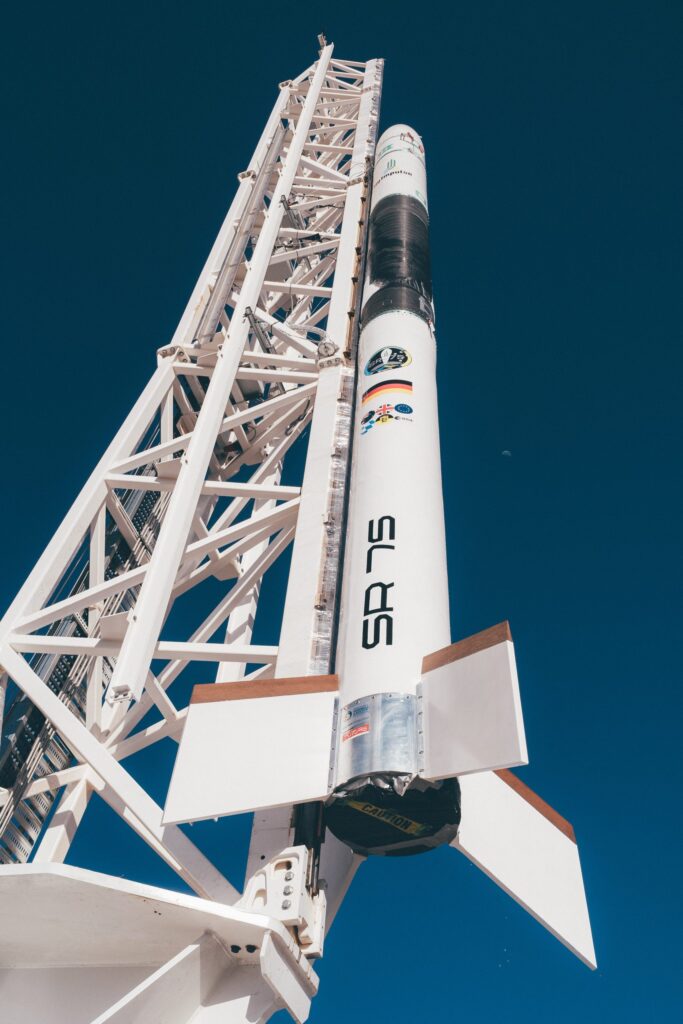
HyImpulse, which has already successfully launched its suborbital SR75 demonstrator from Koonibba, Australia, has established operations in Scotland ahead of its SaxaVord launch. Chief executive Christian Schmierer says the company’s point of difference is its patented fuel system, which uses a mix of paraffin-based solid material with liquid oxygen, claimed to be safer and more affordable than the liquid fuel its competitors use.
He says HyImpulse’s mission is “to make small launches successful”, by targeting payloads from 5kg to 900kg. This year’s launch will be the last using a single-stage, suborbital rocket. After that, it will move to orbital test flights – which require a twin-stage vehicle and velocity of around 28,000km/h as opposed to 10,000km/h for suborbital flight. Schmierer reckons HyImpulse can find customers for at least 50 launches in the next eight years.
While Shetland and the north of Scotland look to exploit the trickle-down benefits of the space launch market, the country’s central belt – where most of the country’s population lives – is understandably the hub of space activities, thanks to its industrial heritage and strong scientific and engineering academic sector, says Peter Young, chair of the board of directors at cluster organisation Space Scotland.
He says Scotland “punches above its weight” in terms of its contribution to the UK and European space sector and that the SaxaVord launch site is the “final piece of the jigsaw” in creating an entire space ecosystem north of the border. “We now have a full spectrum of capability, from the design and build of satellites and rockets to now a launch capability, in addition to a strong downstream industry around data and our academic backbone.”
Scotland also has high hopes when it comes to horizontal launch. Another former Cold War air base at Machrihanish on the Mull of Kintyre is one of two sites shortlisted by the European Space Agency for the Invictus hypersonic reusable spaceplane test programme. Campbeltown airport – also known as Spaceport Machrihanish – is now a community-owned facility which has had some success in attracting space companies to its business park.

While not suitable for vertical launch, the airport’s remoteness – there are just two De Havilland Canada Twin Otter flights to Glasgow each day – and 3,000m runway make it ideal for fast horizontal launches over water, claims director Gordon Stevenson. “There are relatively few airports in the UK where you can do this sort of thing. We had just 1,400 movements last year,” he says.
A decision on the Invictus launch site is expected later this year, and handing it to Machrihanish “would be transformative for the area”, he says. Its rival for the contract is as far away from Scotland as is possible on the UK mainland. Newquay airport was the UK’s first licensed spaceport and the location of Virgin Orbital’s ill-fated attempt in 2023 to launch a satellite-carrying rocket into space over the Atlantic Ocean from a Boeing 747.
The mission, billed as a milestone for the UK space sector, saw the 747 – known as Cosmic Girl – return safely to base. But after suffering an “anomaly”, the rocket and the satellites it was carrying were lost. Virgin Orbital – which had been formed in 2017 as a spin-off from Richard Branson’s Virgin Galactic space tourism outfit to develop the LauncherOne rocket – collapsed shortly after.
Aside from the Invictus bid, Newquay – which had marketed itself as Spaceport Cornwall – has not lost hope of becoming a node in the UK’s emerging space sector. Ironically, the publicity generated by the Virgin Orbit launch worked against the airport as it tried to detach itself from association with failure. “We were left with a perception problem largely because of the strength of the Virgin brand”, admits head of engagement Ross Hulpert.
“We are still very confident about the future of horizontal launch,” he says. “The UK is still the envy of Europe in terms of the regulations we have in place, and the ease of operating here. Others are approaching us in the wake of Virgin Orbit. The failure was completely independent of Spaceport Cornwall and I think people in the industry realised that. We were talking to people from the very next morning.”
The UK industry has to accept and learn from failures if it is to establish a thriving space sector, suggests Martin Barstow, a professor of astrophysics and space science and director of strategic partnerships at local cluster Spaceport Leicester, which brings academic institutions and start-ups together in the East Midlands city. “Virgin Orbit was a great idea. Look at how many times it didn’t work for Elon Musk,” he says.
While he is “excited” that the UK will at long last have sovereign launch capabilities, meaning UK satellite and rocket operators can “circumvent the queues” at over-capacity international launch sites, he cautions that national ambitions will have to be tempered as UK start-ups often struggle for capital. “The UK has a dynamic space industry but SpaceX is so far down the line, we’re not going to create a British SpaceX,” he says.

Aside from Virgin Orbit (a US company heavily invested in the UK), the country’s space sector has had its share of casualties. They include Scottish rocket developer, Orbex, which planned to operate a rival to Saxa Vord, the Sutherland Spaceport on the northern Scottish mainland. The Forres-based firm entered insolvency earlier this year (Skyrora will not comment on an earlier statement that it planned to buy its former competitor’s assets).
The failure of the Sutherland Spaceport to get off the ground (together with another proposed site in the Western Isles) leaves Saxa Vord as the UK’s only vertical gateway into orbit. While its scale will be tiny compared with many of the planet’s busy spaceports, the first launch this year will give a boost to a country and industry that firmly wants to play in the premier league of spacefaring nations.
The post Launching ambitions: the UK looks to new orbital frontiers first appeared on FlightGlobal.