


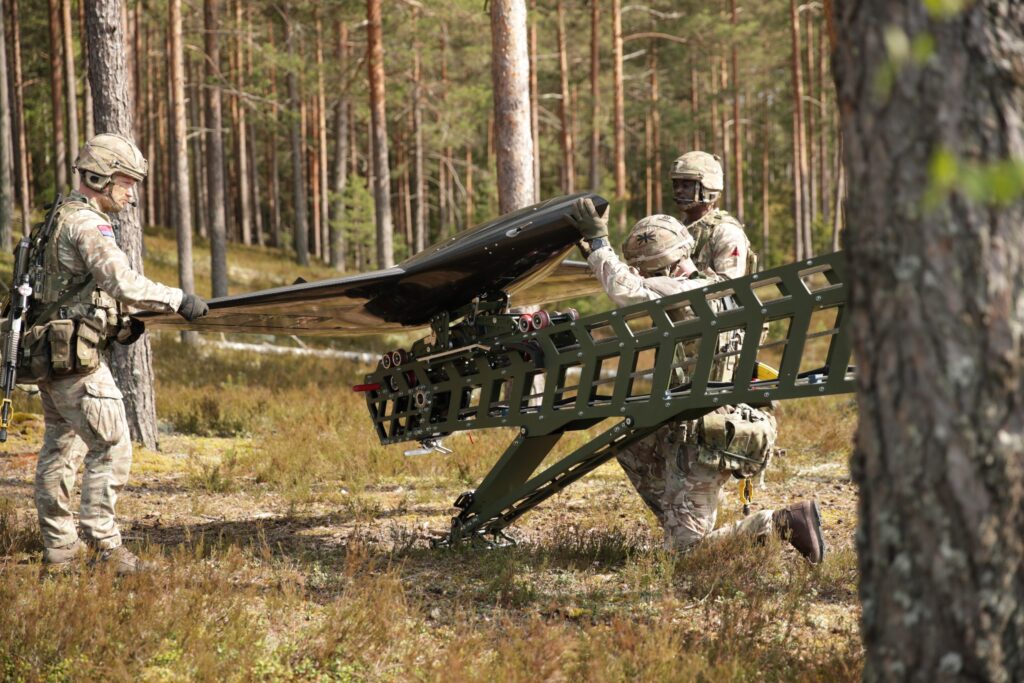
UK-produced attack drone launched from surface vessel for the first time.
The UK Royal Navy (RN) has conducted test launches of the Callen-Lenz Nyan one-way effector (OWE) from an experimental vessel for the first time, as the service develops its new hybrid operating concept.
Staged off the south coast of England in June during exercise Neptune Reach, the activity involved installing a rail launcher for the uncrewed aerial system on the rear deck of the 42m (137ft)-long XV Patrick Blackett.
Produced by BAE Systems-owned Callen-Lenz and only recently unveiled, the microturbine-engined Nyan has a wingspan of 2.9m, with a carbonfibre airframe.
The OWE was “pre-programmed to fly to a specific target” after launch, the RN says.
The work was conducted in support of Project Vantage, which seeks to accelerate the test and evaluation of maritime attack drones.
“The Royal Navy capability team and the Air and Space Warfare Centre are now analysing the results, with the potential for further trials about [the aircraft carrier] HMS Queen Elizabeth,” says BAE.
Deployment of the attack drone on a maritime vessel came one month after the British Army had conducted its own test firings of the Nyan during exercise Spring Storm in Estonia. Personnel from the service’s 26 Royal Artillery Regiment and the RN’s 744 Naval Air Squadron supported the maritime demonstration.

“Britain is serious about the transition to a hybrid navy with new, powerful drones at the heart of the Royal Navy,” says armed forces minister Luke Pollard. “By bringing together army and navy expertise to field strike drones from a ship at sea, we are accelerating the capabilities our forces need to stay ahead of our adversaries.”
RN Lieutenant Commander David Burton notes that the hybrid concept of combining crewed platforms with uncrewed systems will enable the service to “expand reach, tempo and enhance lethality”.
“This activity demonstrates how we are accelerating ‘Atlantic Strike’ concepts into practical, deployable capabilities,” he adds, noting that it represents “a significant step forward in delivering maritime one-way effectors at pace”.
Callen-Lenz chief executive Matt Foster says the trials aboard Patrick Blackett “reflect strong collaboration across the services and industry, highlighting the pace at which we can deliver innovation to advance the UK’s integrated, multi-domain defence capability”.
The BAE subsidiary has already produced and delivered more than 1,000 Nyan vehicles. Speaking last month, Foster said the system “has been very successful in the operational environment”: it is understood that the OWE is already in use with Ukraine’s military.
In its Defence Investment Plan, published on 30 June, the UK Ministry of Defence (MoD) outlined a roughly £250 million commitment named Project Pantheon, which will explore the potential of a hybrid carrier air wing, and to trial “jet-powered drones to work alongside the [Lockheed Martin] F-35B force under Project Vanquish”.
The MoD also has previously invested in Leonardo Helicopters’ Proteus technology demonstrator, with additional funding for that activity announced in early March, with work to build on its initial two-flight test campaign. Such an uncrewed rotorcraft could in the future be used to perform tasks ranging from anti-submarine and anti-surface warfare to airborne early warning.
The post Royal Navy advances hybrid operational concept work with Nyan one-way effector test launch first appeared on FlightGlobal.