


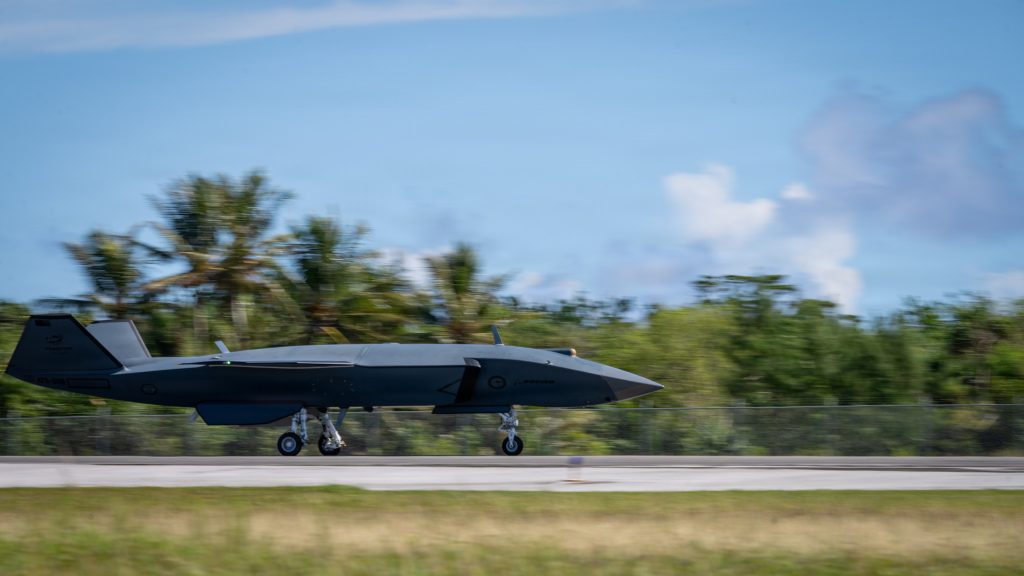
The uncrewed fighter will be the first Collaborative Combat Aircraft to join frontline military drills.
Unmanned fighter jets are about to make their first real-world appearance.
The MQ-28 Ghost Bat, the product of a joint project involving Boeing Defense Australia and the Royal Australian Air Force (RAAF), will participate in this year’s “Valiant Shield” military exercise in the South Pacific.
The biennial series of war games led by the US military’s Pacific Command (PACOM) runs from 22 June to 1 July near the Northern Mariana Islands, Guam and Japan.
Photos released by the US Air Force’s (USAF’s) Pacific headquarters on 24 June show one of Boeing’s MQ-28 Block 1 prototypes on the flightline at Rota International airport in the Commonwealth of the Northern Mariana Islands.
“During the exercise, the uncrewed MQ-28 will fly in concert with crewed fighter platforms, providing a critical opportunity for the joint force to refine tactics, techniques and procedures for this next evolution of airpower,” Pacific Air Forces says.
The MQ-28 will be assigned a variety of missions throughout the exercise, including defensive and offensive counter-air operations. The uncrewed jet logged its first flights outside Australia in May, operating from Point Mugu Naval Air Station on the southern coast of California.
Honolulu-based PACOM says this year’s drills will test the ability of US and allied forces to project power across the vast Western Pacific in scenarios ranging from humanitarian assistance and disaster response to full armed conflict.
“Valiant Shield demonstrates our enduring commitment to a free and open Indo-Pacific,” says Admiral Steve Koehler, commander of the US Navy’s Pacific Fleet.
“Free and open Indo-Pacific” is the Pentagon’s diplomatic phrasing for actions intended to push back on China’s military and paramilitary activity in the region.

The inclusion of the MQ-28 in such a significant event is a feather in the cap of Boeing, which unsuccessfully bid the MQ-28 for the USAF’s Collaborative Combat Aircraft Increment 1 contract.
General Atomics Aeronautical Systems and Anduril Industries were selected to develop the first CCA prototypes for the USAF in 2024. After two years of development, the service awarded production contracts to both companies earlier this month, for the FQ-42 and FQ-44, respectively.
Boeing separately developed the MQ-28 in partnership with the RAAF. Despite being initially passed over by Washington, the MQ-28 is now the most mature CCA design in the world, with well over 100 sorties and a live-fire missile shot to its name.
Boeing is now developing improved Block 2 and Block 3 Ghost Bats, with an eye toward the start of rate production within two years and eventual frontline service with the RAAF.
The MQ-28 is also being offered to Germany for the Bundeswehr’s potential CCA requirement.
It also remains possible, perhaps even likely, that the MQ-28 will be fielded by the USAF. The service is developing requirements for Increment 2 of its CCA programme, which will include both a light- and medium-class fighter.
During the 2026 Valiant Shield Exercise, the USAF says it will analyse the autonomous MQ-28’s ability to extend the “reach, awareness and survivability of crewed platforms in contested environments”.
“The future of airpower is a partnership between our greatest assets: our skilled warfighters and the technology that empowers them,” says Major Daniel Pesich, officer in charge of the USAF’s Experimental Operations Unit (EOU) detachment participating in Valiant Shield.
The EOU is a newly created unit within the air force meant to evaluate CCAs like the MQ-28, FQ-42 and FQ-44, and to develop operational procedures for integrating uncrewed fighters with existing tactical squadrons.
While the Pentagon says it intends for there always to be a “human in the loop” when it comes to authorising CCAs and other semi-autonomous systems employing deadly force, the jet aircraft are capable of taking off, flying missions and landing without flight control inputs from an operator.
The USAF’s goal for the new class is to increase sortie generation with reduced strain on maintenance and personnel.
That is a subtle but important shift from the original CCA goal of creating so-called “attritable” aircraft that would be sufficiently cheap and numerous as to almost be considered disposable assets on the battlefield.
The post Boeing’s MQ-28 to participate in US-led Pacific combat exercise first appeared on FlightGlobal.