


The low-cost weapon system is being rapidly developed for supply to Ukraine.
Three companies have received around £45 million ($59 million) in combined funding from the UK Ministry of Defence to continue their work on developing a low-cost one-way effector for delivery to Ukraine.
On 22 June, the MoD confirmed that the contenders – MBDA UK, MGI Engineering, and Rotron Aerospace – will advance to the next phase of Project Brakestop, following test firings of their surface-to-surface missile designs at the MoD’s Hebrides Range in Scotland.
Performance requirements for the developmental weapon include a range of at least 270nm (500km) while carrying a 225kg (496lb) warhead, and a speed performance of more than 324kt (600km/h).
MBDA last year unveiled its Crossbow candidate for Brakestop, with the turbojet-engined weapon having an expected range of 430nm. Video footage released by the company shows that a first truck-mounted test firing was completed last December, followed by a second campaign in February.
“The successful firings of Crossbow are evidence of MBDA doing things differently: investing in designing and demonstrating a product that is mature and ready for customers ahead of any contract,” the company says. It adds that it is “able to produce Crossbow in 2026, at scale, at pace”.
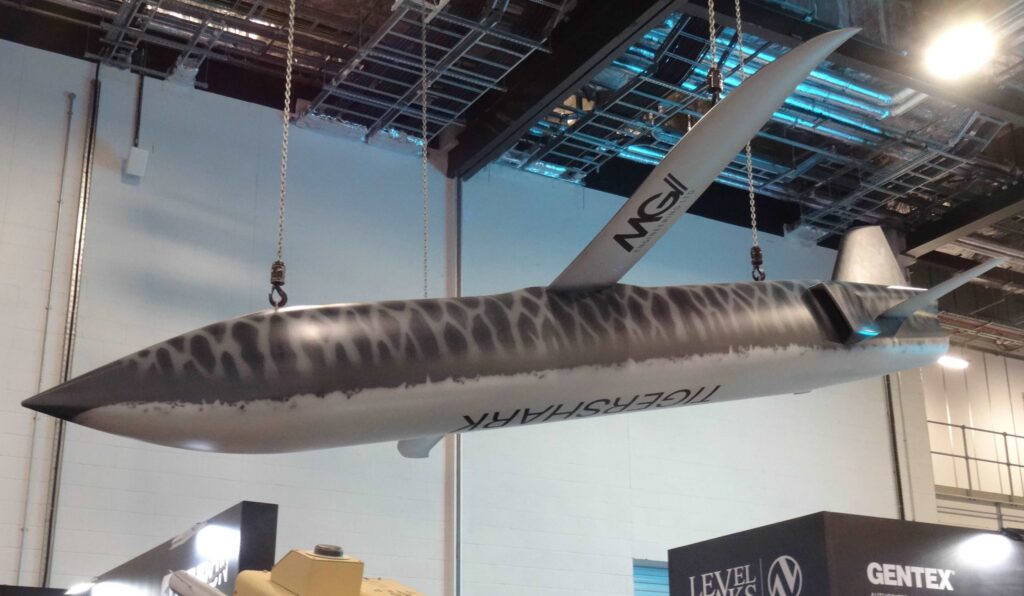
MGI is promoting its TigerShark product as “an affordable and scalable alternative to traditional cruise missile capability”. It cites a range of 486nm with a payload of up to 300kg, and a speed of 405kt.
“By combining long range, significant payload capacity and autonomous operation within an open architecture system, we believe it is well aligned with the requirements being explored through Project Brakestop and the demand of modern conflict,” says MGI chief executive Mike Gascoyne.

The Oxford-based company aims to “scale the production” of its TigerShark from the fourth quarter of this year.
Meanwhile, SkyLance developer Rotron says its successful test firing “validates the core technologies underpinning” its design.
Citing its “lean operating model, rapid development cycles and competitive cost base”, it also claims that its “advanced propulsion technology… delivers a substantially greater operational range than alternative solutions in its class”.
The MoD says that under the companies’ new Phase 2 contracts – which are worth around £15 million per bidder – they will “further develop and produce 15 improved effectors each, alongside launchers and support vehicles”.
“Further testing will take place in the UK in the coming months, followed by additional trials overseas, including in Ukraine,” it adds.
Each weapon should cost around £400,000 minus its warhead, which the MoD says “has already been successfully developed and tested by another UK company”.
The selected contractor must be able to “produce at least 20 weapons a month within months of a production order”, its requirement states.
The MoD launched its Brakestop activity in late 2024, with the competitive process initially drawing responses from 27 companies. Six of those were awarded contracts worth around £5 million each to design and manufacture prototypes for testing before the field was narrowed to the current three bidders.
The post UK funds next phase of Brakestop one-way effector development for Ukraine first appeared on FlightGlobal.