


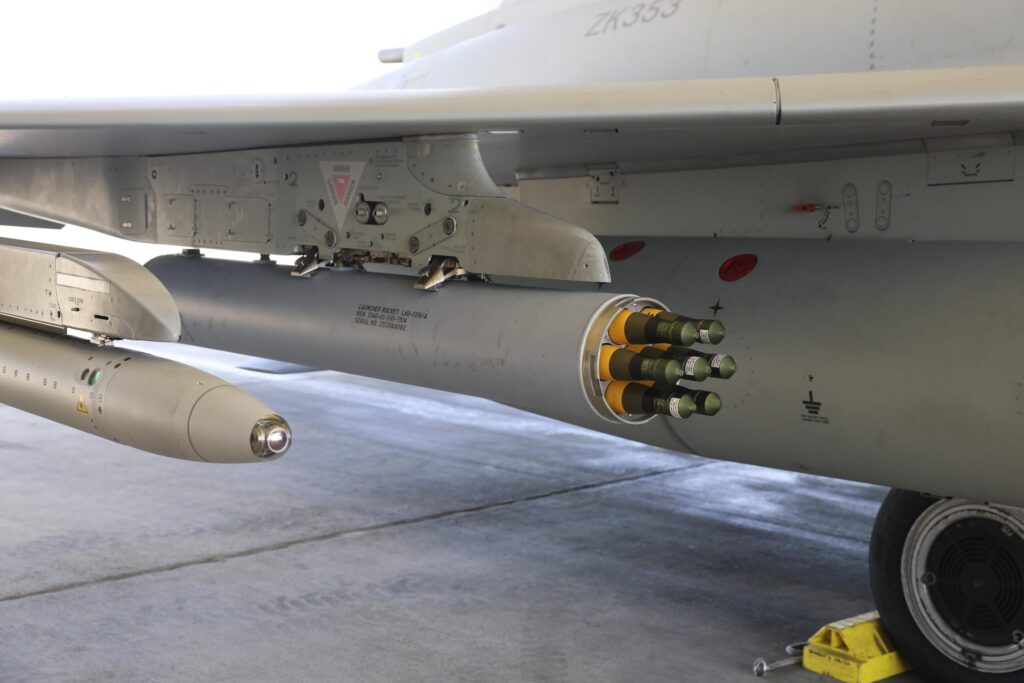
UK company is testing update to enable jet to deploy 14 counter-drone weapons.
BAE Systems is completing tests which will enable the UK Royal Air Force’s (RAF’s) Eurofighter Typhoons to operate with two seven-round launchers for the company’s APKWS guided rocket, building on the defensive weapon’s recent operational introduction on the platform.
“We now have the [rocket] pod on both sides and a switch-box which enables the ability to have 14 shots, which we are in test with at the moment,” BAE’s managing director air operations Richard Hamilton said at the airframer’s Warton site in Lancashire on 18 June.
Typhoons operating from RAF Akrotiri in Cyprus have since May been flown with a single launcher for the 70mm-diameter guided weapons, providing a low-cost means of engaging one-way attack drones.
Hamilton notes that BAE only began exploring the feasibility of the Typhoon using APKWS at the end of 2025, describing it as “a rapid installation of something that’s very effective”. A first air-to-surface launch was conducted in February, followed within two months by an air-to-air shot made after software updates had been installed on the fighter’s Rafael Litening 5 targeting pod.

The counter-drone capability was deployed by the RAF under an urgent operational requirement deal, using a “clearance with limited envelope” approval which is now being expanded.
“The RAF are extremely complementary about how that capability’s integrated,” Hamilton says, describing it as providing “a really effective solution” for the counter-uncrewed aerial system role.
“The benefit we have got is the [Typhoon’s Euroradar Captor M] radar picking up low and slow items at a good range, which gives the operator the ability to self-designate and then fire,” he says. “From a Typhoon point of view it’s game-changing in terms of what the platform can do.”
Meanwhile, Hamilton reveals: “We are looking to how we can support other [Eurofighter] customers if they wish to take that capability into their respective fleets as well.”
He identifies potential interest as coming from “all Typhoon customers”: an operating community which also includes fellow Eurofighter programme partner nations Germany, Italy and Spain, export users Austria, Kuwait, Oman, Qatar and Saudi Arabia and future operator Turkey.
Additional integration work would be required if the APKWS capability were to be brought into the core programme, notably because some operators have the Lockheed Martin Sniper targeting pod instead of the Litening 5.
BAE also is working on an updated version of the low-cost weapon which will add an infrared tracking capability beyond the APKWS round’s current laser-guidance mode, with that to remove the need for a launch aircraft to maintain lock after deploying each weapon.
Meanwhile, Hamilton points to the surge in activity for the Eurofighter community due to the recent conflict in the Middle East and the ongoing war in Ukraine. “The demand on Typhoon over the last 12 months has been exponential in terms of the operational demands that our customers have put, not only in terms of their own user cases, but also the support that we are providing,” he says.
The programme is also enjoying an increase in production thanks to a recent run of order successes.
Hamilton notes that the Eurofighter partner companies have to date delivered 620 of the type, against a current total orderbook for 770. Combined annual output has been increased to around 20 units per year, from 14, to support repeat orders from Germany, Italy and Spain, while BAE also last year secured an order to supply the Turkish air force with 20 Typhoons.
“[There is] a real energy to the [Eurofighter] programme now,” Hamilton says. “We see production into the 2030s, and we stand ready for governments to make decisions about Typhoons in the future.”
With further export opportunities – including a prospective follow-on order for Saudi Arabia and a Leonardo-led proposal for Poland – he says: “Our production lines are primed. We still see a very bright future for Typhoon.”
The post Additional Eurofighter operators eyeing APKWS rocket integration as BAE expands capability first appeared on FlightGlobal.