


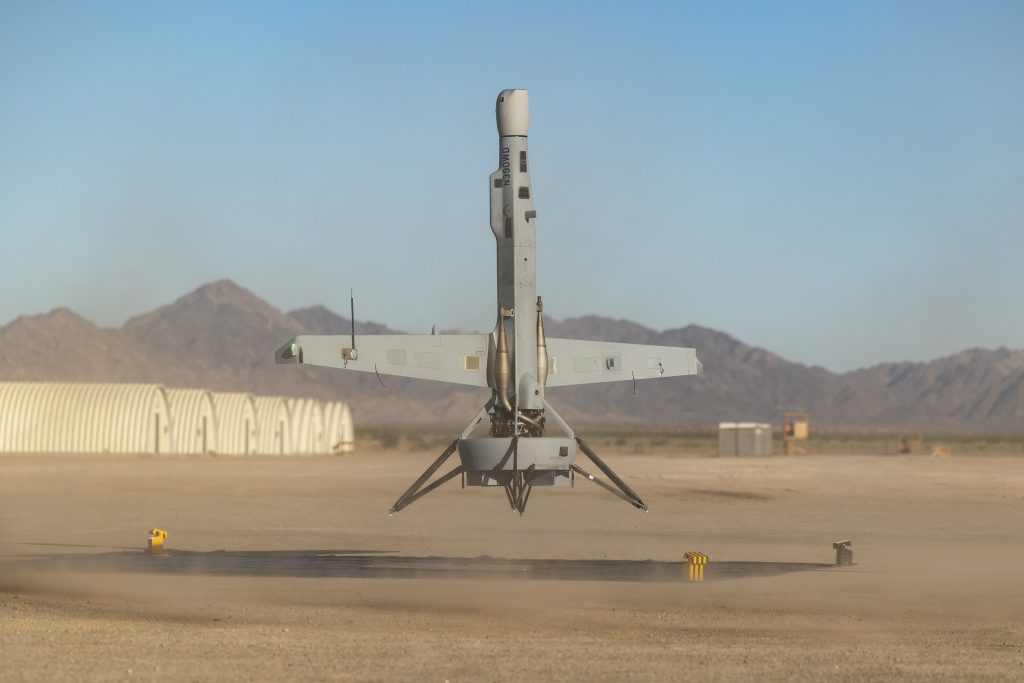
The autonomy company will equip the Pentagon’s LUCAS one-way attack drones with Hivemind agentic software for a test demonstration later this year, swarming 10 or more munitions.
The Pentagon is exploring options to equip its new one-way attack drones with artificial intelligence software that would allow for swarming of multiple munitions and more complex flight patterns.
Autonomy start-up Shield AI has been selected to integrate its Hivemind system into Washington’s new Low-Cost One-Way Attack System (LUCAS) drones, which were reverse-engineered from the Iranian-made HESA Shahed-136.
Tehran pioneered the one-way attack concept, deploying thousands of simple, low-cost UAVs that can be cheaply and quickly produced in massive quantities to deliver an effective long-range strike capability at a bargain cost.
Russia is now actively delivering its own Shahed-136 derivative, the Geran-2, while Washington fielded its first LUCAS-equipped one-way attack squadron in late 2025. That unit has already seen combat action as part of the now-paused US-Israeli air campaign against Iran.
Those LUCAS drones, which are based on the SpektreWorks FLM 136 design, are capable of precision strike, but otherwise use relatively simple flight profiles. Adding Hivemind could significantly enhance the one-way attack concept, allowing multiple vehicles to coordinate actions and react to battlefield changes.
“What AI pilots enable is reduced cost per effect because you’re having higher success rates,” says Brandon Tseng, founder of Shield AI.
Tseng spoke to FlightGlobal at the Special Operations Forces Week conference in Tampa, Florida, on 19 May.
Unlike the unpiloted attack drones, AI-equipped munitions can do more than follow a pre-programmed route. They can adapt to impediments like GPS or radio jamming. Drones flown by AI can also take inputs from other agents in their swarm, redirecting to new targets after one munition records a successful strike, rather than continuing to hit the same mark.
“If you send 20 one-way attack drones at one target, and one of them gets in and blows it up, why not have the other 19 go after a different target and adapt?” Tseng says.
That adaptive capability would further lower the cost of one-way attack strikes, which are already a fraction of conventional long-range cruise missiles. The Pentagon says a basic LUCAS munition costs anywhere from $10,000 to $55,0000 versus $1-2 million for a modern cruise missile.

Hivemind has already flown on 28 platforms worldwide, from small drones to large fighter aircraft like the US Air Force’s X-62 test platform – a modified Lockheed Martin F-16. That jet, paired with Hivemind, was used by the air force and the Defense Advanced Research Projects Agency to explore the potential of autonomously flown fighters to engage in close-range air combat.
Shield AI is also the autonomy provider for the Airbus Helicopters MQ-72, a fully uncrewed cargo variant of the UH-72B/H145 rotorcraft. That design is currently in flight testing as part of the US Marine Corps’ Aerial Logistics Connector programme.
ShieldAI is also a finalist to provide the autonomy brain for the USAF’s first generation of uncrewed fighters, known as Collaborative Combat Aircraft. Hivemind is paired with Anduril Industries’ YFQ-44A prototype, although the software is also compatible with the rival General Atomics Aeronautical Systems YFQ-42A.
The autonomy software is also flying combat missions in Ukraine, both on Shield AI’s own V-Bat intelligence, surveillance and reconnaissance tail-sitting UAS and a number of different one-way attack munitions, including designs from Swiss manufacturer Destinus.
Tseng reveals that Ukrainian drone teams operating the V-Bat have been ranked first among the various drone types at operating range and number eight out of “hundreds” in identifying and locating targets.
The Shield AI founder and former US Navy SEAL commando says the company will leverage that combat experience from Ukraine to develop an AI-equipped one-way attack option for the US military.
“The thing that is wreaking havoc on drones worldwide is jamming GPS and communications,” he says.
Improving LUCAS performance in such denied environments and the drones’ terminal guidance on approach to target will be two objectives of the project, in addition to the swarming and adaptability options.
A demonstration involving 10 or more LUCAS drones equipped with Hivemind is planned for the second half of 2026.
The contract with the Office of the Under Secretary of War for Research and Engineering covers a test demonstration and does not guarantee a transition to full operational integration with the broader LUCAS programme.
The post Shield AI to demonstrate AI-equipped one-way attack munitions later this year first appeared on FlightGlobal.