


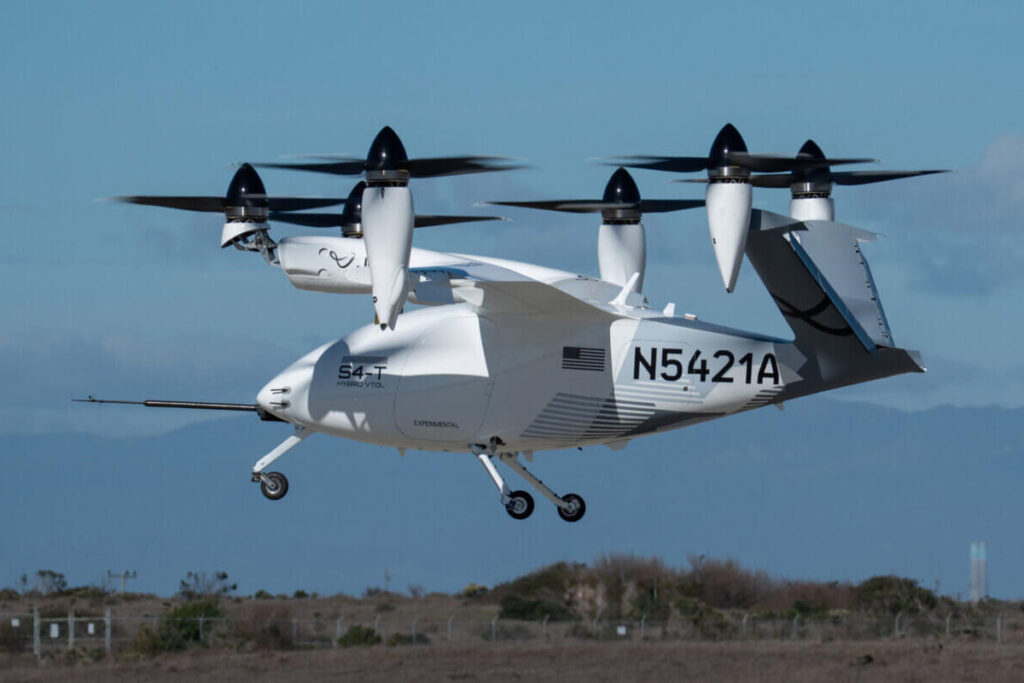
Dubbed the S-4T, the new design is based on Joby’s all-electric S-4 passenger aircraft, modified with a hybrid-electric propulsion system and an autonomous flight control system.
Electric aircraft developer Joby Aviation and defence contractor L3Harris plan to demonstrate a modified version of Joby’s S-4 rotorcraft for the US Army in the coming days.
Speaking to FlightGlobal at the Army Aviation Association of America conference in Nashville on 16 April, executives from the two companies say a demo flight of the new aircraft, dubbed the S-4T, will take place for army officials next week at Joby’s production facility in Marina, California.
The project is taking aim at an emerging requirement from the US Army for an uncrewed, vertical take-off and landing (VTOL) aircraft in the Group 4 category; defined by the Pentagon as having a maximum gross take-off weight greater than 598kg (1,320lb) and operating below 18,000ft.
The army is looking to equip such an aircraft with precision strike armaments and sensors to offer a low-altitude reconnaissance platform for its frontline combat aviation units.
L3Harris began working with Joby in August of 2025 to develop a variant of the all-electric S-4 passenger rotorcraft that would be suitable for military service. That collaboration spawned the S-4T – a hybrid-electric design that maintains the S-4’s multiple tiltrotor configuration but replaces the cockpit with an autonomous flight control system.
“We’ve been looking at different platform providers over time, and that brought us to Joby, because their platform and their technology in this space is actually furthest along across the competitive landscape,” says Jason Lambert, president of intelligence, surveillance and reconnaissance at L3Harris.
That endorsement is a major win for Joby, which has been pursuing defence business as the company pursues civil type certification for the S-4, which was designed as a passenger air taxi and urban air mobility vehicle. Lengthy development and certification timelines on the civil side are pushing electric VTOL developers like Joby to seek near-term revenue in the defence world.
“We see this really huge vote of confidence in Joby and what we can do in the dual-use space,” says John Barranco, a former Bell AH-1 pilot in the US Marine Corps who is now Joby’s head of defence policy.
Joby and other eVTOL manufacturers, including Archer and Beta Technologies, have delivered test aircraft to the US Air Force, but have thus far failed to secure any firm orders from military operators.
“Pure electric is not really ideal for a military application,” notes Lambert. “But a hybrid engine very much is applicable for military applications.”
Known for modifying a wide range of commercial aircraft for defence applications, the partnership with Joby marks the first instance of L3Harris converting a hybrid aircraft, Lambert confirms.
The hybrid-electric propulsion system installed in the S-4T offers several notable military advantages, according to Barranco. Rather than driving the lift-producing rotor blades, the gas turbine generator is used to charge the onboard batteries for the S-4T’s electric engine.
“Which allows you, in an objective area, to operate virtually silently,” notes Barranco.
In forward flight, the S-4T only produces 45 decibels for an observer directly below the flight path. That is less than the noise level created by a household refrigerator, according to Yale University. The volume increases to a conversational 65 decibels while hovering.
The S-4T also has the ability to operate in fully electric mode, which Barranco says does have another important tactical advantage: no infrared heat signature.
“I’m a retired Marine Cobra pilot. The biggest threat for us, the biggest killer for us, was infrared, man-portable air defense systems,” he notes.
Conventionally powered aircraft typically carry a significant thermal signature, which can be detected by passive infrared tracking sensors. Even sophisticated stealth jets like the Lockheed Martin F-35 can give away their position via relatively simple IR detection.
In March, Iran managed to strike a US Air Force F-35 with an air defence munition. The fighter survived, but it is believed that Iran tracked and targeted via passive infrared, circumventing the F-35’s low radar cross section.

Removing the S-4’s cockpit and passenger cabin also gives the S-4T an upgrade to useable payload capacity for weapons and sensors, while the hybrid-electric powertrain offers big improvements to range and endurance. Using only internally carried fuel, the Joby rotorcraft can fly continuously for 5h or 500nm (926km).
That jumps to 10h and 1,100nm with auxiliary fuel tanks. The S-4T will have a maximum gross weight of 3,040kg and be able to reach cruising speeds of 180kt.
The rotorcraft will be controlled by Joby’s Superpilot system – autonomous flight technology acquired by Joby in 2024 when the company purchased the autonomy division of start-up Xwing.
Working with L3Harris, Joby engineers rapidly modified an existing S-4 into the new S-4T configuration, which is now flying from the company’s test and production site in Marina – where army officials will watch the new rotorcraft in action next week.
Although still taking shape, the still-unnamed tender is being positioned to fill the armed reconnaissance void left by the retirement of the Bell OH-58D Kiowa scout helicopter in 2013 and subsequent cancellation of the Future Attack Reconnaissance Aircraft (FARA) programme.
The US Army invested billions of dollars through the FARA effort to develop a manned successor to the OH-58, but ended development in 2024 over concerns about survivability of a deep reconnaissance rotorcraft in modern combat.
Now, the service is preparing to release a formal request for proposal for a new short VTOL platform that could take over that role. The solicitation is expected to be released this summer, with initial contracts being awarded in the first quarter of fiscal year 2027, which starts in October 2026.
At least two, but potentially three competing designs will receive funding for the fabrication of flying prototypes. These will be delivered to two of the army’s frontline aviation brigades in 2028 for evaluation and trials with frontline operators over the course of a year.
As of yet, no other companies have officially confirmed their intent to participate, however several possibilities exist.
Sikorsky’s Nomad family of rotor-blown wing vehicles fit the armed reconnaissance profile nicely, also feature hybrid-electric propulsion and runway independent VTOL capability. The rotorcraft manufacturer is already flying a Nomad 50 demonstrator and is preparing launch flight testing on the larger, Group 3-sized Nomad 100 in the coming months.
Another possible contender is Boeing, who last year revealed a miniaturised tiltrotor concept vehicle called the Transformational Collaborative Rotorcraft or CXR. That design has not yet progressed into build or testing.
Speaking to FlightGlobal in Nashville, Boeing’s head of vertical lift Kathleen Jolivette describes the initiative as being “on hold”, while the company waits for the US Army to provide clear direction on what capabilities they want in future platforms.
“We’re sort of waiting for the requirements to come out before we move forward,” Jolivette said on 15 April.
She adds that Boeing is also expecting those requirements to be released in the near future.
“We’re really anxious to hear about that,” Jolivette says.
The army separately launched a new Unmanned Aircraft Systems Marketplace in late March with the goal of speeding up the procurement of new UAS platforms.
Through that “digital storefront”, commercially available uncrewed aircraft that have been approved for military use will be available for purchase by US forces and allies.
The post Joby and L3Harris to demonstrate autonomous S-4T rotorcraft for US Army first appeared on FlightGlobal.