


The army is weighing wether it should add both an air-to-air refuelling probe for the rotorcraft and an organic tanker platform to the service’s aviation inventory.
The US Army is considering adding an aerial refuelling capability to its next-generation MV-75 Cheyenne II tiltrotor being designed by Bell.
While the new rotorcraft is already being built for an refuelling probe to be cheaply and easily integrated by special operations operators, senior army leaders say they are now considering such a move for the service’s conventional aviation units as well.
“We’re also looking at air refuel as a built in capability for all of the aircraft,” says Brigadier General David Phillips, deputy portfolio acquisition executive for aviation.
Phillips and other top aviation generals spoke to FlightGlobal and other media outlets at the Army Aviation Association of America conference in Nashville on 16 April.
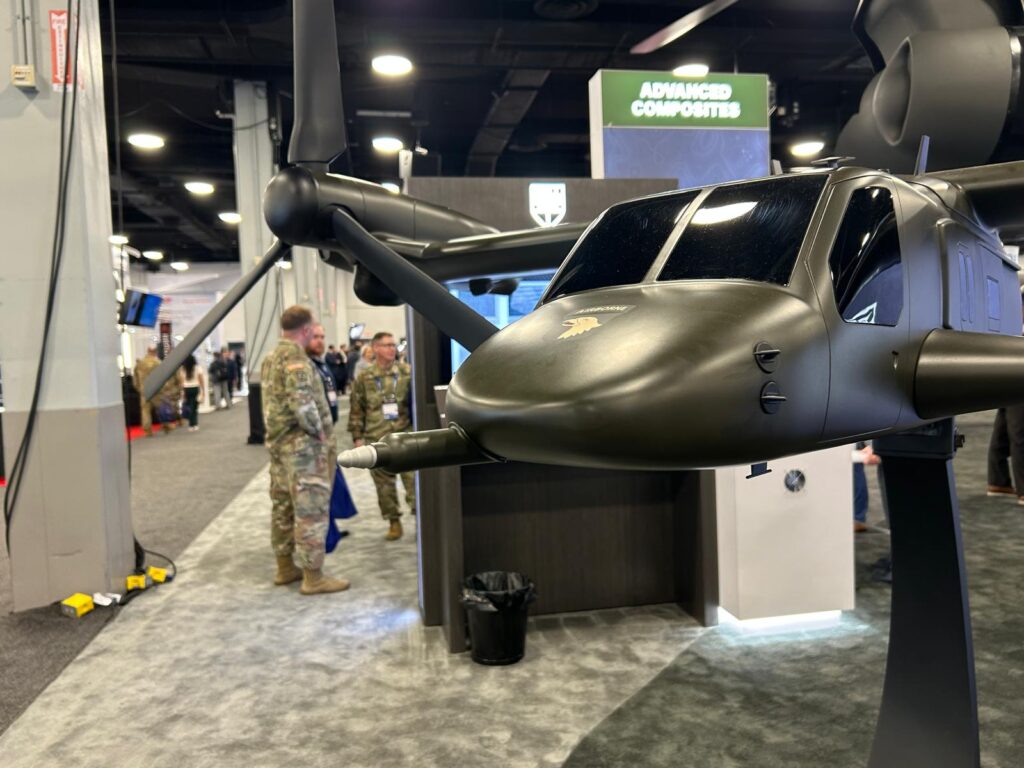
A sub-scale model on display at Bell’s stand at the Quad A conference depicted the MV-75 with a short aerial refuelling probe on the nose. An separate illustration shared by US Army Special Operations Aviation Command during the show featured the MV-75 with a full-sized probe similarly mounted on the nose section.
In a video rendering played by Bell at the show, one of the tiltrotors is seen completing probe-and-drogue refuelling behind an uncrewed tanker drone resembling the Boeing MQ-25 being developed by the US Navy.
While the US Army does not currently have such a drone in its inventory, or for that matter any organic aerial refuelling capability, the service’s top aviation general says it could make sense for the army to add such a platform in conjunction with a probe-equipped MV-75.
“If we put that on a conventional variant, then how do we refuel it?” Major General Clair Gill said from Nashville. “So we’re thinking through, do we need to develop a requirement for aerial refuelling for ourselves, now that we have really enhanced our capability?”
Currently, the only army aviators who make use of in-flight refuelling are the elite pilots from the 160th Special Operations Aviation Regiment, including those flying the Boeing MH-47G Chinook and the Direct Action Penetrator variant of the Sikorsky MH-60L.
Those types currently take on fuel from the US Air Force’s Lockheed Martin MC-130J special operations transports, getting access to which can prove challenging, Gill notes, even for qualification training.
“We don’t have those organic to the army,” he says. “So I think we need to solve our own problems and think about how do we do our own, let’s call it logistical resupply in the air, with something that can keep up with the MV-75.”
While no formal procurement programme or capability requirement currently exists within the army for aerial refuelling, Gill adds that it is something he has raised with top leaders in the Pentagon.
The entire point of the Future Long-Range Assault Aircraft programme that produced the MV-75 was to deliver a troop carrier that can ferry ground combat forces to far-off objectives with a speed and range that conventional helicopters cannot achieve.
While a tiltrotor can offer significant improvement on both counts, they are still limited by the need to resupply on the ground at forward arming and refuelling points (FARPs), which are vulnerable to detection and long-range bombardment.
US installations around the Middle East have suffered heavy damage at the hands of Iranian one-way attack drones since the start of hostilities between the US, Israel and Iran in late February.
Gill says there would be tactical advantages to lessening the dependence on ground FARPs, or at the very least reducing the number that are needed.
“With a Black Hawk air assault that has attack aircraft with it, you’re gonna have to put more FARPs along the way,” the two-star general notes.
“This enables us to put less logistics on the ground, less vulnerability. So there’s a lot of advantage to how far we can go with the aircraft,” he says of an aerial refuelling-enabled MV-75.

Notably, adding a probe to the Cheyenne II would not require a significant redesign of the new tiltrotor.
Anticipating interest from US Special Operations Command and the 160th, the army worked with Bell to leave available physical space in the tiltrotor’s nose section for the addition of a refuelling probe.
“A lot of that has already been baked into the basic air assault platform,” says Ryan Ehinger, Bell’s senior vice-president for the FLRAA programme.
“We can facilitate aerial refuelling probes and other things of that nature,” he added in an interview with FlightGlobal at Quad A.
While an air-to-air refuelling capability for the conventional US Army remains theoretical for now, the service is pressing on with the planned MV-75 fielding.
Bell says it remains on track to field operational tiltrotors by 2030, with the first test aircraft set to begin final assembly in Amarillo, Texas in the coming months. Six Cheyenne II test examples are under contact, with Bell currently fabricating fuselages and wing assemblies.
The first MV-75 wing assembly is already complete and is currently being outfitted with wiring, hydraulic lines and fuel systems in Amarillo. That build process has been proceeding smoothly, with all of the various components and subcomponents fitting together as expected, Ehinger says.
He cites the fully digital design process for the new tiltrotor, including simulations of production assembly, as the cause for the lack of issues with subsystem installation thus far.
“If you start running into problems with that, then it can really slow things down,” Ehinger notes. “Doing all that digitally first saves a ton of time downstream.”
“What we’re seeing from an assembly standpoint, gives me a lot of optimism into the affordability of this platform,” he adds.
While the US Army’s previous chief of staff – a champion of the MV-75 programme who was recently dismissed by Pentagon chief Pete Hegseth – had suggested last year that the tiltrotor could be flying by 2027, current army leaders are saying a first flight within the next two years is a more accurate timeline.
Bell plans to conduct a lengthy programme of ground evaluations on the new design before it lifts off, including structural loading, functional tests of onboard systems, load testing, vibration tests and instrument calibration.
With the V280 prototype that is the basis for the MV-75 design, Bell bolted the aircraft to a run stand and evaluated the airframe in vertical take-off and landing mode, forward flight cruise mode and during transition between the two modes.
“That’s really the same phase we’re going to progress through here,” Ehinger says.
The post US Army considering aerial refuelling capability for new MV-75 tiltrotor first appeared on FlightGlobal.