



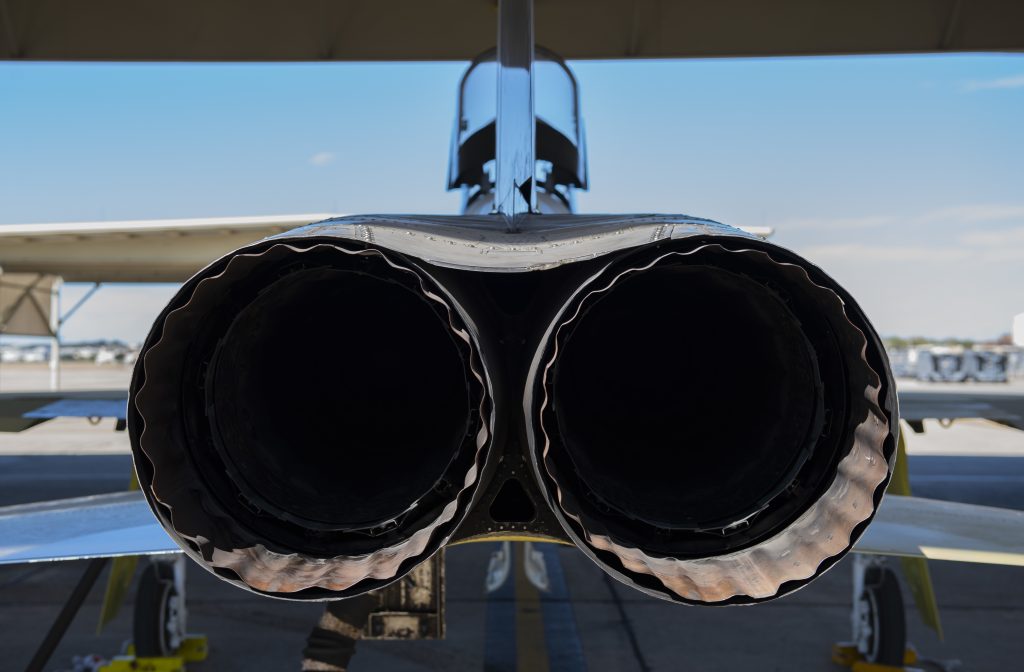
The three-star general in charge of US Air Force training says the service expects to get another decade of use from aged Northrop trainers.
The US Air Force expects to continue operating its aged Northrop T-38 Talon trainer jets for another decade, even as it approaches initial operational capability with the new Boeing T-7A Red Hawk.
Speaking during a Mitchell Institute for Aerospace Studies webinar on 16 November, the commander of Air Education and Training Command said the USAF is confident it can keep the T-38 flying for another 10 years, despite an average age of 59 years.
“It’s going to be flying until 2037 or 2038, doing pilot training missions, which sounds fantastically far away, and it is,” says Lieutenant General Clark Quinn. “But we believe the aircraft will make it… If something breaks on it that we’re not expecting, we may have an issue, but [there are] no signs of that right now.”
At the moment, Quinn says the USAF fleet of 490 T-38s is sitting around a 50% mission capability rate, with the primary culprit being maintenance on the jet’s two out-of-production General Electric J85 engines.
“Those engines were the primary limiting factor about three or four years ago when I first got to 19th Air Force, and we had actually had to cut back on T-38 flying because of that,” Quinn notes, referring to the AETC subordinate unit that oversees flying training.
“We are now back to the correct amount of flying,” Quinn adds.
Ten-year transition from Talon to Red Hawk
The lengthy, decade-long transition between the T-38 and T-7A is being driven by long-running challenges in certifying the Red Hawk and expanding into rate production.
Quinn says AETC is still on track to hit a previous estimate of reaching initial operational capability (IOC) on the Red Hawk in August 2027, although he offers the caveat that two of the three IOC criteria do not fall within his purview.
“We believe we need to have 14 T-7s on the ramp. We need to have all of our initial cadre instructors not just trained but proficient and ready to teach. And we also need the flight envelope of the aircraft to be expanded to the point that we can do the mission of the T-7,” he says.
Only the training of instructor pilots falls within the control of AETC. The command graduated its first class of T-7A instructor pilots in June at Randolph AFB. These are separate from the experimental test pilots who have been evaluating the jet at Edwards AFB as part of its airworthiness assessment.
The throughput of new instructors is currently limited by the number of aircraft available. AETC currently has only three T-7As at its Texas home base, one of which is being used “almost [as] a dedicated maintenance trainer” for training new ground support technicians, according to Quinn.

When it comes to aircraft availability, Boeing has been slow to ramp up T-7A production and deliveries, hindered by engineering challenges with the escape system and onboard software. The T-7A programme only completed its final ejection seat sled test in October.
The air force approved Boeing to begin low-rate production on the Red Hawk in April, clearing the way to start work on AETC’s initial batch of 14 aircraft under Lot 1. Quinn has previously said he expects to start receiving new T-7As at a rate of roughly one aircraft per month, starting in early 2027.
However, full-rate production is not expected until 2029, owing to delays in developmental testing stemming from the engineering problems and a lack of spare parts that have impacted mission readiness rates of the small T-7A test fleet at Edwards.
Those issues are also impacting the envelope expansion phase of flight testing at Edwards, which is a precursor to the start of student training operations at Randolph.
Both factors could cause AETC to not have enough trained instructor pilots certified on the T-7A by August, even if the aircraft are delivered to Randolph and the jet is fully certified by the air force test centre.
“If you go, ‘here’s your full flight envelope’, and you give it to me in August of 2027, that’s not going to work because I needed to have my instructors training on it for several months prior to that,” Quinn says.

Beyond the initial cadre, normal use of the Red Hawk in AETC’s four-month instructor pilot training course will not begin until the T-7 programme has reached IOC. That means there will be a lag between the IOC milestone and when the training command has a full roster of instructors qualified on the new trainer.
Current USAF plans call for a total fleet of 351 T-7As to be delivered by 2036. A 2037-2038 sundown date for the T-38 offers a few years of wiggle room to account for any further delays.
Fiscal year 2027 US budget documents indicate the air force funded the acquisition of 14 T-7As in the current FY2026 and plans to buy 23 jets in FY2027. Annual purchases will continue ramping up until plateauing in 2030 at 60 aircraft annually until the fleet is complete.
Pilot shortage impacts
Back in 2023 as the 19th Air Force commander, Quinn had said the reduced T-38 hours were negatively impacting the USAF’s ability to achieve its goal of training 1,500 new pilots per year.
However, since 2024, the air force has been transitioning to a new model where trainees receive their private pilot’s licence, instrument rating and commercial rating at a civilian Part 141 flight school. Basic military flight certification is then taught on the Textron T-6 Texan II turboprop by air force instructors, after which a new pilot is considered trained.
Quinn says that approach has reduced the impact of T-38 availability on the pilot shortage.
“When you start flying the T-38, and this has only been true the last couple of years, you’ve already got your wings,” he notes.
In September the air force chief of staff General Kenneth Wilsbach said the service is on track to meet its annual pilot training goal for the first time in “many, many years”.
The T-38 is still the primary advanced flight training platform for officers assigned to fighter and bomber aircraft, meaning low availability would still impact the production of new pilots certified on those types.
The post T-38s will continue to train new USAF fighter pilots until 2038 amid slow roll-out of new T-7A trainer first appeared on FlightGlobal.